



Benefits reaped as AI makes rapid progress







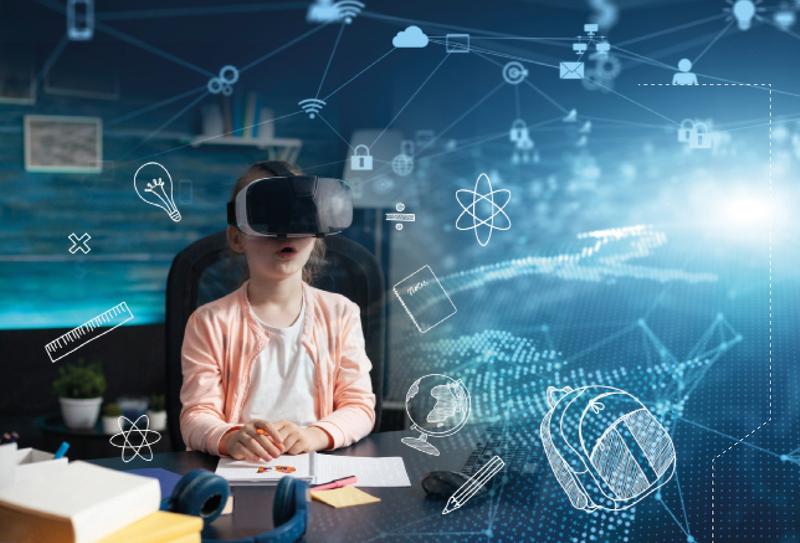
Technological advances transform computer industry and daily life
Just five seconds after Abu was asked to paint a picture of cattle returning to a farm, an image was provided with the reply, "Here it is".
The work of art was truly impressive, as Abu is not a human, but a robot based on artificial intelligence, or AI.
In addition to painting, the robot can write reports, make video clips, and, at the command of those in its user group, perform all the tasks a human can do on a computer.
Thanks to the development of computer algorithms, the development of AI has accelerated so rapidly in recent years that it has acquired skills previously thought to be the sole preserve of humans.
Zhou Xiao, an assistant professor at Renmin University of China's Gaoling School of Artificial Intelligence, listed some examples of AI that can be used in daily life, including those that compete with humans in playing games such as Go.
This game, developed by the AI company DeepMind in October 2015, features a search algorithm, deep neural networks and reinforcement learning — the science of decision-making.
AI can also recognize car registration plate numbers to help police hunt suspects. For example, in 2016, AI could correctly recognize 94 percent of car plate numbers, but a police officer was still required to man a computer screen. By 2020, AI could correctly recognize 99 percent of car plate numbers, doing away with the need for a human. Police forces are also benefiting from the use of robotic dogs.
The recently launched AI-related technology ChatGPT (Generative Pretrained Transformer) uses a natural language transformer algorithm to enable it to "understand "human language.
Wang Jianshuo, founder and CEO of Baixing AI, a company building the basic infrastructure for a world in which bots talk with bots, said, "The way in which this algorithm works is comparable to finding a point in a space.
"In human language, one might need thousands of parameters to describe an object. For example, to be defined, an apple needs parameters such as "edible", "fruit", "green "or "red", and to be grown from a tree. It is generally less than 10 centimeters in diameter. The more parameters there are to define, the more accurately AI can find the right point."
Wang cited apples and bananas as two examples. With parameters such "edible", "sweet" and "fruit", neither humans nor AI could distinguish them from each other.
But with the addition of parameters referring to shape, such as "long" or "round", such distinction is achieved. Parameters referring to color, such as "red", "green" or "yellow" enable a more certain judgment to be made.
"That's also how GPT works — most of the time it takes thousands of parameters for AI to define an object like we humans do. We just do not realize that," Wang said.
GPT-3 technology, on which ChatGPT and related technologies are based, features an excellent understanding of human language.
Unlike other forms of AI that can only take commands from certain types of sentences, GPT-3 analyzes a sentence like humans do to obtain its true meaning, which enables it to be commanded like talking to a friend.
However, this also means that AI might be misunderstood if given orders without ample clarity and information.
A reporter twice asked BaixingAI, a domestic app, to draw an image titled "crane". However, the app initially drew a bird flying amid mountains and rivers, before drawing a machine working at a construction site.
In an academic essay on ChatGPT's potential, prospects and limitations, Zhang Junping, a professor of computer technology at Fudan University in Shanghai, stressed that the amount of data the language model uses is of key importance to AI such as GPT.
"ChatGPT generates responses that match the user's intent with multiple variations. It captures previous conversational context to answer certain hypothetical questions, greatly enhancing the user experience in conversational interaction mode," Zhang wrote in the essay.
Swift progress
AI has revolutionized not only the computer industry but also daily life. With the technology making major progress in the games industry over the past five years, people can now play games such as chess or Go with smart forms of AI as opponents to sharpen their own skills.
With image-recognition AI becoming more advanced, it is now easy to use it to unlock a door or make a payment. GPT is also developing rapidly, with the result that the way in which people interact with computers might change.
Chen Jing, a researcher at the Fengyun Institute of Science, Technology and Strategy in Beijing, said the progress made by GPT, and the emergence of GPT4, have fundamentally changed the way in which humans interact with computers.
Computers typically receive instructions from humans mainly through a keyboard or mouse, with the user clicking on an icon, or typing in a command. However, with speech recognition and facial recognition AI technologies becoming more mature in the 2010s, computers can now receive new forms of input, such as sound, Chen said.
GPT4 technology, announced by the research company OpenAI on March 15, takes this process a step further. With its ability to recognize images more accurately and reliably, this technology understands humans more efficiently.
Chen said the technology could enable humans to command machines through gestures. For example, there are already smart appliances on the market that can be given oral instructions. In the future, humans will be able to convey such instructions simply by waving their arms, with this action being caught on camera. Such technology currently exists but is not yet fully developed.
"Imagine leaving home for the office. You have to turn off the lights and lock the door," Chen said. "With GPT-4, all you need do is wave goodbye to the camera at your gate, and AI will understand you, turn off all unnecessary appliances, close the door, and lock it.
"When you come home, just smile at the camera, and it will 'wake up' everything. This is not only because AI recognizes your face based on technology that became fully developed around 2020, but also because it can understand your gestures based on GPT-4."
Wang said one of the biggest changes AI could bring to humans is the way in which we live.
"There used to be a saying that AI could only do repetitive work, such as copying and pasting, but as it has advanced, such a saying is fast becoming outdated. Today, AI is creative, as shown in the images it draws, and it also saves time and energy for we humans and helps us be more creative."
Occupational link
Not everybody is delighted with the advances made by AI, and such unhappiness appears to be linked to a person's occupation.
Xi Li, a 41-year-old painter, who uses a pseudonym, said: "The images drawn by AI are soulless. This technology can help humans, but never replace human hands.
"We don't call the work produced by AI a drawing — AI is only collecting material online and sticking it together."
A science fiction writer, who requested anonymity, said AI can never write as well as professional writers. "There is no yardstick to measure how good an essay is, but those written by AI just do not ring true," he said.
Qu Xiaobo, a professor at the Institute of Population and Labor Economics and deputy director of the Chinese Academy of Social Sciences' Human Resource Center, said some people are worried about losing their jobs to AI.
"This is understandable. Even we professors worry about being replaced by AI professors," he said.
Qu remains positive about employment prospects in the age of AI. "While diminishing jobs, AI also creates new ones," he said.
"Its general effect on the market will depend on how many jobs disappear and the number of new ones that emerge. Apparently, AI will increase Total Factor Productivity, or TFP, in society, which means it will theoretically create more jobs than it replaces."
A search for "AI" on several domestic job websites locates new positions involving AI such as "consultant," "engineer "and "tutor". In Beijing, these jobs cover numerous pages, with the salaries offered ranging from 15,000 to 30,000 yuan ($2,182 to $4,365). The average monthly salary for such jobs last year was about 15,000 yuan.
Qu said these newly emerging jobs mainly involve dealing with AI, or what he terms "jobs for human-AI interactions".
Wang said the rapid development of AI will create new jobs, adding that with every major technological advance, new employment opportunities emerge.
"With the invention of automobiles, we got drivers, with the invention of airplanes, we got pilots. Living standards in general have been rising with such progress, as productivity has increased. The faster AI progresses, the easier life will become," Wang said.
However, keeping hold of a job remains a challenge for many who lack the skills needed for a new occupation.
Qu said there is a "structural mismatch "in the jobs market, adding that this is not unique to AI, but has been observed throughout human history, as technology makes continual progress. The difficulties graduates currently face in finding jobs are part of such a "structural mismatch, Qu added.
To solve this problem, individuals need to keep learning new things to acquire experience and skills. Qu also stressed the role played by the State in providing employees with better training to enable them to constantly update their skills to meet changes in the employment market.
Zhang, from Fudan University, said AI is still far from being sufficiently developed to replace humans.
Addressing the future of AI, all the interviewees in this article see hope.
Zhou said GPT-4 has not performed well in all tests, but it has revolutionized the AI industry by enabling it to understand the human tongue.
"In essence, AI has been invented by humans to assist them," Zhou added.
Yang Xiaoheng contributed to this story.



















