



Achieve dual carbon goals in a balanced way







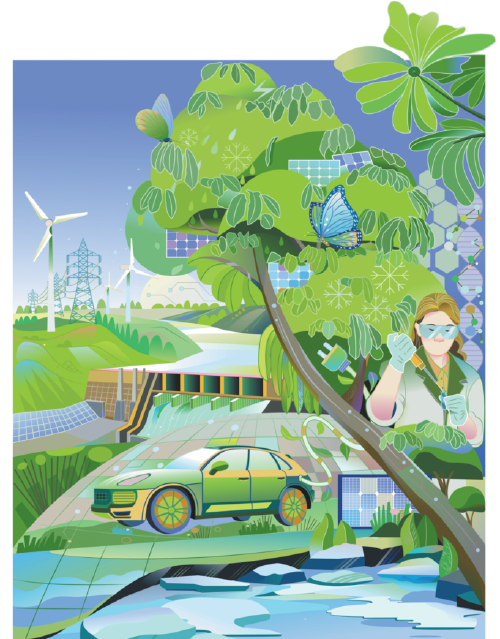
Energy in different forms, such as heat and electricity, fuels the economy and helps humans meet their basic needs. Although China has rich coal reserves, they are still finite in terms of quantity, and extracting coal is full of uncertainties, for it requires hard labor and has huge ecological and social implications. And this does not agree with the energy and resource conservation policy which China has been emphasizing on the road to modernization which emphasizes the harmony between humankind and nature.
True, fossil fuel-powered economic growth has paved the way for China to become the world's second-largest economy, but it has also brought large carbon emissions. That's why all local governments have energy-conservation and water-recycling departments to achieve self-sufficiency in energy.
The first binding energy intensity target was set for the 11th Five-Year Plan (2006-10) period. The 13th Five-Year Plan (2016-20) adopted a dual control policy for the total amount and energy consumption intensity, capping the total energy consumption at 5 billion tons of standard coal equivalent annually. And energy consumption per unit of GDP(energy intensity) was expected to decline by 15 percent from 2015 to 2020.
On the global front, China rose to leadership position in the climate governance system when some other countries shirked their international responsibilities, with President Xi Jinping announcing at the 75th annual session of the United Nations General Assembly in 2020 that China will peak its carbon emissions before 2030 and realize carbon neutrality before 2060.
The 14th Five-Year Plan (2021-25) for National and Economic Development and the Long-Range Objectives Through the Year 2035 started synchronizing the management of energy consumption and carbon emissions. It requires energy use and carbon intensity to decrease by 13.5 percent and 18 percent by 2025, respectively, compared to 2020. Overall, carbon intensity is expected to reduce by more than 65 percent by 2030 compared to 2005.
China is committed to meeting the medium-term decarbonization targets set for 2025 and 2030. The stakes are too high to fail and decisions made today will have far-reaching implications for the future. In fact, the country has learned the lessons of what resorting to last-minute measures for meeting the dual control energy consumption targets means.
From late September to October in 2021, many parts of China experienced power outages, power rationing, and severe disruptions in production, leading to market instability due to irregular supplies and rising prices of raw materials, which affected people's daily lives.
And then the severe drought in the summer of 2022 lowered the generation capacity of hydropower, making coal the bedrock of energy security. Coal is critical for grid stability, as it accounts for about 70 percent of peak load provision.
Since energy security, economic social stability, and carbon reduction are all desirable goals, they need to be synchronized. Dual control of total energy consumption and intensity mainly focuses on the power sector and large end energy users. But decarbonization demands a holistic approach involving energy consumption, diversification of energy source, structural upgrading of industries to enable them to move up the value chains, reducing the economy's dependence on heavy and construction industries, electrification of transportation and industry, modernizing agriculture, and ecological and land preservation, and restoration to increase carbon sinks.
Thus, dual control of total carbon emissions and energy intensity addresses the environment/climate-economy dichotomy. It has the potential to guide the formulation and implementation of a holistic and forward-looking long-term development strategy that is politically viable, technically functional, administratively operable and financially feasible.
The dual energy policy provides a good basis for aligning economic and environmental/climate objectives and stimulating collective action. For example, power generators, grid companies and local governments now have the incentive to work together to increase renewable energy generation and storage by overcoming challenges such as the curtailment of wind power and reluctance to share transmission infrastructure. It could also give rise to innovative measures to reform the power markets and differentiate customers by their preferences for energy mixes.
Upgrading of traditional energy and carbon intensive industries such as steel, non-ferrous metals, oil refining, chemicals and building materials are already underway, and the efforts to reduce carbon emissions instead of direct energy consumption will provide more flexibility and minimize disruption in the industrial and transportation systems.
China's new energy policy could help supply the missing links for the interconnected environmental, climate, economic and social issues, address the incompatibility in policy measures and help realize the dual carbon target of peaking emissions before 2030 and achieving carbon neutrality before 2060 via balanced, if not optimal, approaches.
China has invested heavily in research and development for finding technical solutions to energy-related problems. The key challenge lies in building an all-encompassing carbon emissions inventory for economic and human activities and institutions and policies enabling collective action based on monitoring, reporting and verifying the volume of carbon emissions.
The author is an associate professor at the School of Energy and Environment &Department of Public and International Affairs, City University of Hong Kong, and a visiting associate professor at the School of Public Policy and Management, Tsinghua University.
The views don't necessarily reflect those of China Daily.





