



Bank failures made in America damage the entire world







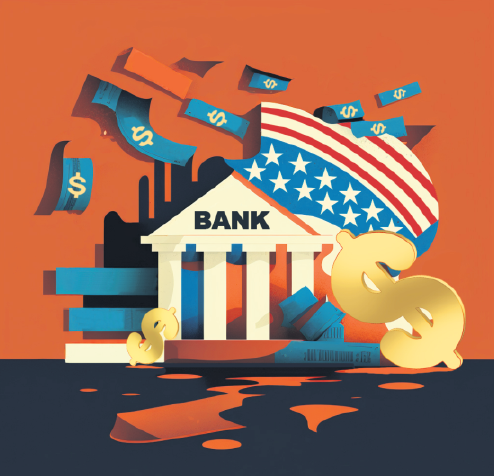
The bank failures in the United States and Europe have triggered a debate on the causes and consequences of the banking crisis. The crisis has also prompted some populist social media to claim that "tons of dollars" are fleeing to Hong Kong. Obviously, the Hong Kong banking industry has firmly denied any such abnormality has happened.
The root cause of the banking crisis is the frequent interest rate hikes by the US Federal Reserve. The sharp rate hikes in the short term significantly increased the commercial banks' liabilities, which had a negative impact on bond prices that account for a relatively high percentage of the banks' assets. That, for the failed banks, was the last straw that broke the camel's back.
For banks, especially small and medium-sized ones, the rapid depreciation of bond prices can be devastating, because they may not have enough capital to absorb the losses and may be forced to declare bankruptcy. A recent study shows that the devaluation of US bonds due to rate hikes has cost the US banking system more than $2.2 trillion in bond market value. In addition to the Silvergate Bank, Silicon Valley Bank and the Signature Bank, at least 186 other small and medium-sized banks could face bankruptcy.
The story of the failure of the US and European banks can be traced back to 2008, when the US required Swiss banks to hand over information on all US depositors. Switzerland resisted for many years but was finally forced to share the information, which destroyed the confidentiality element on which Swiss banks thrived. Thus began the decline of the Swiss banking industry.
In Europe, Credit Suisse, the second-largest bank in Switzerland, collapsed last month. But what has angered Credit Suisse additional tier 1(AT1) bondholders is the Swiss financial regulators' announcement on March 19 that the bank should write off $17.2 billion of its AT1 bonds to zero following the bank's merger with rival UBS for $3.2 billion. This means the bondholders' investments (AT1 bonds) worth $17.2 billion have seemingly been lost.
Shareholders had no right to vote on the deal, and equity investors lost more than 60 percent of their investment, with Credit Suisse's largest shareholder, Saudi Arabian National Bank, losing nearly 80 percent of its 9.9 percent stake in the bank.
The Fed's rate hikes have failed to reduce inflation to the extent expected; instead, they have squeezed the balance sheet of banks, leading to the collapse of some banks. The quantitative easing policy and financial rescue plan after the COVID-19 pandemic broke out stabilized the US economy and American people's livelihoods. But the main drivers of this round of inflation, geopolitical conflicts and global supply chain disruptions continue to be very active. The solutions to these problems are far beyond the capability of the Fed.
More important, it is difficult to control inflation by simply hiking rates and shrinking the balance sheet. In fact, efforts to do so backfired on the banks.
On the collapse of the Silicon Valley Bank, the Federal Deposit Insurance Corporation quickly stepped in and took over the bank, indicating that the US financial regulator has a mature and orderly handling mechanism for bank risk disposal. And the subsequent statements of President Joe Biden, the Fed and the Treasury showed the US has the will and financial resources to ensure the safety of depositors' money.
Philosopher Mencius said people without permanent property have no perseverance. And in the US, which is an inequitable society, most permanent properties are owned by a few rich people, as well as the upper middle class whose wealth is mostly in financial assets and real estate.
It is possible that the banks' failures will make the Fed realize it's time it changed its course and found another way of reducing inflation and boosting economic growth. Perhaps it has already done so, for this could be one of the reasons why it narrowed the rate hike to 25 basis points on March 22.
In an interview with CNN a few days ago, US Treasury Secretary Janet Yellen said banks are most likely to remain cautious and may further tighten their lending rates against the backdrop of recent bank failures, negating the need for more Fed rate hikes.
We have already seen "some tightening of lending standards in the banking system" and there may be some more to come, Yellen said, which "could be a substitute for further rate hikes that the Fed needs to make". But there is nothing "dramatic enough or significant enough" now, she said, to alter the present economic outlook. The economic outlook, according to her, remains one for moderate growth and a continued strong labor market with inflation coming down.
The US authorities, apart from using the Bank Term Funding Program, which supports US businesses and households by making additional funding available to eligible depository institutions so banks can meet the needs of all their depositors, could also use direct window guidance or accurate open market operations to help enterprises and individuals to expand or run their businesses. These tools can produce better results than rate hikes; they will also prevent unintended consequences such as the bank failures.
Fed officials and US economists should realize that today's US is not the US of the past, today's Fed is not the Fed of yore, nor is Janet Powell Paul Volcker, who as Fed chair in the 1980s used super-high interest rates as a controversial way of subduing inflation, and succeeded after two recessions.
The author is an associate researcher at the Institute of American Studies, Chinese Academy of Social Sciences.
The views don't necessarily represent those of China Daily.
If you have a specific expertise, or would like to share your thought about our stories, then send us your writings at opinion@chinadaily.com.cn, and comment@chinadaily.com.cn.





