


Ink masters who gave depth and scope to an art tradition








The scenery at the West Lake, in Hangzhou, Zhejiang province, had remained unchanged for hundreds of years when the world ushered in an era of rapid change at the dawn of the 20th century.
Chinese artists realized that they were being tasked with breathing new life into their style. They wouldn't be able to fulfill the cultural needs and demands of a modern world if they continued to cling to some of the rigid, backward disciplines in the creation of their work.
Among those who bravely faced the challenge to reform Chinese painting were Huang Binhong (1865-1955) and Pan Tianshou (1897-1971). The two were both recognized as great inheritors of the essential cultural spirit of the Song Dynasty (960-1279) and, at the same time, incorporated modern ideas into ink-brush painting.
This enabled a pushing forward of the frontier of the genre, amid the ever-changing art scene of the 20th century.
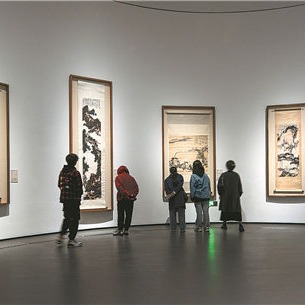
This explains why two exhibitions, respectively showing how the two master artists gained nourishment from Song art, are being staged alongside Embrace the Landscape at the Art Museum of the China Academy of Art, all of which will run through Sunday.
Both Huang and Pan had close links with Zhejiang. They were raised in the province, and, although moving constantly, they settled down in Hangzhou for the rest of their lives, teaching at the China Academy of Art. The two are often viewed as the modern-day equivalent of the Ma-Xia school, named after prominent Song artists Ma Yuan and Xia Gui, whose innovation also added new levels to Chinese painting.
Both Huang and Pan emphasized the tracing of the past to attain individual achievements, but they each invented a different approach.
"If someone learns from ancient artists, but overlooks learning the rules of nature, they will not be able to present the true magnificence of mountains and waters," Huang once said. He traveled extensively, thrusting himself into the embrace of landscapes and feeling the deep resonance of nature as it was expressed in Song paintings.
Yu Xuhong, director of the Art Museum of the China Academy of Art, says the exhibition of Huang's work not only shows drawings that he made primarily between 1925 and 1948, in which he emulated works of important Song painters, but also displays landscape paintings based on his extensive journeys to present his own development.
"He gave simple, clear lineaments to the mountains, streams and trees. Then he layered thick accumulations of darkness to complete a monumental landscape, delivering a feeling of 'a night walk in mountains', a phrase he used to describe the atmosphere of Song paintings," Yu says.
Xu Hongliu, deputy head of Zhejiang Provincial Museum, says the dense strokes and distinctive darkness in Huang's work are like heavy rain, to remind the viewer of the dynamics of the lives in nature and the rhythm that runs through a Song landscape.
Unlike Huang, who used a lot of ink shades to depict solids and the void, it was in painting big rocks where Pan found the answers to refreshing the look of Chinese painting for a new era.
The exhibition of Pan's oeuvre shows his sketches of rocks, which he once used in his classes. The most iconic works of his often depict imposing cliffs, or sometimes simply one huge, square rock in the center of paintings, and he would add clusters of flowers and plants in the corner to soften the tone of the composition. Such signature treatment added new dimensions to both the landscape and flower-and-bird paintings, by blurring the boundary between the two genres of Chinese painting.
Chen Yongyi, head of the Pan Tianshou Memorial Museum in Hangzhou, says that it is easy for one to feel the inner world of Pan as being strong as a rock. "His strokes to contour his subjects are mighty and unbounded … a power that will remind one of a wild horse galloping."
Yu says both Huang and Pan carried on the spirituality and naturalism of Song art and Chinese cultural tradition, and with an open heart and mind, they ushered Chinese painting to embrace modernism, initiating the future of the style, and they themselves became cultural peaks of their time.