In his poem Asking, Vietnamese writer Huu Thinh wrote, "I ask earth: How does earth live with earth?/We honor each other./I ask water: How does water live with water?/We fill each other up./I ask the grass: How does grass live with grass?/We weave into one another creating horizons./I ask man: How does man live with man?/I ask man: How does man live with man?/I ask man: How does man live with man?"
At the first salon of the "literary network" of the Belt and Road Poetry Bridge, held in Dongyue Temple, a Taoist temple in Beijing more than 700 years old, in early March, Xia Lu, an associate professor from the School of Languages at Peking University, read the poem in Vietnamese, Chinese and English. She translated the poem into Chinese and English. Her emotional reading touched those present.
"To answer the question 'How does man live with man', there is at least one good way, that is, to listen. If we are willing to listen to the other, we definitely will make the world a better place," said Jiang Haoshu from China Writers Association, one of the initiators of the literary salon.
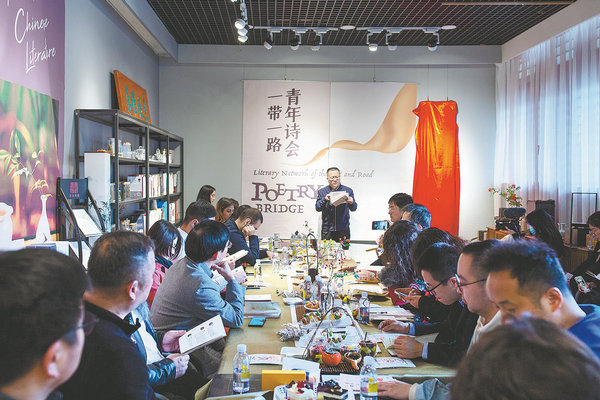
During a two-hour "tea with Chinese literature" session, among other guests, six international students from countries involved in the Belt and Road Initiative studying at Tsinghua University joined four Chinese poets and scholars to read poems in Mandarin, Thai, Armenian, Myanmar, Urdu, French, Indonesian, Vietnamese, English and the Shanxi dialect.
It's spring and magnolia flowers in the yard of the temple are in bud. For thousands of years, poets across the world have created masterpieces about spring, said Li Shaojun, chief editor of Poetry Magazine in the opening speech of the activity. Poems that can best represent authentic beauty of the season transcend the limit of time and space, reaching people around the world, he added. "Today, we gather here to read poems, sharing with each other beautiful words from different cultures of countries involved in the BRI, which itself is a wonderful thing happening in spring."
Mbaka Ndoo Trinella from Congo who is studying international relations at Tsinghua, chose to read in French Being a Woman in the Democratic Republic of Congo, a poem created by young Congolese poet Ruth Maketa in 2021. Trinella said the poem resonated with her deeply when she first read it.
"For ages, women in Africa have contributed tremendously to society but our social status has been rather low. So when they asked me to pick a poem that I liked and wanted to share, I chose this," she said in Chinese.

Ding Si Htoi San Pan, 28, from Myanmar, read a piece from Myanmar poet Zawgyi.
"Actually, there are 41 poems in this series, The Way of Water Hyacinth, by Zawgyi. I chose this because I like it best. It talks about how a person faces difficulties with courage. Despite repeated efforts, he or she is determined to go to the destination," she said.
This event offered her a chance to take a look at Myanmar poetry, and also poems from other countries, she added.
"I'm touched by Being a Woman in the Democratic Republic of Congo, the Indonesian poem Courage by Soe Hok-Gie, and also the Chinese poem Dipingxian (Horizon) by Su Liming," she said, adding that they are all powerful, about fighting for dreams despite all the difficulties.
Li Xiaoyang, from North China's Shanxi province, read his own poem Yinmode Beidou (Obscured Big Dipper) in the local dialect; Chinese poet Yang Biwei read her own Gudu Xingqiu (Lonely Planet); Zoon Ahmed Khan from Pakistan read Muhammad Iqbal's Beyond the Stars, which inspires young people to pursue their dreams; Hayk Geghamyan from Armenia read the love poem If I Were Breeze by Armenian poet Avetik Isahakyan; and Chayan Yailert from Thailand read Journey to Phukhaothong, by Sunthorn Phu, the "Shakespeare of Siam".
While listening to the poems read in the original languages, attendees could refer to the Chinese translations on pamphlets.
Apart from reading, artist Luo Shijie played the guqin (Chinese seven-string musical instrument) at the event, and Lai Dafu, a scholar from the China University of Petroleum, played a piece of Chinese music with an ocarina.
"This is a wonderful experience for me. I love all the poems. They are so beautiful. I'm deeply touched hearing them read in different languages," said Jiang from China Writers Association.
"This afternoon is a great start for cultural exchanges. We are communicating through poetry and music in such a place that has a history of more than 700 years to explore the destinies of different cultures and nations, and the destinies of people. Our feelings and understanding can turn into poetry and all the poems can become bridges for us to better understand each other."
Lu Yang, a researcher from One Belt-One Road Strategy Institute at Tsinghua University, said, "It's the first time for me to hear poems read in 10 languages and dialects. Although we have the Chinese translations, they sound so different in their own languages."
She said the salon offered an opportunity to directly communicate with overseas students about their poetry and culture, and that more such events will take place.
"The BRI is to promote cooperation in different aspects, such as the connectivity of infrastructure and facilities, unimpeded trade, financial integration, and most importantly closer people-to-people ties. Through poetry, we listen to each other and increase communication. It truly is 'beauty for all to enjoy' and can draw people closer to each other," Lu added.