



US sanctions amplify harm of bank's failure







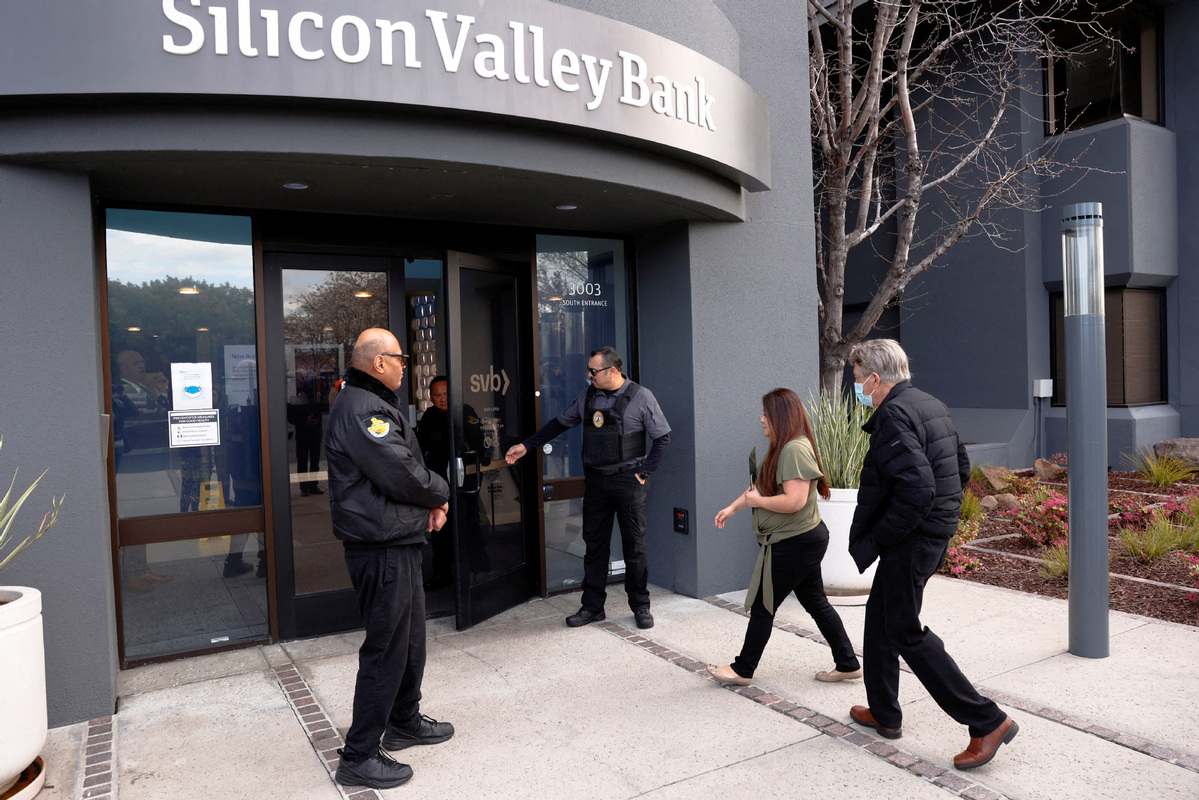
The sudden collapse of the Silicon Valley Bank has sent shockwaves throughout the financial world. This forced US regulators to step in and close the Signature Bank in New York, citing "systemic risk".
The crisis has not only caused concern and anxiety across the financial world including in London and Shanghai, but also raised fears of a wider global financial storm.
It remains to be seen whether the Silicon Valley Bank will become the next Lehman Brothers, but the crisis has highlighted the potential damage that US sanctions and the populist trend of political correctness could have on the financial system.
Known for its deep involvement in the Silicon Valley information and communications technology industry, especially in the development of startups, the bank found itself in trouble due to a surge in deposits in recent years and a shortage of high-quality loan projects.
As a result, the bank chose to invest heavily in US government bonds. But the aggressive rate hikes by the Federal Reserve over the past year caused the market price of these bonds to plummet. While the losses on these bonds would not have been realized if the bank had chosen to hold them until maturity, the actual losses became a reality when the bank was forced to sell its low-yield bonds to meet customer demands for cash.
Moreover, the root cause of the Silicon Valley Bank crisis-securitization may exacerbate the instability of the financial system and cause market turbulence.
Assuming that a financial institution foresees that the market price of a certain bond it holds will plummet during a crisis, the speed and flexibility of transferring the above risk assets are beyond the reach of lower levels of securitization.
But such risk assets have not been disposed of by the financial system. Instead, they have gradually concentrated in financial institutions and specific financial markets that lag behind in risk response during the dynamic process of asset allocation. And when the crisis finally strikes, the financial institutions and markets that have concentrated in these shrinking assets may erupt in violent turbulence.
Due to securitization, the financial markets are highly correlated, leading to constant shocks in the entire financial system. Before securitization, as many financial institutions and markets shared the above risk assets, such turbulence might not have occurred.
In other words, due to the high dependence of the US administration on borrowing for years, and the enormous amount of US government bond that has stockpiled in the financial market, when the Fed resorts to iron-fist rate hikes to curb surging inflation, the previously accumulated enormous low-yield US bond stockpiles in the market will inevitably experience astronomical paper losses. Even if it is not the Silicon Valley Bank, there is a high probability of such risk assets accumulating in other banks and causing them to "go bankrupt".
The US financial market is facing potential systemic risks, compounded by the country's recent trend of imposing indiscriminate sanctions against other countries and entities. Compared with commercial financial institutions, central banks and sovereign wealth funds that manage official foreign exchange reserve assets have a stronger incentive to adopt a "hold-to-maturity" strategy for holding US Treasuries, as well as more abundant liquidity to support this strategy. This is especially true for central banks of countries with sustained current account surpluses.
However, two factors have been motivating foreign central banks to discontinue their "hold-to-maturity" strategy and sell off US Treasuries, thereby exacerbating the pressure on the US financial market to sell off these assets and drive down their prices.
First, the Fed's aggressive interest rate hikes have ignited capital outflows from many emerging markets, as well as speculative attacks on currencies. Many of these countries have had to sell off a portion, if not most, of their foreign exchange reserves (most of which are US Treasuries) to meet the demand for currency exchange, rather than continuing to hold these assets as reserve assets.
Second, the US' indiscriminate imposition of sanctions on the global trade and financial system has forced "big players" with large foreign exchange reserves to sell off US Treasuries in order to avoid the fate of having their reserves frozen, even confiscated by the US and European Union countries like what has happened to Russia.
Furthermore, the more sustained the current account surplus of a country, the more likely it is to have had an incentive and ability to adopt a "hold-to-maturity" strategy for US Treasuries. But in the new Cold War era, these countries are increasingly becoming the targets of US sanctions and attacks, and hence their stronger than ever motivation to sell off US Treasuries in large amounts. The significant reduction in US dollar reserves held by some major countries in the past two years illustrates this point.
While the causes of the crisis are primarily economic, the response of governments and financial regulators to support struggling financial institutions is largely a political issue. The current political climate in the US, with a strong emphasis on "political correctness" and populism within the Democratic Party, may hamper the ability of the government and financial regulators to take swift and effective measures to prevent the crisis from spreading and becoming uncontrollable.
The author is a researcher at the Chinese Academy of International Trade and Economic Cooperation. The views don't necessarily represent those of China Daily.
If you have a specific expertise, or would like to share your thought about our stories, then send us your writings at opinion@chinadaily.com.cn, and comment@chinadaily.com.cn.





