



Explainer: A glimpse of Chinese democracy through lens of 'two sessions'







BEIJING -- "If the people are awakened only to cast a vote but become dormant afterwards, that is no true democracy."
The scenario depicted in a 2021 white paper "China: Democracy That Works" where people have the right to elect, but not to participate, never played out in China. For the Chinese, the story always revolves around their participation in democratic elections, consultations, decision-making, management, and oversight in accordance with the law, forming what's known as the whole-process people's democracy.
What are the most-eyed aspects of this idea? How does China put it into practice? Is Chinese democracy really, as what Western media has repeatedly claimed, a rubber stamp? The annual gatherings of the National People's Congress and the National Committee of the Chinese People's Political Consultative Conference could be a critical window into these questions.
REPRESENT THE MAJORITY
In the 1940s, the Communist Party of China (CPC) came out with an innovative way of mobilizing rural people to exercise their voting rights by casting beans as their ballots. This rich legacy of democratic practices has evolved into today's whole-process people's democracy, where official balloting develops annually in people's congresses at all levels.
At the end of 2020, 2.62 million people were serving as deputies to people's congresses at township, county, city, provincial and national levels, official data showed. Among them, those at county and township levels made up roughly 95 percent of the total.
"All the delegates are elected from the village, then from the town, then the city," said Muhammad Asghar, special correspondent of Associated Press of Pakistan in China. "So it is a collective, and it is from the grassroots."
Shen Yanfen, a star driver of farm vehicles from Shihu Village, China's Guangdong Province, is one of the deputies to the 14th NPC elected in January through this process. "I want to speak for farmers," she said, hoping to turn the spotlight on China's agricultural machine operators.
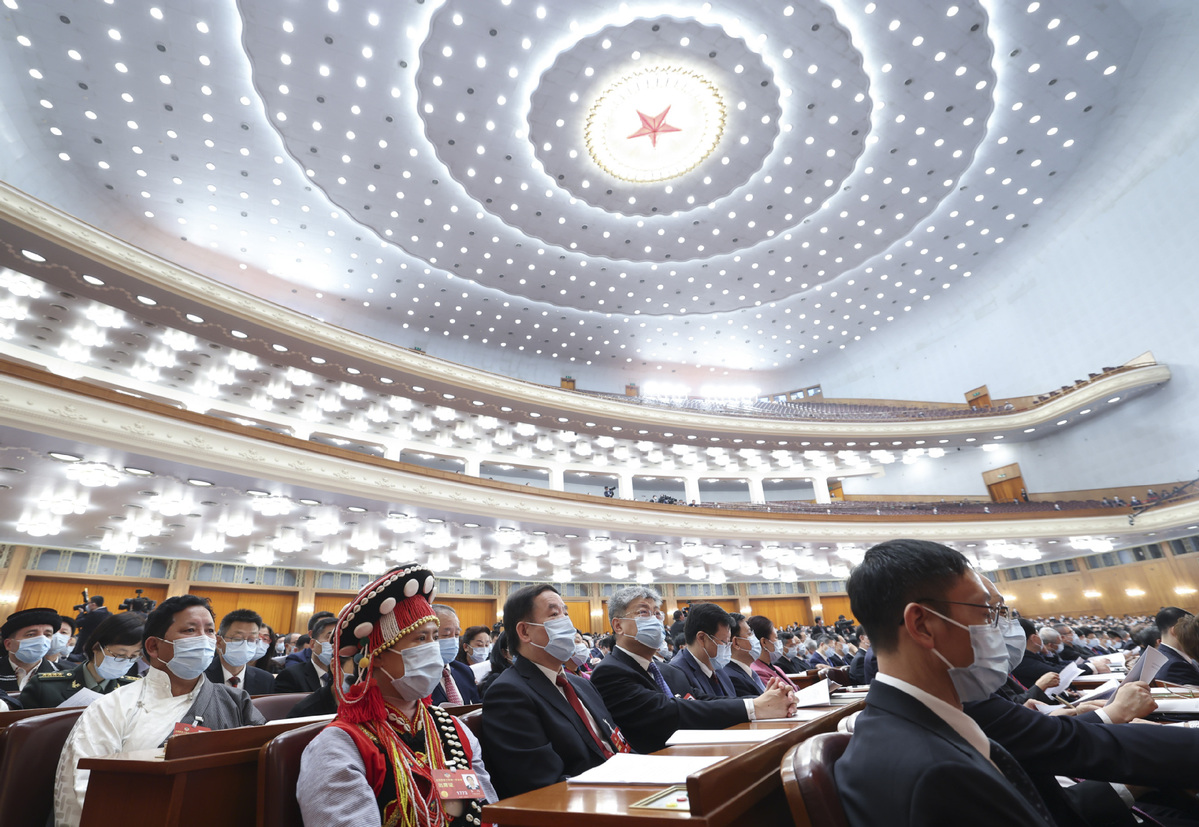
As the top legislature, the ongoing 14th NPC gathers 2,977 deputies from an array of professions and backgrounds. Among them, 442 are from ethnic minorities, accounting for 14.85 percent of the total and covering every one of the 55 ethnic minority groups, the latest official figures showed.
A total of 42 deputies represent those overseas Chinese who have returned to the motherland. Altogether 790 are women who make up 26.54 percent of the total, and 497 are workers and farmers who account for 16.69 percent of the total. Each deputy casts a vote of equal weight, thus being fully representative of the people.
"It brings everybody on board. It incorporates the views of all members of the society, no matter who you are," said Eric Biegon, a journalist from Kenya Broadcasting Corporation, who got an opportunity in 2017 to visit the Great Hall of the People in Beijing for the "two sessions."
"The delegates from all parts of China come to Beijing. And when they come, they discuss different affairs, particularly for the next year, and they give their advice to the central government," Asghar said.
FREE SPEECH
From national legislation to daily matters, the Chinese can speak their mind freely and participate fully in consultations and decision-making at the "two sessions."
Gathering in Beijing, masters of the country from all walks of life have sat next to one another to appoint the president and other officials of China, adopt the first-ever Civil Code since 1949, and approve the 14th Five-year Plan (2021-2025) that charts the course for China's future development.
Touching upon what people truly want, Huang Xihua, a deputy to the NPC for the past two decades, suggested in 2022 working from home one or two days a week, while Hu Wei, a CPPCC member, proposed that the precious 10 minutes off between classes at school not be taken up for more exercises.
Official data showed that in 2022, offices and departments under China's State Council handled 8,721 suggestions from NPC deputies and 5,865 proposals submitted by CPPCC National Committee members, accounting for 94.8 percent and 95 percent of the total respectively. Around 4,100 suggestions and proposals were adopted, which were turned into 2,100 relevant policies and measures.
"All types of issues related to all types of people, all types of ethnic groups, rural problems, urban problems appear [during the 'two sessions'] ... The reports are established for discussion, criticism, suggestions, and it is the product of exchanges," said Eduardo Regalado, senior researcher at International Policy Research Center of Cuba.
People can also make their voice heard outside the hall of the "two sessions." For example, the Standing Committee of the NPC has by far set up over 5,500 grassroots-level legislative information offices, which everyone can walk in and join in the drafting, research, revision and post-assessment of draft laws.
"They always speak, they always give their opinions," said Asghar. "The government takes their opinion into consideration and makes policies accordingly."
MULTIPARTY COOPERATION
There are no opposition parties in China, but it doesn't mean that China's political party system is a system of one-party rule. Nor is it one in which multiple parties vie for power and govern in turn.
With the aim of promoting unity, strengthening multiparty cooperation and practicing people's democracy in the process of political consultation, the CPPCC was established more than 73 years ago, and has done its utmost to increase trust, dispel doubts, convey the will of the people, draw on their wisdom, and build the broadest consensus.
Throughout the decades, it has also ensured that the risks of inadequate oversight in one-party rule, as well as the problems of continual transfers of governing parties and destructive competition in multiparty political systems, are effectively mitigated.
In 2001, a man with a pointy nose and a pair of sunken eyes arrived in northeast China's Changchun City. The man, with the name Jean Christophe Iseux von Pfetten, turned out to be the first ever non-Chinese member of the CPPCC. He was in Changchun not for travelling, but for attending its city-level CPPCC.
"This was an amazing opportunity in 2001 to be invited by the then a mayor of Changchun to be a special invited member of CPPCC. But it was also a very important element of my learning curve on how the democratic system in China did work," said Pfetten, now president of the Institute for East-West Strategic Studies in Britain.
"In this CPPCC, you have a maximum of a quarter or a third of the house to be constituted of CPC members, which is very different from the case of the NPC. And you have representation of other political parties, you have representation of business, you have representation of religious minorities, as well as academic, then it's a very wide range of society which is being represented at the stations of the CPPCC," he said.
"The Western concept of democracy is meant to screen politicians through free competition, but increasingly lengthy political debates made it difficult to articulate the truth," said Ang Teck Sin, a political commentator in Singapore.
"The Chinese model basically changed the traditional perception of democracy," Ang said. "It's a system the world can draw from."


- China issues guidelines to enhance professional social work workforce
- China-Vietnam friendship exchange to strengthen bonds, security, ministry says
- Beyond the racetrack: F1 Chinese Grand Prix showcases Shanghai culture
- AWE 2026: A glance at tech for the future
- China has broken disability-poverty link, Rome seminar hears
- Mainland slams Lai Ching-te's secessionist remarks





