Digital resources to open up access to education







Development of infrastructure urged as experts highlight role of new tech
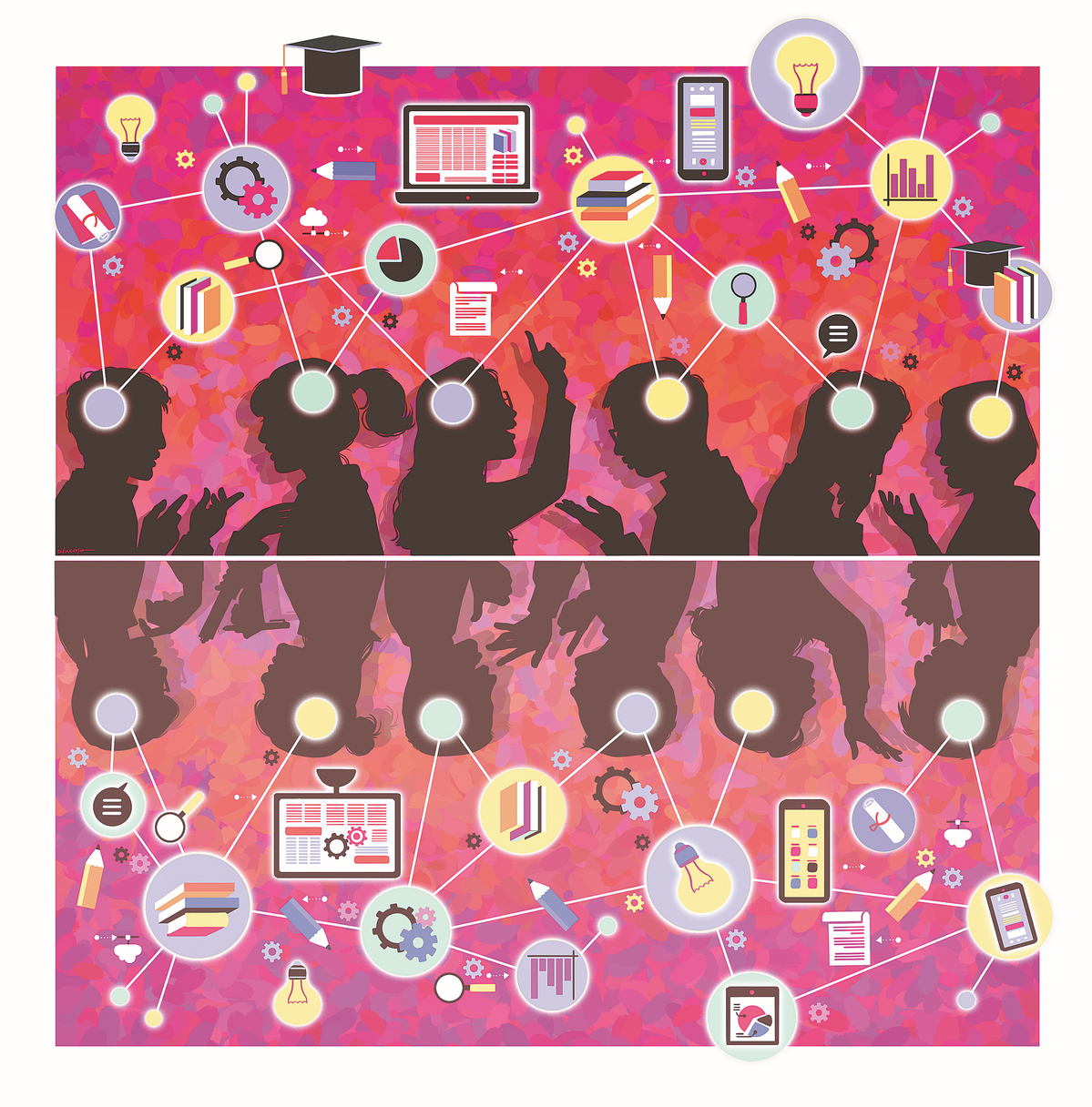
Countries and regions need to accelerate the building of digital infrastructure and expand the supply and application of high-quality education resources, so that digital education resources can move freely around the world, according to education officials and experts from home and abroad.
China is committed to opening up its massive open online courses resources and sharing its quality digital education resources with other countries and regions, they said at the Global MOOC and Online Education Conference 2022.
Themed "Digital Transformation of Education for the Future", the forum was held online from Friday to Saturday and hosted by the Global MOOC and Online Education Alliance and the UNESCO Institute for Information Technologies in Education.
The forum aims to improve the quality of education through modernizing traditional classroom teaching and learning and making high-quality educational resources more accessible to all learners.
Stefania Giannini, UNESCO assistant director-general for education, said that while it harbors immense opportunities, the digital transition is also disruptive and carries the risk of widening inequalities. That is why the focus of the conference on inclusion, equity and quality in higher education in the digital era is highly relevant, she said.
According to UNESCO's data, one-third of students globally didn't have access to distance learning at the peak of the COVID-19 pandemic, while those who speak minority languages and women were the most disadvantaged. In response to these challenges, there is a call to action to ensure quality public digital learning for all people, she said.
"Technologies must be put to the service of enriching learning experiences and sharing knowledge openly to advance our collective wellbeing," she said.
Andreas Schleicher, director for education and skills at the Organization for Economic Cooperation and Development, said MOOCs have become incredibly popular among students, to some extent out of necessity, over the last few years as a result of the pandemic.
Provided with choices, young people are looking to take greater ownership over what they learn, how they learn and where they learn, and when in their lives they want to invest in their learning, he said.
"When you look at the potential of education, technology can make learning so much more personal, so much more adaptive, so much more interactive. While you study mathematics on a computer, the computer can figure out how you study and then adapt your learning correspondingly," he said.
Technology is making learning more fun, giving young people game-based learning opportunities, he said.
"Universities are starting to take advantage of this as well. Why would you listen to your professor explaining the result of an experiment when you can do that experiment in a virtual laboratory? As a student, you can now have the world of knowledge at your fingertips and project it into whatever you're doing in real time," he added.
Du Yubo, president of the China Association of Higher Education, said smart education has become the inevitable trend of global education reform and development, and the higher education community faces the task of guiding the future of humanity through digitalization.
This year, the Ministry of Education launched the Smart Education of China platform, which has been used by people in 166 countries and regions and has been visited 29.2 billion times, he said.
Du said that the application of modern information technology has presented great opportunities and sustainable momentum to the high-quality development of higher education.
In the future, the barriers of time and space and identity can be removed so that everyone will be able to learn, whenever and wherever they want, he said.
Wu Yan, director of the Ministry of Education's department of higher education, said this year marks the 10-year anniversary of MOOC. China first started to build its MOOC platforms in 2013, with only five MOOCs and hundreds of users, he said.
That number has soared to 61,900 MOOC courses and more than 370 million users, he said, adding that this year alone, China has added 14,400 new MOOC courses and 224 million MOOC learners.
MOOC has helped the country to successfully move courses online due to the COVID-19 pandemic, which also has transformed teaching, learning and university management, Wu said.
The unique advantages of MOOCs and online education have been leveraged to promote educational equity and sharing with universities in western regions, he said.
Covering more than 1,000 courses in 14 foreign languages, China's MOOC platforms have also been used by 13 million international learners in 166 countries and regions, he added.
John Hennessy, 10th president and honorary professor of Stanford University, said the biggest lesson coming out of the first MOOC — the Machine Learning MOOC — which was offered by his university, is that it's very hard to teach a course to thousands of students whose backgrounds and ability to adapt, to stay current with the material and work through it, are varied.
The other thing is that the attention span of students looking at videos is remarkably short, and after about 15 minutes, more than half were no longer engaged, he said.
"We can't give up quality. If we give up quality, then we're not going to have achieved what we want to achieve in terms of developing an alternative model to traditional classroom-based teaching," he said. "Therefore, we've got to be able to give students a little bit of material, ask them an online quiz, give them feedback on that quiz in an adaptive automated fashion and then let them move forward."
Giuliano Noci, vice-rector for China at Politecnico di Milano, said digitalization can promote lifelong learning for university students.
It enables universities to conduct comprehensive evaluations of the skills of students and create individual information databases, he said.
Based on their profiles, interests, skills, capabilities and aspirations, the universities can recommend tailor-made content to students, monitor their progress, give feedback and adjust educational paths based on their professional development, he said.
Supported by augmented reality, digitalization can offer students opportunities, practice and experience unseen before, and the meta-verse can create infinite new learning modes to make them more energized and improve their participation in learning, Noci said.
In the ever-changing world, educators have the responsibility to provide stable and dependable learning environments for students to develop their skills, he added.
Asha Singh Kanwar, president & CEO of the Commonwealth of Learning, said COVID-19 caused the biggest disruption to education in human history. The closure of campuses affected more than 220 million higher education students worldwide.
But on the other hand, technology use continues to grow, with 66 percent of the world's population connected to the internet, she said.
Kanwar shared her thoughts on the elements of education of the future. First, the future will be a blend of online and in-person approaches, using a range of technologies that are affordable, accessible and available. Because of the existing digital divide, technology must be placed in an appropriate social, cultural and political context.
Second, in order to address growing inequalities, governments and institutions need to develop policies that address the needs of the last person in the queue, such as women, girls, those in remote regions and persons with disabilities, and policies that target the margins are also more effective in serving the center.
Third, the world needs to create an ecosystem of lifelong learning with opportunities for skilling and reskilling throughout life and adopt a green learning agenda.
In short, education for the future is quality education that is affordable and accessible to all. It is education that leads to sustainable development and results in modeling sustainable behavior that leads to the prosperity of both the people and the planet, she added.





- China's Global Governance Initiative receives positive feedback at forum
- China's Xizang sees steady tourism growth in 2025
- First-of-its-kind pearl auction held utilizing Hainan FTP
- Agarwood exhibition steeps Shanghai museum in fragrance
- The Fujian Coast Guard conducts regular law enforcement patrol in the waters near Jinmen
- IP protection for new fields to improve