



Global Economy 2023







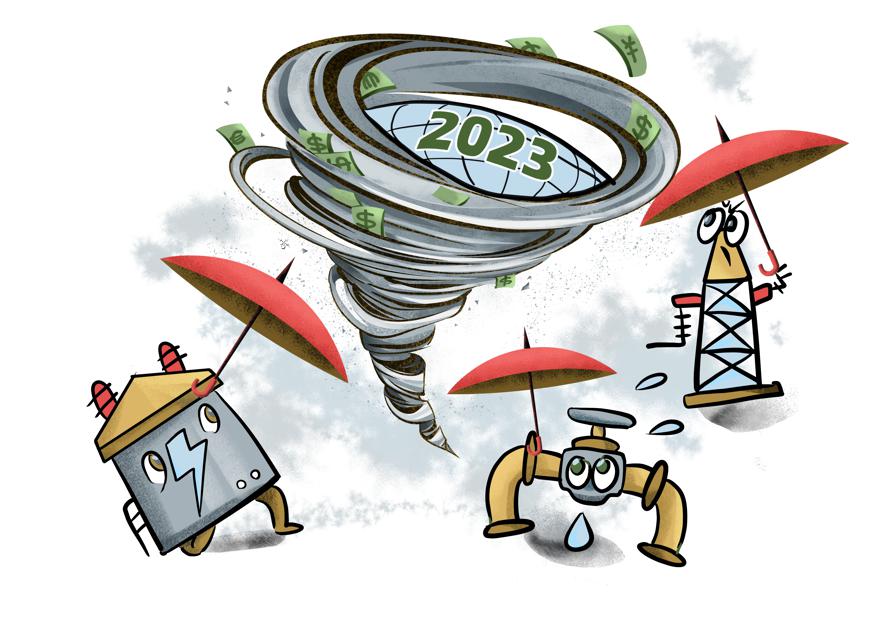
Editor's note: The global economy has changed significantly over the past few years, in the way that it is organized and governed by collaborating nations. These changes have repercussions that not only affect the flow of goods and services between countries, but also monetary and financial policies. Four experts share their views on the issue with China Daily.
World must avoid fragmentation
by Gita Gopinath
Now is a particularly challenging time for the global economy with the outlook expected to darken in 2023.
Three powerful forces are holding back the global economy: the conflict between Russia and Ukraine, the need to tighten monetary policy amid the cost-of-living crisis and persistent and broadening inflation pressures, and the slowdown of the Chinese economy.
During the International Monetary Fund's annual meetings in October, we projected global growth to slow from 6.0 percent last year to 3.2 percent this year. And, for 2023, we lowered our forecast to 2.7 percent — 0.2 percentage points lower than projected a few months earlier in July.
We expect the global slowdown to be broad-based, with countries accounting for one-third of the global economy contracting this year or next. The three largest economies: the United States, China, and the euro area, will continue to stall.
There is a one in four chance that global growth next year could fall below 2 percent — a historical low. In short, the worst is yet to come and, some major economies, such as Germany, are expected to enter recession next year.
Let's take a look at the world's largest economies:
In the United States, tightening monetary and financial conditions mean growth could be about 1 percent in 2023.
In China, we have lowered next year's growth forecast to 4.4 percent due to the weakening property sector, and weaker global demand.
In the eurozone, the energy crisis caused by the Russia-Ukraine conflict is taking a heavy toll, reducing our growth projection for 2023 to 0.5 percent.
Almost everywhere, rapidly rising prices, especially those of food and energy, are causing serious hardships for vulnerable households.
Despite the slowdown, inflation pressures are proving broader and more persistent than anticipated. Global inflation is now expected to peak at 9.5 percent in 2022 before decelerating to 4.1 percent by 2024. Inflation is also broadening beyond food and energy.
The outlook could worsen further and policy trade-offs have become acutely challenging. Here are four key risks:
The risk of monetary, fiscal, or financial policy miscalibration has risen sharply at a time of high uncertainty.
Turmoil in financial markets could cause global financial conditions to deteriorate, and the US dollar to strengthen further.
Inflation could, yet again, prove more persistent, especially if labor markets remain extremely tight.
Finally, the hostilities in Ukraine are still raging. Further escalation would exacerbate the energy and food security crisis.
Increasing price pressures remain the most immediate threat to current and future prosperity by squeezing real incomes and undermining macroeconomic stability. Central banks are now focused on restoring price stability, and the pace of tightening has accelerated sharply.
Where necessary, financial policy should ensure that markets remain stable. However, central banks around the world need to keep a steady hand, with monetary policy firmly focused on taming inflation.
The strength of the US dollar is also a major challenge. The dollar is now at its strongest since the early 2000s. So far, this rise appears mostly driven by fundamental forces such as the tightening of monetary policy in the US and the energy crisis.
The appropriate response is to calibrate monetary policy to maintain price stability, while letting exchange rates adjust, conserving valuable foreign exchange reserves for when financial conditions really worsen.
As the global economy is headed for stormy waters, now is the time for emerging market policymakers to batten down the hatches.
Eligible countries with sound policies should urgently consider improving their liquidity buffers, including requesting access to precautionary instruments from the IMF. In addition, the US could reactivate currency swap lines to eligible countries, as it extended at the start of the pandemic. This would provide an important safety valve in times of currency market stress. Too many low-income countries are close to, or already in, debt distress. Progress toward orderly debt restructurings through the G20's Common Framework is urgently needed, to avert a wave of sovereign debt crises.
For China, low inflation and weakening growth allow for greater support for vulnerable households which together with strengthening social safety nets would promote consumption. The new rules to loosen COVID restrictions will help mitigate the policy's economic impact and will be critical to sustain and balance economic recovery. In the property sector, urgent action at the central government level is needed to safeguard financial stability.
These efforts will be good for China — for the economic well-being of the Chinese people — and good for the world.
There is one other final risk to global prosperity that should be mentioned.
Over the longer term, geo-economic fragmentation could undermine the gains from globalization. As we know, trade has been a key driver of growth and integration. We can't now let trade policy become a source of fragmentation — which hurts all countries but especially the most vulnerable people and communities.
Guardrails need to be put in place to defend existing avenues of global collaboration and to make progress on climate policies, debt resolution, and other global issues.
The global community — led by the major economies — must step up to put the necessary guardrails in place and prevent geo-economic fragmentation.
The world desperately needs cooperation to tackle key vulnerabilities including climate change, food insecurity and elevated debt burdens.
The author is first deputy managing director of the IMF.





