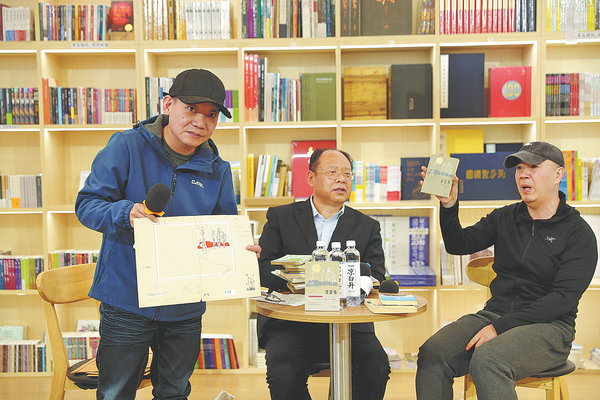
A highlight of the activities is one to launch the digital collection of Baihua Xiao Kai Ben (Baihua small-sized books), held in Tianjin on Nov 22. It is a type of book measuring 113 millimeters by 160 mm, which was published by Baihua Literature and Art Publishing House and became popular in the 1980s. Liu Yunfeng, a professor at the School of Journalism and Communication, Nankai University, and Guo Yafei, a senior art editor at Tianjin Education Press, were invited to talk about the history and value of the design.
According to Liu, in 1962, a prose collection of writer Sun Li (pen name) was sent to the publishing house to be published, but only with about 28,000 words, making it hard for editors to turn it into a book. They hoped Sun could write more, but he was sick and couldn't.
As a result, art editor Chen Xin designed a new pattern for the book, which was small and elegant, making up for the shortage of words with decorative images filling blanks at the end of prose. The book achieved unexpected success after being published, and since then, all the prose collections published at the publishing house applied such a pattern until about 2000.
Over the years, works of many Chinese writers, like Ji Xianlin, Ba Jin, Bing Xin, Feng Jicai and Zong Pu, were published in such a pattern, making it famous in the country, viewed as a symbol of the aesthetic values of the 1980s.
According to Liu, the design, also called pocket book, features a small size with fewer pages. It is lightweight and easy to carry, and its popularity seemed to be not a sole example in China, but a global trend since similar patterns were popular in other countries. This includes Iwanami Bunko, a series of small books published by Japanese publisher Iwanami Shoten, which was a success in the country as well.
The digital collections of Baihua Xiao Kai Ben were released on the same day, making three classical books of the style reappear in the digital version.
"The digital collection of the pattern is meaningful. It is the reproduction of the classical, and a review of the hard work of publishers in the old days," says Guo.
According to him, designers of the books were all famous painters, illustrators and cartoonists, who drew cover images manually, and had their own features for each one. The way of printing at that time made each cover image seem like an engraving.
Liu started to collect books of this pattern from 1987, when he was in college. By 2010, he had collected 100 books, and published a book to introduce the pattern, especially some classical cover images. According to him, "This pattern is a cultural resource, and we need to pass it down."
Other activities of the week included book launches, photography exhibitions, performances and recital parties, among which an activity discussing the relationship between literary works and films and TV series aroused much attention.
Writer Hu Xuewen, who is famous for his realistic works, has seen seven of his novels adapted into films. Hu analyzed which kind of literary works can be adapted into films. "When a novel is adapted into a film, on the surface it tells a good story, but the point is that it has value and energy, which can touch and even shock the readers. It makes people feel it not only tells a story of the characters, but also of their own."
Writer Wu Xin believes literature is the fermenter of many other art forms, especially films and TV series. He believes writers need to take their own ideas as the dominant factor in creation while learning skills from films and TV series, in their ways of showing the relationship between characters, master of rhythm and management of dramatic conflicts.