



Daily samples relaxed for some population groups







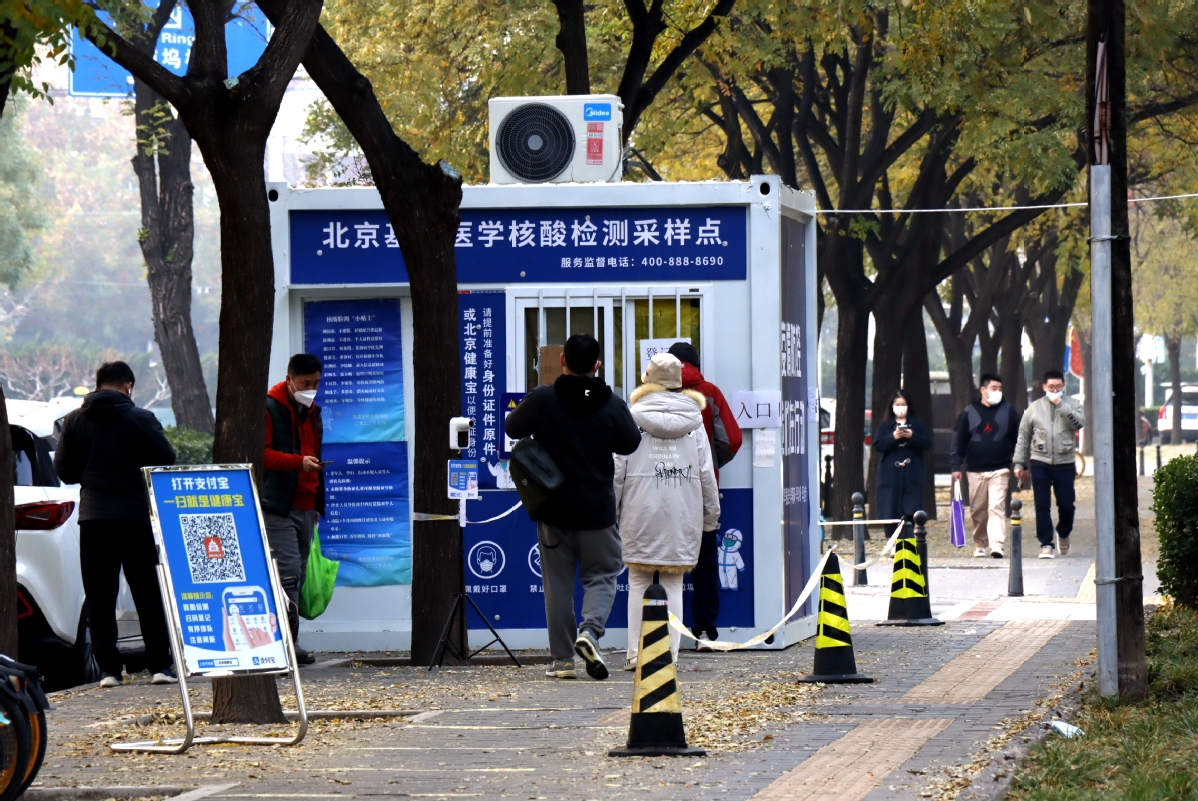
Some regions across the country have adopted COVID-19 testing policies aimed at more precise and human-oriented epidemic screening and intervention.
Beijing's Chaoyang district, the hardest-hit area during the ongoing outbreak in the capital, announced on Tuesday that certain groups, including the homebound elderly, students taking daily online classes, babies and those working from home, are exempt from daily nucleic acid tests during mass screening to reduce infection risks.
Meng Rui, deputy head of the district, said at a news conference on Tuesday, that the move is to better protect groups of the population and make the best use of the testing resources for groups with real infection risks.
"Any policy needs to be improved during its implementation," said Meng.
"We will continue to take the measures more precisely by making adjustments accordingly."
On Nov 27 and 28, the Yuexiu and Liwan districts of Guangzhou, Guangdong province, announced similar measures exempting certain population groups from mass screening to reduce infection risks.
The Chongqing Health Commission announced at a Saturday news conference that communities and neighborhoods without confirmed cases will be excluded from the latest three rounds of nucleic acid testing.
To curb the latest outbreak, four districts in Chongqing — Yuzhong, Jiulongpo, Jiangbei and Yubei — and three counties have conducted universal or partial regional testing. Notably, streets and townships with no confirmed cases, as well as communities with no positive cases for five consecutive days are exempt from the testing.
In Zhengzhou, Henan province, health officials at a Friday epidemic intervention news conference announced that low-risk areas would no longer conduct mass testing.
In Harbin, Heilongjiang province, a similar announcement has been issued by local authorities.
Starting on Tuesday, homebound elderly people, students who take online classes at home and those without social activities are exempt from mass testing.
In all of these locations, a negative test result from within varying time periods will still be required in most public places.
Wang Songsong contributed to this story.


- Chinese courts conclude trials of two criminal gangs from northern Myanmar
- Guarding Great Wall as lifelong commitment for Beijing local villager
- China Coast Guard drives away Philippine vessels illegally intruding into Huangyan Island waters
- Mega projects emerge as tourism powerhouses during Chinese New Year
- Xinjiang through my eyes: The desert mailman
- Chinese researchers develop AI model to process stellar data from different telescopes








