People-to-People exchanges, the foundation of future China-Tanzania relationships







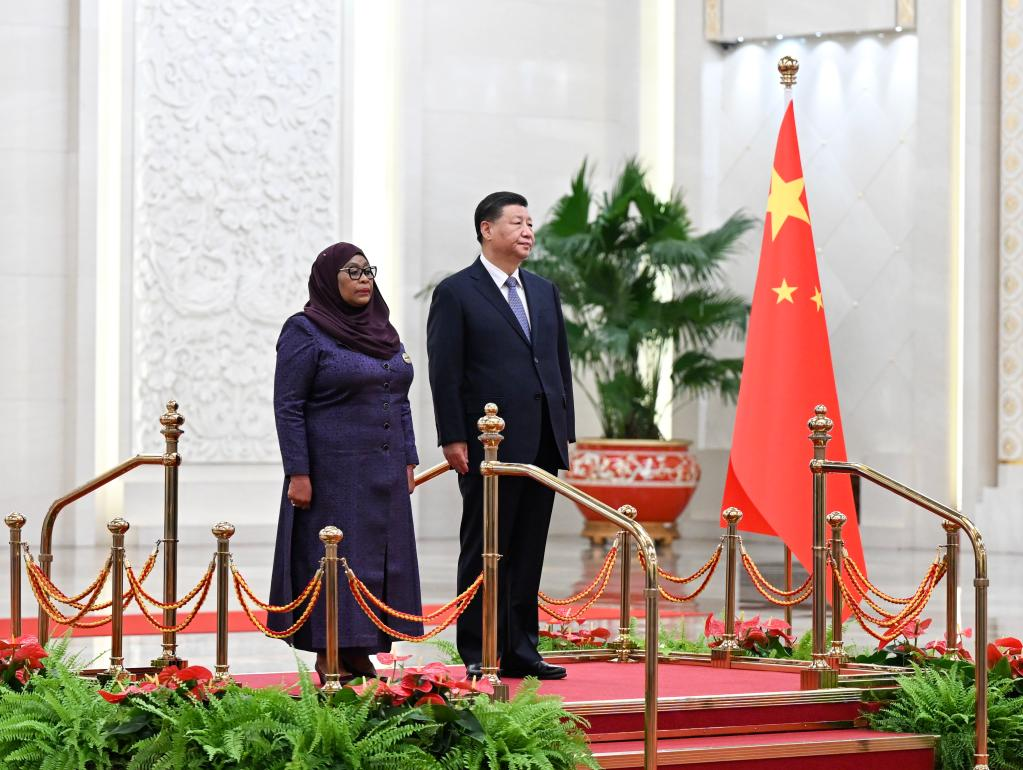
Last week, Chinese President Xi Jinping met Tanzanian President Samia Suluhu Hassan and the two leaders agreed to upgrade bilateral relations to a comprehensive strategic cooperative partnership. As the first African head of state received after the 20th National Congress of the Communist Party of China, Hassan's visit was symbolic as it fully shows Tanzania's endorsement for cooperation with China, the closeness of China-Tanzania relations, and the significance of China-Africa ties in China's overall diplomacy.
In their meeting, Presidents Xi and Hassan emphasized the importance of people-to-people and cultural exchanges and encouraged more academic and media exchanges between the two countries, as well as continuing to advance the friendship between the two peoples. Why do people-to-people exchanges matter? What can be done to strengthen mutual understanding between the Chinese and Tanzanians?
First, as Chinese engagement with Tanzania continues to grow, it is imperative for Chinese companies, entrepreneurs and workers to gain a better understanding of local situations, such as costume, culture and regulations. Growing bilateral relations allow both sides to develop pragmatic cooperation in multiple forms, including aid, trade, investment, financing and contract, and in a variety of sectors including information, Communication and Technology (ICT), infrastructure, manufacturing, agriculture, mining and trade. According to the Tanzania Investment Center (TIC), China is Tanzania's largest foreign investor, contributing to approximately 150,000 direct local jobs and generating substantial revenues and foreign reserves for the country.
However, language barriers and cultural differences can sometimes cause misunderstandings, and could put the sustainability of the relationship at risk if both sides do not actively work to mitigate them. In my last field trip in Dar es Salaam in 2016, I witnessed Chinese companies organizing learning workshops, some of which focused on Swahili, while others focused on Tanzanian culture and labor law. The Chinese community and enterprises in Tanzania have also actively engaged in corporate social responsibility initiatives that aimed at improving the livelihoods of ordinary people in the local communities. Such efforts are crucial in facilitating a deeper understanding of locality.
Second, deepening people-to-people exchanges is of major practical importance to build a China-Africa community with a shared future. Under the umbrella of FOCAC (the Forum on China–Africa Cooperation), many efforts have been made to develop new approaches and mechanisms for technology transfer, knowledge-sharing and- building. For example, China Agricultural University (CAU) launched the "Simple Technology Big Harvest" project in 2011, along with the Tanzanian Government and Sokoine University of Agriculture in Morogoro province. The project has helped scale up maize production and boosted farmers' income, and has been featured in the UN publication Good Practices in South-South and Triangular Cooperation for Sustainable Development. In 2018, in collaboration with the Morogoro authorities, CAU initiated another agricultural cooperation project called "Small Bean and Big Nutrition", aiming to promote the intercropping of maize and soybean for local farmers and improve their nutrition structure. Following demand-driven and multi-stakeholder approaches, these two projects are concrete examples of people-to-people exchanges and China-Africa cooperation for resilience and food security. Through exchanges, communications and coordination, Chinese experts, Tanzanian officials and farmers explored creative and inclusive ways to foster mutual learning and better understanding of each other's development experience.
Third, people-to-people exchanges can encourage a sense of common pursuit between these two countries. During President Hassan's visit, China and Tanzania agreed to strengthen their cooperation on global issues such as climate change and the 2030 Agenda for Sustainable Development. This demonstrates the two countries' consensus in boosting common development and prosperity. People-to-people exchanges, especially exchanges of students, experts, scholars and non-government organizations, could inspire collective efforts in pursuing the greater good and shared interests. Poverty alleviation and the exchange of development experience are among the common interests between the two countries. As indicated in the joint statement between China and Tanzania, the two countries will increase exchanges on governance experience and boost common development and prosperity.
China's conspicuous success in alleviating poverty could be of valuable experience for Tanzania in its fight against poverty and pursuit of sustainable development. This summer, a group of African students from CAU visited multiple villages in Yunnan Province to learn about Yunnan's practices and experiences of poverty alleviation. Many of the African students found the visit meaningful and they appreciated the interaction with local villagers and officials, which allowed them to gain a comprehensive understanding of China's rural governance and experiences in eliminating extreme poverty.
Last but not least, to create high-quality people-to-people exchanges, media workers must play a greater role. Scholars have pointed out a number of challenges and problems when it comes to reporting China-Africa relations, which include but are not limited to fake news, misinformation, sensationalism, stereotypes and generalizations. Despite scholars' continued efforts to debunk myths, stories such as "debt-trap" "land grabbing" still regularly appear in Western and some African media platforms. Lazy journalism has become commonplace due to a lack of fact-checking. A thorough and competent coverage of Africa as well as China-Africa relations requires imagination, reflection and in-depth communication between media professionals from Chinese and African organizations.
It is anticipated that President Hassan's successful visit in Beijing will result in increased exchanges between the Chinese and Tanzanians, as well as between non-governmental organizations, think tanks and the media, strengthening the relationship between the two countries, and laying a more solid foundation for a stronger China-African community. The upgrading of ties between the two countries could inject much-needed impetus into Tanzania's economy, which has been heavily disrupted by the COVID-19 pandemic and the turbulent global economy, and help the country move faster towards industrialization and modernization.
Li Hangwei is an associate professor at the College of International Development and Global Agriculture, China Agricultural University.
The opinions expressed here are those of the writer and do not necessarily represent the views of China Daily and China Daily website.
If you have a specific expertise, or would like to share your thought about our stories, then send us your writings at opinion@chinadaily.com.cn, and comment@chinadaily.com.cn.