



Diving ducks take to better waters







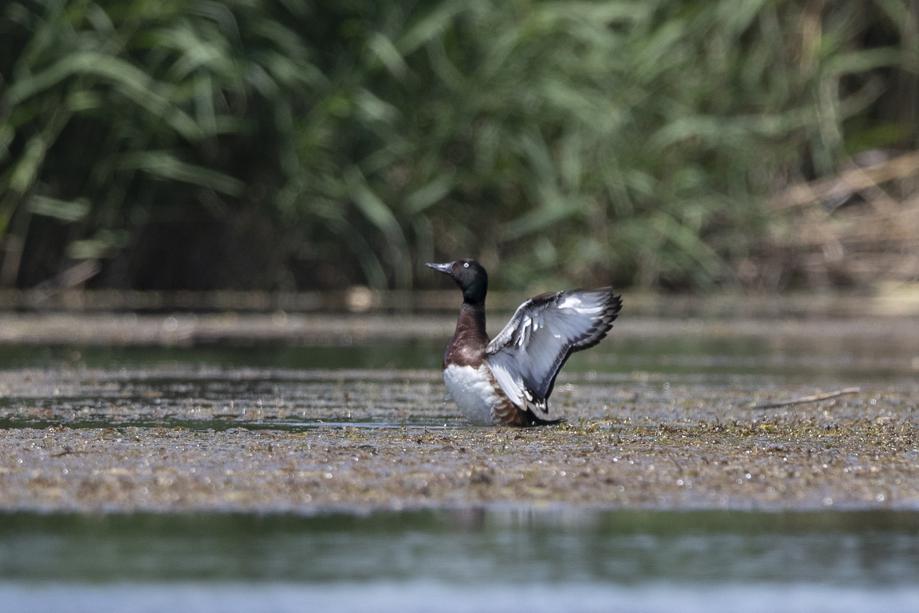
Researchers and wetland protectors in Wuhan, Hubei province, are stepping up efforts to allow more wildlife to survive and thrive in their natural habitat, with a treasured duck species one of the latest beneficiaries of the growing focus on the environment.
Li Peng, a senior engineer of the Wuhan Landscape and Forestry Bureau's Wetland Conservation Center, and his team members are analyzing the habits and diet of Baer's pochard, a critically endangered species of diving duck.
In 2012, the blue-headed duck was listed as critically endangered by the International Union for Conservation of Nature after its numbers declined due to a deteriorating habitat.
The ducks were rarely seen in Wuhan until bird-watchers observed them breeding in the city in 2014, according to the Wuhan Bird Watching Society.
"Despite that, no scientific results showed that the duck has turned from migratory to resident bird in the city because researchers would not attach tracers to the animals to prevent disturbing them," Li said.
In 2019, Li and his colleagues started researching and rescuing the breeding habitats of the duck. By analyzing its habits and diet through the feces and feathers, they found that the duck feeds on submerged plants, shrimp, snails and aquatic insects. The birds also like to rest at shoals where food is sufficient.
Based on the results, the team will create an area toward the restoration of the habitat in the city's Qijiawan area, where the blue-headed duck was first discovered.
"We chose this place because the duck is more likely to feel homesick, according to previous observations. They won't change habitats so frequently," Li said.
The birds like shallow water, with some parts of open water to move about and play, as well as spots of lotus plants for them to hide and sedge to build nests. Li said.
"We are trying to cultivate a healthy living environment for them," Li said.
Before 2015, just 30,000 birds spent their winter in the Chenghu Lake Wetland area of Wuhan because the environment was not so ideal for them, said Yan Jun, head of the Wuhan Bird Watching Society.
"At the time, we could see nets used for cage aquaculture at the lake, which should be wintering spots for birds. The nets divided the water surface and fishing boats moved around," Yan said.
"Since 2015, the local government has removed illegal fishponds in the lake and rolled out environmental restoration projects. By January this year, the lake's bird population has almost reached 85,000, according to our surveys," he said.
Guo Song, who used to be a wetland developer, joined the team protecting Chenhu Lake Wetland in 2019. His former job involved reed management and business operations in the field.
"I didn't get to know about birds, though I often saw flocks of them. After my team was merged with the wetland bureau, I patrolled wetlands and became acquainted with the birds. I can tell what species they are. I feel birds are like my friends. I love them and want to protect them," he said.
Last year, five curly feathered pelicans were spotted again in the wetland after six years. The number of gray cranes, white cranes and cygnets have also increased, he said.
As part of local government measures prioritizing wetland protection, a major Wuhan ring road which opened in April 2021 added 6 kilometers during its construction to make way for more than 20 wetland lakes.


- The Devil Still Dances: High Vigilance against Japanese Militarism's Infiltration in Sports and Culture Fields
- 189 historical artifacts of Japanese invasion donated to museum in NE China
- Death toll rises to 8 in North China factory explosion
- Over 140m train tickets sold for Spring Festival travel rush
- Vice-president of Agricultural Development Bank of China under investigation
- PLA conducts routine patrols in South China Sea












