



Smart and Inclusive
A comprehensive ecosystem for digital technology-based elderly care services







A comprehensive ecosystem for digital technology-based elderly care services
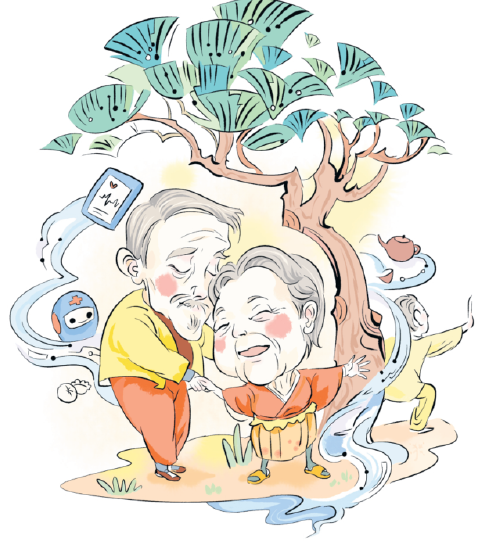
Aging is a major global trend of the 21st century. In East Asia, Japan, the Republic of Korea, and China have already become aged societies, and Japan has already become a super-aged society.
In China, the proportion of population aged 65 and above was 14.2 percent last year and will grow to around 30 percent by 2050. These countries are confronting high degrees of aging and rapid paces of aging.
Another major trend in today's global development is scientific and technological progress, especially when it comes to digitalization. Digitalization is transforming societies and economies and creating new tools and demands for governance.
Demographic changes can combine with scientific and technological progress to build a future society supported by smart technologies. We can call this new social pattern a smart aged society.
The transition toward a smart aged society requires continuous investment in the research and development of technologies, and in the real-world application of those technologies.
A good framework for smart elderly care has five components. First, smart technologies can provide high-quality services for the elderly and satisfy their diverse needs. Second, as the technologies serve the elderly, wearable devices and the internet of things can collect data on the elderly and their interactions with their surroundings. Third, the collected big data can form a platform on the cloud. The standardization of the data and the construction of data storage infrastructure can help promote the sharing of data between different contexts. Fourth, data mining, machine learning, model simulations and artificial intelligence can build on the data to improve the development of a smart service system. Finally, we can apply smart elderly care under different scenarios, increase the supply of smart elderly care, and bolster the application of information technology in all stages of the life cycle.
Such smart technologies can be used in preventive care, medical treatments, restorative care, nursing and hospice care. By learning about the lifestyles of the elderly as well as their specific needs, smart technologies can provide variegated, personalized, and targeted services. Smart elderly care will update through continuous technological innovations and applications.
The transition toward a smart aged society is not simply a matter of various technological innovations. It also needs to occur in tandem with economic and industrial development, with improvements in the social system, and with institutional growth in management capacities. To build a smart aged society, we need to establish and improve an entire ecosystem with technological, economic, social, and institutional dimensions.
According to existing estimates, smart healthcare and elderly care will create an industry of considerable size. This industry involves the production and sales of smart technological products, such as chips, sensors, wearable devices, and domestic service robots. In areas such as pharmaceutical production, medical instruments, biotechnology, as well as health and medicine, smart elderly care will draw financial resources from a large and diverse array of funders to support entrepreneurship.
To build a social service system featuring smart elderly care, smart technologies should be well integrated into different scenarios and social life. Smart technology could be employed in at-home care, community services, tele-health and remote services, and institutional care to better satisfy the specific needs of the elderly.
One prominent challenge for the development of smart technologies and the aging society is the digital divide, which may exclude the elderly, especially the eldest of the elderly, from a digitalized society. It is therefore important to achieve digital inclusion to close various digital divides.
In addition, a smart aged society should better deal with the relationship between technology and society. A smart aged society is one where smart technology serves the people by meeting the needs of the elderly, and by bolstering social engagement among the elderly. People's lives cannot be controlled by technology and data systems, and technology cannot be allowed to become a force that controls human society.
As smart aging societies develop, institutions must update themselves for digital governance. For example, as we apply smart technologies to elderly care, we collect a large volume of big data on demographic and behavioral information. This creates risks for data security and individual privacy. As governments deal with aging through smart elderly care, they need to adopt reforms in public management and related institutions.
Thus, as we transition toward a smart and inclusive aged society, we need to establish an ecosystem with technological, economic, social, and institutional dimensions. Governments, companies, social organizations, research centers, educational institutions, as well as other entities all have a role to play in this process. Only then can we use smart technologies to improve elderly care services and build a smarter, wealthier, and livelier aging society.
Since the 2010s, China has started to place emphasis on the integration of the internet, the internet of things and elderly care. In 2017, the Ministry of Industry and Information Technology, the Ministry of Civil Affairs, and the National Health Commission jointly embarked on an action plan for smart elderly care. The first phase of the program extended from 2017 to 2020, and the second is underway (from 2021 to 2025). Building upon the Internet Plus concept and smart technologies, this initiative has established numerous and various experimental programs and model programs across China.
With these exploratory efforts, China is moving toward a smart aged society. As people take stock of what occurred in these explorations and tackle specific problems that emerge from these trials, new business areas are being developed, knowledge about smart elderly care can spread across society. Meanwhile, we can also generate new knowledge through these trials, as they provide us with data, with research questions and with new demands. Research and application follow one another in a virtuous cycle.
When it comes to smart elderly care, Japan, the ROK and other countries have accumulated rich experience in technological innovation, service application, and institution building. This means that there are many opportunities for industrial and broader social cooperation between countries. By learning from one another, all countries can benefit as they develop smart technologies for their aging populations.
To sum up, with the development of new technologies, the economy, institutions, and society as a whole, we will continue to upgrade the smart aged society as the population continues aging. All members of society, including the elderly, will benefit from this development.
The author is a professor of the School of Social Development and Public Policy at Fudan University and a senior fellow of the Institute of Population Research. The author contributed this article to China Watch, a think tank powered by China Daily.
Contact the editor at editor@chinawatch.cn.





