


The Long and colorful journey of enamel







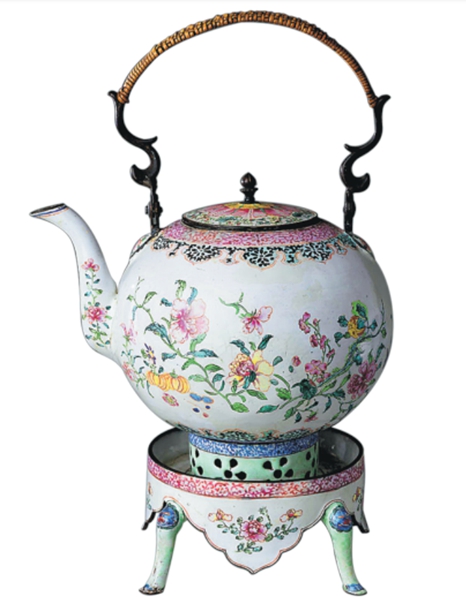
Found on several exhibits in the current display is a lotus scroll pattern composed of repeating lotus flowers set within meandering, intertwining tendrils. Now considered archetypal Chinese, it is mostly likely to have traveled the Silk Road from the West, where it had been modeled after acanthus, a plant commonly used to make foliage decoration.
Also traveling the ancient route were Sasanian silverware and pilgrim flasks. The former found their way into a 16th-century porcelain ewer whose red enamel had taken a cue from Chinese lacquerware. The latter, having quenched the thirst of Sogdian merchants and others who had trekked the long road, were reinvented as a pair of luxurious 18th-century cloisonne bottles, both sides densely populated with dragons and tigers, horses and monkeys, alluding unabashedly to the secular pursuit of fame and fortune.
Elsewhere, cloisonne assisted in the spiritual quest, as in the form of a 15th-century base that once supported a three-dimensional ceremonial mandala that probably comprised models of temples and colored sands. If visual intensity could help focus attention and induce piety, a belief central to certain mandala designs, then cloisonne is well-suited to the job.
For Lu, the mandala base testified to the fervor of the Ming court for Tibetan Buddhism. Similar objects have been found in stupas in Tibet and are believed to be the Ming rulers' parting gifts for visiting Tibetan monks, he says.
On a Ming Dynasty cloisonne bowl the Eight Treasures of Tibetan Buddhism — a lidded jar and conch shell being two of them — jostle for space with a miscellany of emblems derived from Taoism and other indigenous beliefs. These include ingots, rhinoceros horns and the Three Peaks, cloud-wreathed worshiping sites for Taoist practitioners.
To further complicate the scene, the center of the bowl's interior base is taken up by the stylized symbol of taiji (yin-yang), a primary force of the universe in Chinese philosophy. If anything, the bowl is the result of a continual effort to adopt, acquire and assimilate, to incorporate something foreign into China's ever-expanding visual art vocabulary.
- Christie's Shanghai to showcase two masterpieces for limited time
- Guizhou craftsman brings clay whistle alive
- Calligraphy and Painting Challenge themed on the Spring Festival calls for entries worldwide
- Amazing China in 60 Seconds: Liaoning
- Artworks shown at national academy picture routes to rejuvenation