Tradition boosts graft fight







Campaign against corruption is rooted in cultural heritage, Yang Yang reports.
Editor's note: China's ancient wisdom informs its contemporary leadership. In this series, China Daily explores how age-old principles and philosophies continue to steer the country's governance.
On Sept 19, Sheng Guangzu, former chief of the members group of the Communist Party of China and general manager of China Railway Corp, now known as China State Railway Group, was expelled from the Party for seriously violating Party discipline and national laws. Procuratorates will further prosecute his case and illegal gains.
Four days later, Sun Lijun, former vice-minister of public security, was sentenced to death with a two-year reprieve for taking bribes, manipulating the stock market and illegal possession of firearms.
In the first half of the year, of those punished, 21 had served at the provincial or ministerial level, 1,237 at the bureau level and 10,000 at the county level. The two above are the latest examples that display the Party's zero-tolerance attitude toward corruption.
The fight against corruption is the most important political issue that concerns the people's trust and support, and it is a battle that the CPC cannot afford to lose and should never lose, said Xi Jinping, general secretary of the CPC Central Committee, in a group study session of the Political Bureau of the CPC Central Committee on improving anti-corruption capability in June. He reiterated the need to create deterrents, strengthen the institutional constraints and build up moral defenses among officials.
In November 2012, when Xi was sworn in as general secretary of the Central Committee of the CPC, he promised to improve people's livelihoods and tackle pressing problems, including corruption.
Since the 19th National Congress of the CPC in 2017, the Party has improved its self-governance and worked tirelessly to tighten discipline and improve conduct, Xi said in another study session of provincial and ministerial-level officials in July. He added that the Party has also taken coordinated steps to ensure that officials do not have the audacity, opportunity, or desire to engage in corruption.
Integrity vital
According to the Central Commission for Discipline Inspection, anti-corruption bodies nationwide investigated over 4 million cases between November 2012 and October 2021, in which 4.37 million officials were put under investigation.
According to China's top antigraft bodies, in 2021, discipline inspection and supervisory authorities around the country received about 3.86 million complaints and tips, handled more than 1.82 million items of evidence of violations and filed 631,000 cases for investigation, and the numbers for the first half of 2022 were 1.75 million, 739,000 and 322,000 respectively.
New laws and regulations on supervision have been made since the 18th National Congress of the CPC, including the Law on Administrative Discipline for Public Officials that was passed in 2020.
But to eradicate corruption, in addition to the deterrents, legislations and regulations, one fundamental thing is to have the ideas of integrity and self-discipline embedded in the hearts of Party members and officials, experts say, so that they will not have the desire to commit corruption.
"To tackle graft, we must start from the cultural source to build a clean government," said Li Qiufang, president of the Chinese Association for Radio, Film and Television Exchanges, in an interview with the China Discipline Inspection and Supervision Daily.
Dong Zhenhua, deputy director of the department of philosophy teaching and research at the Party School of the Central Committee of the CPC, says fine Chinese traditional culture, revolutionary culture and advanced socialist culture are the important sources of probity culture in a new era.
"To promote the construction of probity culture in a new era, revolutionary culture can teach Party members a noble character of self-lessness and dedication, the advanced socialist culture can nurture a cultural soil of honesty and justice, and fine traditional Chinese culture can cultivate a spiritual pursuit of self-discipline and integrity," he says.
Fine traditional Chinese culture is the spiritual lifeblood of the Chinese nation, containing rich philosophical ideas, spiritual strength and cultural nutrition, and therefore is an important source for the Party members and officials to build up moral defenses against corruption, he says.
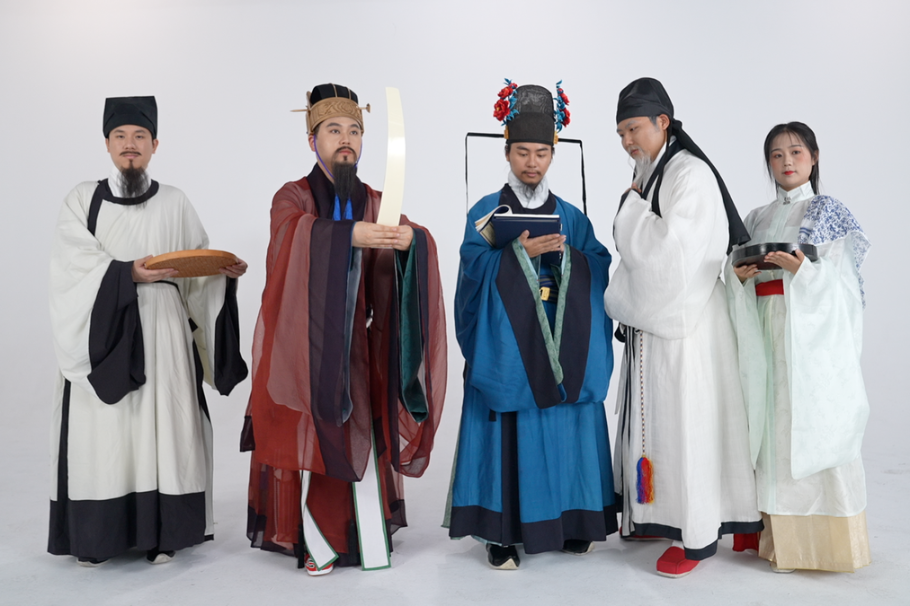
Traditional Chinese culture has always attached great importance to moral cultivation. For centuries, rulers in different dynasties advocated ideologies and morality that guided officials to cultivate their conduct and to be honest and upright so as to better serve the country. In ancient China, probity was regarded as a virtue and key requirement for officials.
Guiding ideologies
Originally, lian (probity) meant the edge of a house's corner that was sharp and convergent. But during the Spring and Autumn Period (770-476 BC), it started to include meanings of probity, integrity, thrifty and perspicacity, writes Bu Xianqun, director of the institute of ancient history with the Chinese Academy of Social Sciences, in a published article.
Yan Ying, a great philosopher and statesman during the Spring and Autumn Period, said probity is fundamental to governance. Almost all the philosophers of that historical period were recorded to make remarks about the problems concerning probity.
Confucius once said: "When a prince's personal conduct is correct, his government is effective without the issuing of orders. If his personal conduct is not correct, he may issue orders, but they will not be followed."
He also gave concrete prescriptions for governments: "To govern means to rectify. If you lead the people with correctness, who will dare not to be correct?"
Alongside Yan Ying and Confucius were Mencius, Mo Di, Han Fei, among other philosophers, who, based on the extensive and profound exploration of lian's meanings, connected the concepts of probity with the governance of states, directly leading to the birth of the thought that takes probity as the fundamental to evaluate officials in ancient China's governmental organs, Bu writes.
For many scholars in the following dynasties, when annotating The Rites of Zhou, a Chinese book on organizational theory that dates back over 2,200 years, they stressed that probity was the first and foremost quality for an official, he writes.
Scholars in the Ming Dynasty (1368-1644) believed that only probity can guarantee equality and hence justice; without probity, an official must engage in malpractices, so that laws will be useless and people do not know what to follow, Bu writes.
Throughout the Chinese history, the thoughts about probity had been continuously developed and enriched, becoming the spiritual sources of officials' self-discipline in different dynasties.
Dong says: "Traditional Chinese culture upholds honesty and integrity, and takes probity as the fundamental of the governance of a country. Taking in these thoughts and carrying them forward in a new era will greatly help Party members and officials to cultivate their conduct and mind."
Contact the writer at yangyangs@chinadaily.com.cn