Joint communiques above US acts








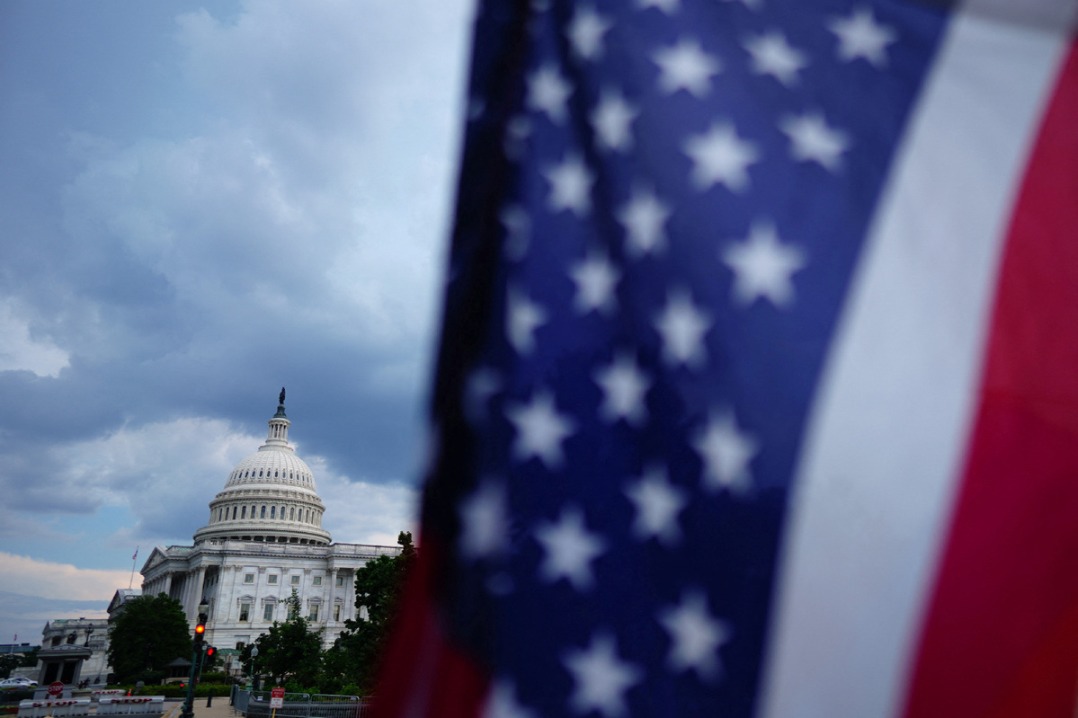
The Senate Foreign Relations Committee is scheduled to mark up the Taiwan Policy Act (TPA) on Wednesday, which is described as "the most comprehensive restructuring of US policy toward Taiwan since the Taiwan Relations Act of 1979." The TPA seeks to provide $4.5 billion in security assistance to Taiwan over four years, and recognize China's Taiwan as a "major non-NATO ally" of the United States.
Such a bill, if passed, will only ratchet up the already high tensions across the Taiwan Straits. Because it is another blatant US provocation seeking to challenge China's sovereignty and territorial integrity and hollow out the one-China principle by undermining the three joint communiques with domestic legislation.
However, the truth is, any discussion on China-US relations should be held under the framework of the three joint communiques issued by the two countries, that is, the Shanghai Communique of Feb 28, 1972, the Joint Communique on the Establishment of Diplomatic Relations of Dec 15, 1978, and the US-China Communique on US Arms Sales to Taiwan of Aug 17, 1982.
According to customary international law, which is codified in the Vienna Convention on the Law of Treaties, a treaty means an international agreement concluded between states in written form and governed by international law, whether embodied in a single instrument or in two or more related instruments and whatever its particular designation. And since the three joint communiques are treaties that are legally binding on both China and the United States, they are governed by international law and therefore should be abided by the two countries.
The core of the three joint communiques is the one-China principle, which forms the political and legal foundation of China-US relations. In the communiques, the US side acknowledges that the People's Republic of China is the sole legal government of China, and the people of the US will maintain cultural, commercial and other unofficial relations with Taiwan residents within this context.
The US, in the communiques, has committed to never infringing on China's sovereignty and territorial integrity, or interfering in China's internal affairs, or pursuing a policy of "two Chinas" or "one China, one Taiwan". The US' commitments are in black and white, and thus leave no room for ambiguity or denial.
The three joint communiques followed the passing of United Nations General Assembly Resolution 2758, which underscores the one-China principle that the People's Republic of China is the only legitimate government of China. It is important to stress here that the UN General Assembly resolutions on membership are legally binding on all the UN member states, including the US.
But due to domestic political pressure, the US Congress, shortly after issuing the Joint Communique on the Establishment of Diplomatic Relations, enacted the Taiwan Relations Act, which aims to maintain, in disguised form, official and military relations between the US and Taiwan.
The Taiwan Relations Act seriously violates the one-China principle, the three China-US joint communiques and the spirit of UN General Assembly Resolution 2758, and thus is unlawful in international law.
The Taiwan Relations Act offers the anti-China political forces in the US a legal excuse to follow the "policy" of "two Chinas" or "one China, one Taiwan". Worse, many in the US even believe that under the US Constitution, the three joint communiques are executive agreements and therefore inferior in terms of legal force to legislation passed by the Congress.
However, there is no truth in such beliefs judging by the ambit and jurisdiction of international law. Under international law, there is only one US and its executive and legislature represent the country bearing the name of the United States of America. So any act done in the name of the US shall be regarded as that of the country.
Also, according to the principle of promissory estoppel, a country cannot go back on its international commitments. Promissory estoppel is a legal principle that a promise is enforceable by law and prevents a party from going back on its word, and the doctrine of promissory estoppel is part of the law in the US and other countries.
Therefore, the US is obligated to abide by the commitments it has made in the three joint communiques and not pass any law that is in conflict with those commitments. In other words, the claim that the Taiwan Relations Act is legislation passed by the Congress and the three joint communiques are executive agreements does not give the US the legal power to go back on its international promises.
Moreover, according to customary international law, a country should handle its relations with other countries on the basis of international law, not based on its domestic laws that are in conflict with international law. And according to international law, the Taiwan Relations Act is unlawful.
No country can abrogate its commitments on the pretext that its domestic law conflicts with international law. In fact, by giving precedence to its domestic laws over international laws, the US has been violating international law. Also, any act that derives from the Taiwan Relations Act is illegal in light of international law, that is, the three joint communiques and UN General Assembly Resolution 2758.
Given these facts, China is firmly opposed to any official US exchanges with the island's authorities in any form and under any name. China's claim is based on facts, that there is but one China and Taiwan is an inalienable part of China, and that is predicated in international law.
And the US Senate's political show to "upgrade" the Taiwan Relations Act, which is motivated by the pursuit of political gains in the run-up to the midterm elections, only reinforces the fact that some senators are willing to sacrifice long-term Sino-US ties for their own selfish interests. The Taiwan Policy Act shows how lawlessly the US is willing to act in pursuit of its aims.
The author is dean of the School of International Law, China University of Political Science and Law.
The views don't necessarily reflect those of China Daily.
If you have a specific expertise, or would like to share your thought about our stories, then send us your writings at opinion@chinadaily.com.cn, and comment@chinadaily.com.cn.