China bolsters links with Central Asian nations







Tangible benefits
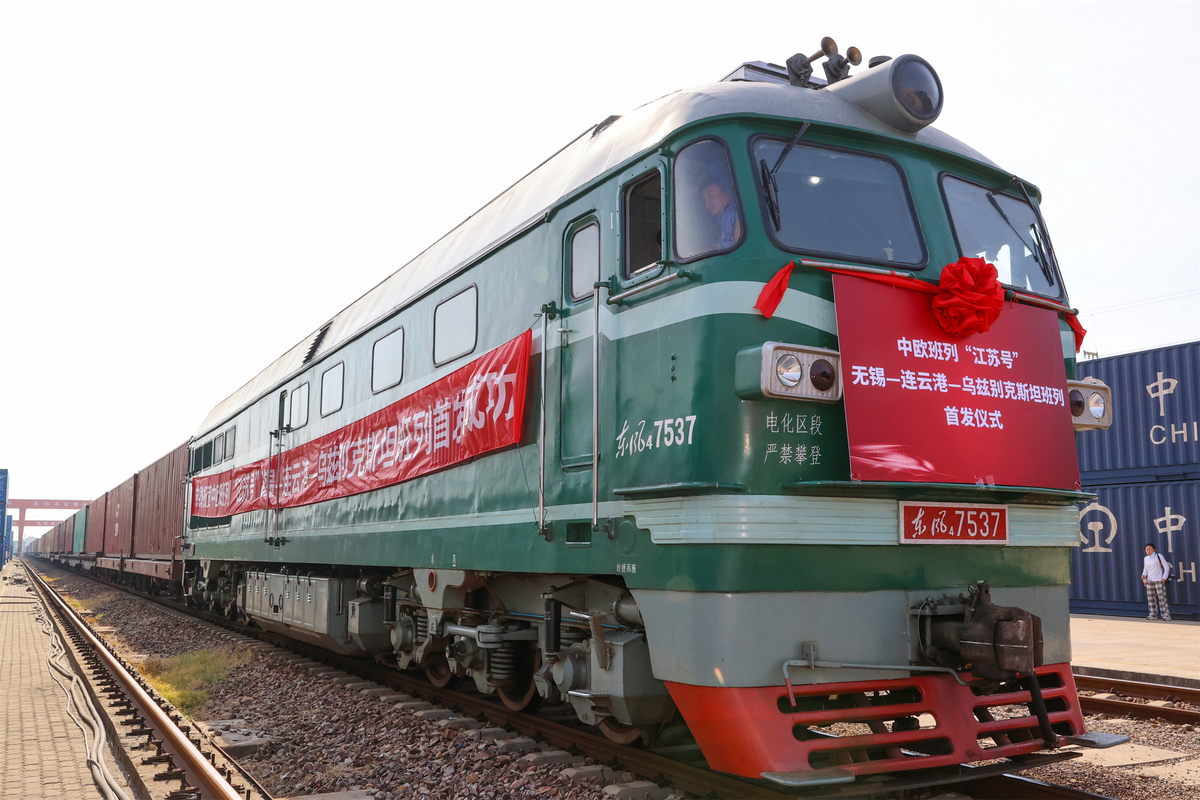
Central Asia, especially Kazakhstan, has served as a key gateway on the western route for China-Europe freight trains. As of July, more than 57,000 train journeys had been made via this transportation corridor — which was launched in 2011 — with shipments of 5.3 million TEUs (twenty-foot equivalent units) of goods worth nearly $300 billion.
The launch of China-Europe freight trains shortened the time fivefold to transport goods between Kazakhstan and Europe, according to a report by the Chinese Academy of Social Sciences.
Sun Xiuwen, an associate professor at Lanzhou University's Institute of Central Asian Studies, said improving infrastructure connectivity has become a priority for China and Central Asian nations in their efforts to build a community with a shared future.
Despite the COVID-19 pandemic, the exponential rise in the number of trips made by China-Europe freight trains through Central Asia speaks volumes for the steady efforts made by the two sides in using their respective strengths, she said.
Sun added that China has taken part in a series of infrastructure construction projects in the five nations, including the China-Kyrgyzstan-Uzbekistan International Highway and the Vakhdat-Yovon railway in Tajikistan, helping the five countries strengthen their transportation capacity.
To help these nations alleviate power shortages, Chinese companies built power plants in Dushanbe, capital of Tajikistan, and Bishkek, capital of Kyrgyzstan, as well as a power transmission project spanning 410 km in Kyrgyzstan, she added.
Li Ziguo, director of the Department for European-Central Asian Studies at the China Institute of International Studies, wrote in a research note in March that China has become the largest or the second-largest trading partner of Central Asian countries and a major market for their commodities.
Improved infrastructure networks have made the region a key corridor for China's exports to Europe, he wrote.
"The Chinese economy and the economies of Central Asian countries have been further integrated in the process of jointly building the Belt and Road Initiative, which has accelerated the globalization of the five countries," Li added.
Greater potential
During the summit in January, Xi said China would grant assistance of $500 million to Central Asian countries to support livelihood programs, and offer 5,000 places at seminars and workshops to help these countries train professionals in fields including health, poverty reduction, agricultural development and information technology.
Analysts and industry insiders have highlighted the significance of the China-Kyrgyzstan-Uzbekistan railway in further unleashing the potential for BRI cooperation between China and Central Asian nations.
Last month, China's National Development and Reform Commission said in a statement that a team of Chinese experts had arrived in Kyrgyzstan to conduct field work on the railway, marking the start of a feasibility study for the project.
In July, Kyrgyz President Sadyr Zhaparov said during a meeting with Chinese State Councilor and Foreign Minister Wang Yi that Kyrgyzstan regards the China-Kyrgyzstan-Uzbekistan railway as an important link in building the Belt and Road Initiative, and is eager to advance and accelerate this state-level cooperation project.
Wang told Zhaparov that the time is right to build the rail link, and that China is ready to work with Kyrgyzstan and Uzbekistan to speed up the feasibility study.
The rail line is expected to be 523 km long, including 213 km in China, 260 km in Kyrgyzstan and about 50 km in Uzbekistan.
Zhaparov said in a media interview in May that construction of the railway could start next year.
Zhao, from the Chinese Academy of Social Sciences, said this project was launched as the BRI yielded tangible benefits and entered a phase of high-quality development, which spoke highly for the high level of recognition among Central Asian countries for the results produced by the BRI.
"The railway's construction and operations will serve as a new driver for the transportation, trade and economic growth of relevant nations — further promoting development of the BRI," she said.
Li Shengping, manager of a freight forwarder based in Urumqi, capital of Xinjiang Uygur autonomous region, said that when it is completed, the railway will further increase the efficiency of China-Europe freight train services and energize the economic growth of countries along the route.
He expects the railway to help transform Kyrgyzstan and Uzbekistan into regional logistics centers, as it will become the shortest rail route to move Chinese goods to Europe and the Middle East, possibly reducing the transportation time by seven to eight days.
Li added that China's booming economic links with Central Asia have seen the emergence of hundreds of freight forwarders in Xinjiang, which borders the region.
"With construction of the railway, I am confident in the broader prospects for the industry," he added.
Dey Aleksander, an Uzbek national working as a senior marketing manager at the Central Asian branch of China Energy Co, said the BRI has produced quicker economic growth in Central Asia and promoted deeper bonds between people.
The initiative has also served as a key channel for boosting investment in the region and for raising standards of living, he said.
"The BRI has helped Central Asian countries to increase exchanges with other nations, especially as more people have started to get to know China and learn Chinese."