



Cozier life is on, powered by smarter tech







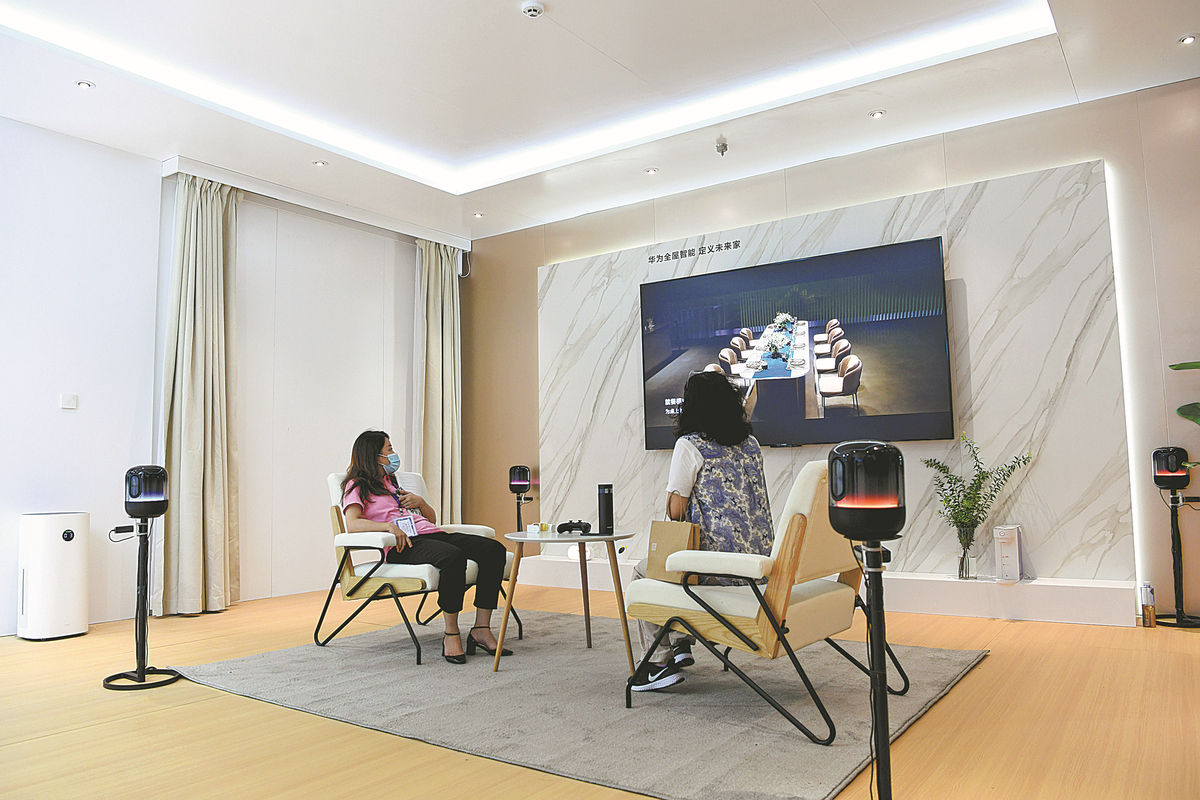
At-home gadgetry increasingly becoming more user friendly as apps simplified, better coordinated
Su Ying, a tech-savvy expert in Shenzhen, Guangdong province, is always eager to try out the latest fancy smart hardware products. For instance, he has more than 50 smart home devices in his home, but they aren't always as smart as he thinks they should be.
"The smart home devices have to be controlled via four different apps under separate management. Though now I can use one app to turn off the lights in the living room while I am physically in the bedroom, and authorize the use of digital door locks for my family members, I came across three major problems," Su said.
All management must be done through the smartphone, and it is extremely cumbersome to connect the phone with 50 other smart home devices. Meanwhile, connections are unstable. "When there are more than 10 smart devices, I started to feel dizzy, and in fact, many of them are less used, and end up as just useless decorations," he added.
Su is part of a growing number of Chinese consumers willing to embrace smart home products, making the nation's smart home industry an even more promising one in the years to come.
China's smart home device shipments will grow 17.1 percent year-on-year to exceed 260 million units in 2022 as smart home optimization and upgrades continue, according to United States-based market research firm International Data Corp.
Shipments are expected to grow at a compound annual growth rate of 21.4 percent to hit 540 million units in 2025, and the market size by then will exceed 800 billion yuan ($115.8 billion), IDC said.
The trend is in line with a global report by US personalized communications services provider Plume. The company found that home tech users have growing appetites for the internet of things and smart home technologies. Specifically, on a global basis, the average number of connected devices per home stood at 17.1 at the end of June 2022, up 10 percent compared with the same period a year previously.
While problems faced by Su are getting more and more common among the consumer group, "we expect smart home technologies to accelerate upgrades due to the rise of a fully managed services market along with evolution in user-device interactions, upgrades in connectivity and broadened sales channels," said Quorra Liu, senior market analyst for devices research, IDC China.
IDC said 5G and artificial intelligence will play key roles in bolstering the connection of different smart home devices in various application scenarios and facilitating interaction between human beings and machines.
Other cutting-edge technologies, such as voice interaction and facial recognition, have been gradually applied in smart speakers, security surveillance equipment and other smart home devices to enhance user experience and enrich their functions, IDC added.
And that is exactly how Chinese companies are working to solve the problems.
They are working hard to beef up their product solutions powered by new technologies. Huawei Technologies Co, for instance, unveiled its smart home project offering a full set of smart home devices to cover an area of 550 square meters in total, specifically including a living room, a kitchen, a study, a home gym, an entertainment room and a garage.
Shao Yang, chief strategy officer of Huawei's device business group, said the company aims to change the device-focused approach into a people-centered approach-namely, letting the home space welcome people and better serve users.
Huawei aims to enable every at-home user to get the most comfortable, intelligent service by integrating home spaces and devices in an orderly manner, unlike the traditional ways of installing independent, unconnected smart products, the company said.
Specifically, by using wireless technologies, Huawei's products-including phones, PCs, tablets, watches, smart speakers and smart TV-are integrated with products from Huawei ecosystem partners to provide a comfortable, intelligent and immersive smart home experience, the company said.
In the living room, it just takes a few words to wake up the smart assistant and enable the Back Home Mode. In this mode, air purifiers and warm lighting are turned on, and even curtains are closed. These connected devices can all be controlled using the same smart assistant, Huawei said.
In the kitchen, consumers can find a full complement of household appliances powered by Huawei's self-developed operating system HarmonyOS, Shao said, adding that by simply tapping phones lightly against such devices, connections are established. Air cookers, food processors and other kitchen appliances have built-in recipes, making it easier than ever to cook like a master chef.
Such functions are partially enabled by HarmonyOS. Yu Chengdong, CEO of Huawei's device business group and CEO of the company's intelligent automotive solution business unit, said in July that more than 300 million of the company's devices have now been equipped with HarmonyOS 2, which makes it the world's fastest-growing operating system.
Meanwhile, more than 170 million third-party products equipped with HarmonyOS Connect for IoT functionality have also been shipped out of factories to retailers across China, Yu said.
Xiang Jiangxu, vice-president and chief technology officer of home appliance maker Midea's IoT business, said, HarmonyOS covered "almost all categories of our products"-some 200 varieties-last year.



















