



Shifting to e-vehicles







Editor's note: Hong Kong will spend HK$240 billion on various measures in the next 15 to 20 years to tackle climate change in a bid to achieve carbon neutrality by 2050. In this series, we examine how green buildings, green transport and hydrogen fuel will help the city realize its goal while shaping a decarbonization value chain that is expected to diversify the local economy.
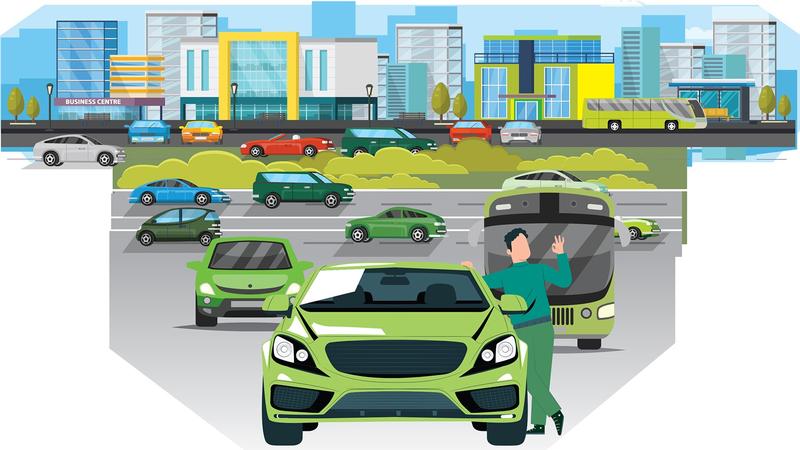
Hong Kong's transportation sector is the second-largest source of carbon emissions in the city, accounting for about 18 percent of total carbon emissions in 2019, according to the special administrative region's Climate Action Plan 2050.
Among the categories of vehicles, private cars were responsible for 4.5 percent of the emissions, followed by medium-goods vehicles (3.2 percent) and franchised buses (2 percent).
The SAR government unveiled the "Hong Kong Roadmap on Popularisation of Electric Vehicles" in March 2021, pledging to achieve zero vehicular emissions by 2050 — in concert with its carbon neutrality target.
Other targets proposed in the document include nonregistration of new fuel-propelled private cars, covering hybrid vehicles, in 2035 or earlier; higher first-registration tax concessions for private e-car owners under the One-for-One Replacement Scheme; trial promotion of various types of commercial vehicles through the New Energy Transport Fund; and the procurement or replacement of electric vehicles for government small and midsize private cars.
A business value chain is expected to emerge from promoting the electric-vehicle industry in the decarbonization drive. The value chain would arise from establishing an electric-vehicle charging network in public and private facilities; nurturing sufficient power electronics and electrical engineering talents; developing the EV battery recycling industry; encouraging mobile-app launches by technology companies; and promoting smart-city town planning consultancy services. The entire value chain would also offer job opportunities.
Creating a network
To get the results, Hong Kong should take a comprehensive approach in town planning to make EV charging facilities more popular. "Inadequate charging facilities would impede the wide use of EVs in Hong Kong. At present, the ratio of EV chargers to electric vehicles is 1 to 4 in Hong Kong, meaning four EVs would have to queue up at one EV charging facility. Hong Kong needs more EV charging stations to improve the situation," says Ernst & Young Advisory Services Partner Nelson Chow.
In Hong Kong, EV charging facilities are located mainly in private residential and commercial buildings, while overseas, there are also EV charging facilities at public roadside areas.
"Owners' corporations of residential buildings may not be willing to install EV charging facilities because of the potential disruption to existing car spaces if they are erected in the parking areas of buildings. The barrier to entry is high," says Lawrence Cheung Chi-chong, the Hong Kong Productivity Council's chief innovation officer.
The government plans to have at least 5,000 public chargers in Hong Kong by 2025 and double that figure in the future. There would be a minimum of 150,000 parking spaces in private residential and commercial buildings equipped with EV charging facilities before 2025, according to the EV road-map document.
As of the end of June, the number of EVs in the SAR stood at 33,214 — about 3.6 percent of the total number of vehicles on the road — data from the Environmental Protection Department showed. There were 5,046 EV public chargers in service, including 2,746 medium chargers and 877 quick chargers, in all of the city's 18 districts.
"EV charging facilities should be more evenly distributed across the city. For example, new transportation infrastructure should have EV provisions in town planning for the Northern Metropolis development and the Lantau Tomorrow Vision project," Chow says.
In his view, government departments concerned should conduct in-depth market research to assess technical feasibility, environmental concerns and public safety when installing EV charging facilities at public roadside areas.
"The government will play a very important role in pushing the development of the EV charging ecosystem. It should consider installing EV charging facilities in town planning for new-development areas, so as to provide more space in linking infrastructure to EV charging," suggests Emily Leung Suk-man, general manager of mobility at Shell Hong Kong — the city's first mobility solution provider in EV charging services at parking lots and gas and oil stations.
Shell Hong Kong — a subsidiary of global energy and petrochemical company Shell PLC — plans to provide more than 300 EV charging points in Hong Kong, apart from adapting some of its existing gas stations in the city for the charging services, in the next two to three years, taking into consideration factors like wiring connections, safety precautions, and securing electricity supplies.
Based on a preliminary evaluation, Shell Hong Kong believes about one-third of its 41 gas stations in the SAR are suitable for installing EV charging facilities. "Shell Hong Kong intends to work with the government and other parties, such as power companies, in assessing the possibility of building EV charging facilities within a short period, based on the geographical characteristics of each gas station," Leung says.
Shell Hong Kong is also collaborating with local property developers in the push to make Hong Kong greener. It has formed the New World Green Transport Alliance with New World Development Co and Sime Darby Motors Group. The alliance will spend HK$50 million ($6.4 million) within the next five years on setting up more than 100 universal EV charging points in the city from the fourth quarter of this year.
Currently, EV charging standards vary among regions worldwide. EVs sold in Hong Kong and European automakers adopt the International Electrotechnical Commission standard; automakers in the United States use the SAE International standard; while in Japan, the locally developed CHAdeMo system is dominant; and Chinese mainland manufacturers opt for the GuoBiao national standard. Therefore, the EV car industry needs professionals who are familiar with and can harmonize the various EV charging standards.


- Foreign experts' support for modernization hailed
- Long March 10's booster retrieved from sea for 1st time
- Fujian villages bear witness to changes
- Global visitors experience authentic Chinese culture
- Surnames as a bridge across the Strait
- Xi'an workshop lets tourists hand-make their own Terracotta Warriors








