



Further policy easing may be in offing







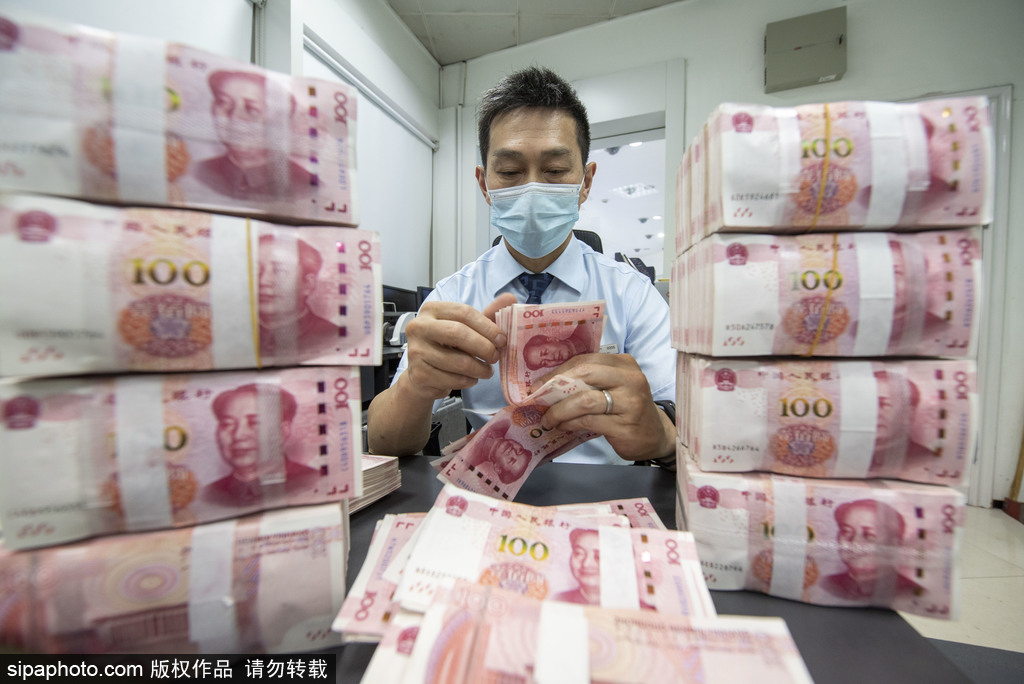
The People's Bank of China, the country's central bank, recently lowered the rate on 400 billion yuan ($58.89 billion) of one-year medium-term lending facility loans to some financial institutions by 10 basis points to 2.75 percent. It also conducted 2 billion yuan of seven-day reverse repo operations at an interest rate of 2 percent, down from 2.1 percent.
It was an unexpected cut in interest rates. In China's second-quarter monetary policy report, the PBOC strengthened its focus on refraining from adopting a deluge of strong stimulus policies. The market expects liquidity to remain ample. As for the 10 bps interest rate cuts by the central bank, we understand they were carried out mainly for the following three reasons.
First, there is a rising need for cutting interest rates to support the real economy. Growth of some key economic data slowed in July from June, which does not augur well for a strong economic recovery in the third quarter and points to a deep-seated lack of growth momentum. On the one hand, demand declined owing to unsolved real estate problems. And given the increased risk of recession in Europe and the United States, the sword of Damocles is still hanging above the slowing export growth rate, despite exports' short-term resilience.
On the other hand, overall market expectations are weak. During the three-year COVID-19 pandemic, some have been suffering deteriorating balance sheets, hampering consumption recovery. Meanwhile, enterprises still face problems like disruptions to production and logistics as well as insufficient demand, and enterprises do not have a strong willingness to use tax credit refunds to recycle into expanding investment.
Second, credit and social financing declined in July. Limited improvements in business and consumer confidence failed to boost demand for loans to the real economy. So far this year, social financing data have fluctuated greatly. As a result, it is still necessary to further reduce interest rates to stimulate loan demand.
Third, inflation and exchange rates reduced their role of acting as constraints, and it is time for a more discretionary monetary policy. In terms of internal inflation, growth rates of the consumer price index and the producer price index for July were both lower than market expectations, and the growth in core CPI also slowed in July. Meanwhile, the proportion of pork prices in the CPI slipped from 2.3 percent in early 2021 to 1.3 percent in July 2022 based on the Laspeyres Price Index. Therefore, subsequent inflation levels due to rising pork prices may be less drastic than previously thought.
As for external constraints, the latest US July consumer inflation data came in weaker than forecast, indicating a peak in overseas inflation. The market altered its expectations for the US Federal Reserve to raise interest rates in September. The US dollar index fell, and the renminbi exchange rate rose steadily.
International capital flows are expected to achieve marginal improvements due to domestic economic recovery and lower expectations for overseas central banks to hike rates. Therefore, we may interpret the exchange rate to be "adhering to bottom-line thinking", as written in China's second-quarter monetary policy report, which better allows for two-way fluctuations in the exchange rate and lets the exchange rate play its role as an internal and external balance regulator under the new situation of an improved external environment and international capital flows.
Liquidity has continued to ease this year since early April, and the rate cuts sent a positive policy signal. On the one hand, the seven-day reverse repo rate averaged only 1.56 percent in July and dropped to 1.34 percent since the beginning of August, far below the policy rate of 2.1 percent.
On the other hand, the cost of bank liabilities fell quickly. According to a news conference on financial statistics in the first half, the interest rate on newly absorbed time deposits was 2.5 percent in June, 16 bps lower than that of the same period last year. In addition, the cost of interbank liabilities fell sharply just as the money market interest rate did, and the spread between the issuance interest rate of one-year interbank certificates of deposit and MLF loans expanded, which averaged 27 bps in the first quarter and expanded to 60 bps in July and 81 bps since the beginning of August.
The main reasons for the contraction of MLF loans are that banks have insufficient demand for high-cost MLF funds and the divergence between policy rates and market rates is huge, reducing the leading effect of MLF policy rates on the cost of bank liabilities, so there is a great need for convergence between policy rates and market rates.
In order to employ monetary policy to support the real economy, it is urgent to maintain the stability of total credit. Against the backdrop of advance issuance of government bonds, we need to pay more attention to the growth rate of aggregate financing to the real economy, excluding government bonds.
We expect to see some monetary policy tools in the second half. This will increase medium and long-term lending. In the fields of technological innovation and green development, if funding is not as expected, it can be optimized by improving financial support in relending or extending the scope of funding applications. In the field of traditional infrastructure, policy-related and developmental financial instruments are combined with an 800 billion yuan increase in policy banks' lending quotas to fund infrastructure projects, thus leveraging infrastructure financing.
Also, there is a need to fully meet the credit needs of micro and small businesses, real estate and enterprises affected by the COVID-19 pandemic. It is advisable that the PBOC considers lowering relending rates for the agriculture sector and small businesses once more by 10 to 25 bps.
In addition, there is a need to stimulate demand for lending by improving the market reform mechanism for deposit rates and further lowering deposit rates, so the over-five-year loan prime rate may be reduced notably. Meanwhile, the PBOC could cut the reserve requirement ratio by 0.25 to 0.5 percentage point when necessary, which would lead to a reduction in LPR by 5 bps.
What needs to be emphasized is that according to current cuts in policy interest rates and lending rates, monetary policy is extending more support to the real economy, which is comparable to the period when the COVID-19 pandemic broke out in 2020.However, the current economic recovery is clearly weaker than at that time, so monetary policy easing will continue.
The writers are Zhong Zhengsheng, chief economist at Ping An Securities Co Ltd and director of the China Chief Economist Forum, and Zhang Lu and Chang Yixin, analysts at Ping An Securities.
Their views don't necessarily reflect those of China Daily.



















