



Self-driving vehicles on verge of becoming common







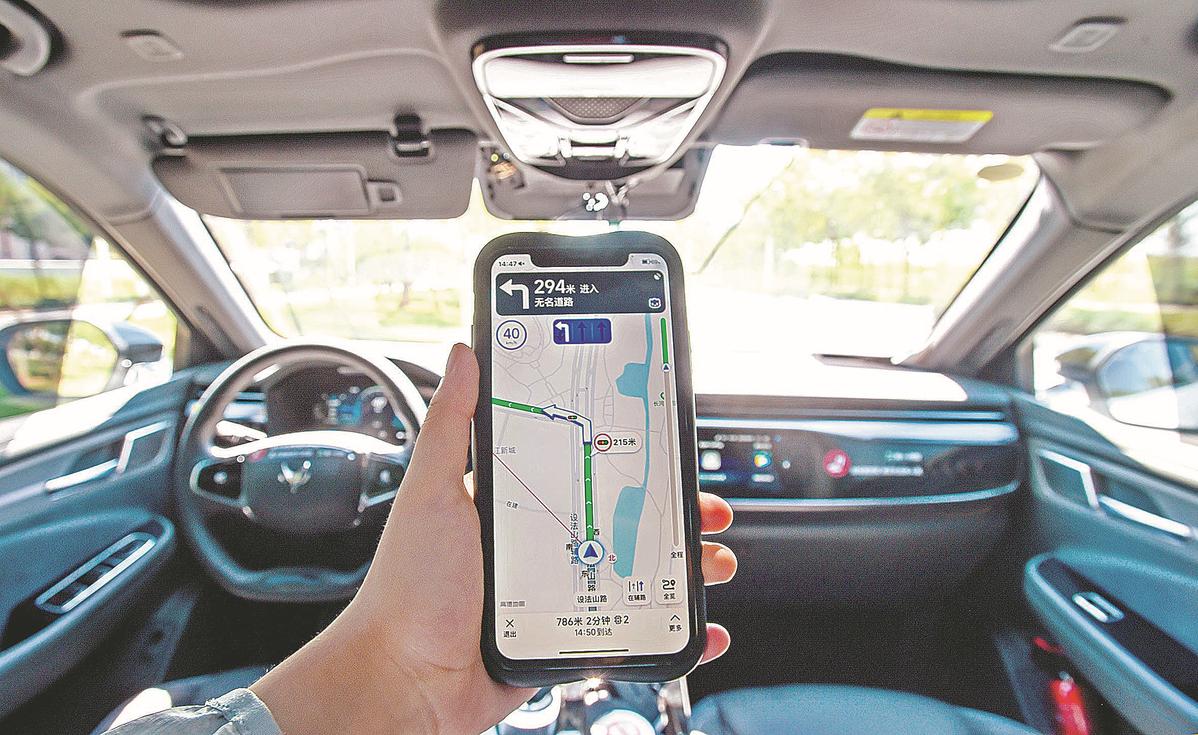
They will also provide up to 30 self-driving vehicles without a safety operator behind the steering wheel for commercial services within an area of 60 square kilometers in Yizhuang, the Beijing suburb. However, a supervisor will sit in the front passenger seat to ensure safety. In April, the two companies received permits to operate driverless taxis on open roads in Beijing.
Yang Diange, a professor from the School of Vehicle and Mobility at Tsinghua University, said: "Level 4 self-driving technology will first be deployed in taxis and trucks and in some designated areas, and large-scale application of such technology in private vehicles might be seen by 2030."
Level 4 autonomy means the car can drive by itself in most conditions without a human backup driver. It is one level below Level 5, which is generally described as full automation, able to drive by itself in all conditions.
Yang noted the commercial operation of self-driving vehicles will promote the iteration and innovation of technologies, and help enterprises explore reasonable business models, thus allowing autonomous driving technologies to create more value.
As autonomous driving technology continues to mature, the sector is poised to witness robust growth in the coming years. The market size of China's self-driving taxi services is expected to surpass 1.3 trillion yuan ($191.4 billion) by 2030, accounting for 60 percent of the country's ride-hailing market by then, said a report by global consultancy IHS Markit.
The revenue of China's ride-hailing sector is projected to rise to 862 billion yuan in 2025 and 2.25 trillion yuan in 2030, with a compound annual growth rate of 28 percent, the report added. It is noteworthy that the robotaxi market will eventually be dominated by two to three major service providers, with the top providers occupying more than 40 percent of total market share.
Self-driving startup Pony.ai is beefing up efforts to push the commercial application of self-driving technologies. The company announced recently it has formed a partnership with ride-hailing platform Caocao in an effort to encourage the use of robotaxi services in Beijing.
Beginning Aug 3, passengers in the capital have been able to hail driverless robotaxis provided by Pony.ai through the Caocao mobile app and its mini-program in a designated area of 60 square kilometers in Yizhuang, with 250 pick-up and drop-off locations. The company has completed over 900,000 self-driving trips.
Pony.ai also has received permits to operate 100 autonomous vehicles as traditional taxis in Guangzhou's Nansha district, charging fares based on local standard taxi pricing for its robotaxi services.
More than 500 sites, including residential areas, commercial buildings, transportation hubs, schools and hospitals, have been covered. The service is available on weekdays from 8:30 am to 10:30 pm, and passengers can pay for rides via Alipay or WeChat Pay.
"The inclusion of autonomous vehicles in the unified and standardized management of taxis proves that both government policy and the public are increasingly accepting robotaxis as a form of everyday transportation," said Lou Tiancheng, co-founder and chief technical officer of Pony.ai. The company also plans to expand its commercialized robotaxi footprint to Shanghai and Shenzhen next year.
The application of self-driving technologies is not limited to robotaxis, but can also be used at mines, airports, highways and distribution parks, said Wang Bo, research manager of market consultancy International Data Corp, adding there have been significant improvements in autonomous driving technologies covering computer chips, lidar sensors, cameras and related computing capacities.
Lidar, short for light detection and ranging, is a sensing method that uses laser light to determine the presence, shape and distance of objects.
Li Xinbo, an automotive industry expert from China Auto Information Technology Co Ltd, said more efforts should be made to strengthen the construction of intelligent transportation infrastructure, such as the 5G-enabled, vehicle-to-everything (V2X) system, which supports the transfer of information from a vehicle to moving parts of the traffic system as a way to improve traffic efficiency.
Continuous testing on public roads, easing regulations as well as cost reductions in autonomous vehicle manufacturing will help accelerate the deployment and commercialization of self-driving cars, said Lyu Jinghong, an intelligent mobility analyst at research firm BloombergNEF.
"China has caught up with the United States, with Wuhan and Chongqing allowing driverless vehicles to carry passengers and charge for such services. More Chinese cities are expected to follow the two cities by gradually allowing for robotaxi tests and commercialization, which will help autonomous driving developers improve their technologies and explore business models," she said.
According to BloombergNEF's 2022 electric vehicle outlook, China will operate the world's largest robotaxi fleet with about 12 million units by 2040, followed by the US, with around 7 million autonomous vehicles.




















