



New skills vital for youth facing 'frictional unemployment'







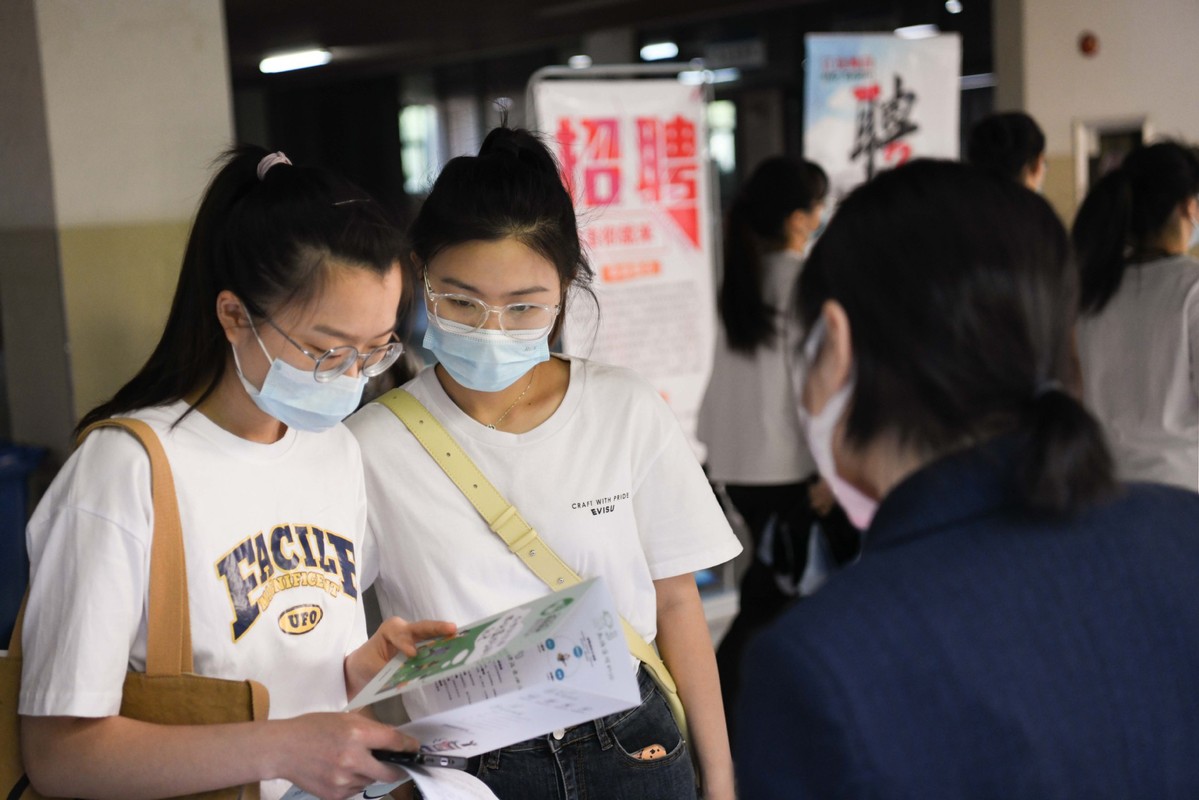
China has to overcome many challenges to stabilize the employment situation in the country, especially because millions of fresh college graduates and other youths enter the job market every year and the sluggish demand of enterprises for workers has raised the unemployment rate.
Young people, especially college graduates, face "frictional unemployment" (the time gap between a person voluntarily leaving a job and finding another). They also face structural and cyclical unemployment risks.
Therefore, the authorities should adopt both long-term and short-term policies to address the youth unemployment problem, and strike a balance between pandemic prevention and control and economic growth.
Official data show youths between 16 and 24 years still face difficulties in getting a job, with the youth unemployment rate reaching 16 percent in March, 18.2 percent in April, 18.4 percent in May, 19.3 percent in June and 19.9 percent in July. And since more than 10.75 million youths graduated from universities this year, a historical high, it has become even harder for them to secure a job.
The high youth unemployment rate indicates China's macroeconomic growth has been below expectation. This can be attributed to the spread of the Omicron variant of the novel coronavirus in the Pearl River and Yangtze River delta regions — two key drivers of the economy — in the first half of this year, which reduced the demand for workforce, thus exerting more pressure on fresh graduates to find a job.
Compared with other groups, a high unemployment rate among college graduates can have a more devastating effect on economic and social development, because they are precious human resources. If they cannot develop their skills or use their creative minds due to persistent unemployment, that will have a negative effect on their social network and career development.
College graduates are facing more complicated problems in seeking employment than other groups because of the impacts of cyclical, frictional and structural unemployment. With regard to frictional unemployment, most fresh graduates enter the job market at the same time every year, making it hard for them to find a suitable job. As for structural unemployment, university education, to a large extent, cannot always meet the demand of a rapidly developing economy and labor market due to a lack of adequate education reform. The lingering COVID-19 pandemic and the turbulent international situation are also responsible for the unstable demand for workers.
In fact, structural and cyclical unemployment could create more imperceptible challenges for young people seeking jobs.
Although skilled and well-educated workers have driven China's rapid development over the past decades, the country's labor market is undergoing a shift in the digital era, which has created a structural contradiction in the job market. And given the economic uncertainties, the gap between employers' requirements and graduates' knowledge and skills has grown because what universities teach the graduates and what employers demand are different. Youths' job preference has changed, too, with many preferring stable jobs or deciding to pursue postgraduate education to avoid entering a depressed job market.
The cyclical effect on youth employment is still being felt because employers proceeded with caution during the pandemic. On the other hand, college graduates' preference for stable jobs or decision to pursue postgraduate or even higher studies reflects their pessimistic outlook on future prospects.
Yet by pursuing a relatively small number of stable jobs or postgraduate education, the young graduates are hampering the efficient allocation of human resources and widening the supply-demand gap between potential recruits and employers. As such, they will face bigger structural unemployment risks and find it more difficult to meet the demand of the labor market in the future.
To address these contradictions, too, the authorities should introduce long-term and short-term policies. The short-term measures should be aimed at curbing the rising youth unemployment rate, preventing graduates from withdrawing from the labor market, and ensuring that short-term and frictional unemployment problems do not become long-term and structural unemployment problems.
Besides, the government and universities should work together to optimize the recruitment service and training system, establish databases to track and monitor graduates' employment situation, and evaluate the labor market to help graduates find a suitable job.
Expeditiously reforming the education system, improving education quality, increasing college enrollment, and strengthening vocational education are some of the long-term measures that can address the structural contradictions.
The author is a professor at the Institute of Population and Labor Economics at the Chinese Academy of Social Sciences. The views don't necessarily reflect those of China Daily.
If you have a specific expertise, or would like to share your thought about our stories, then send us your writings at opinion@chinadaily.com.cn, and comment@chinadaily.com.cn.





