



China still global growth engine







Editor's note: Despite facing multiple challenges both on the international and domestic fronts, the Chinese economy continues to drive global growth. But can China achieve high-quality, sustainable development and common prosperity? Three experts share their views on the issue.
As the major economies in the West completed their industrialization and began to move toward post-industrial services, growth acceleration gave way to deceleration. Yet per capita incomes continued to rise, thanks to reforms and social transfers.
Since the 1980s, China has followed in their footprints. When the reform and opening-up began, China's per capita GDP, adjusted to purchasing power parity (PPP), was just about 2 percent that of the US. By the mid-2020s, it will be one-third of the US level.
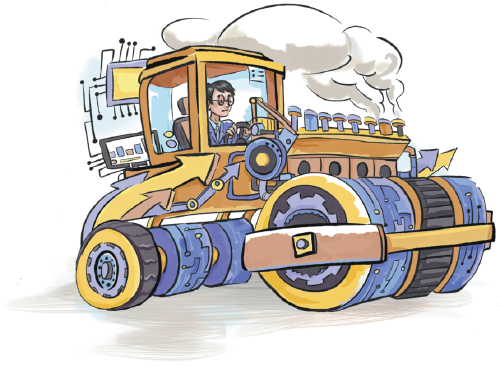
The past decade was critical to the expansion of China's economy and Chinese people's living standards in that it consolidated China's role as a global growth engine.
In 2007, a year before the onset of the global financial crisis, the International Monetary Fund declared China and, to a lesser degree, India and several other large emerging economies to be the new global growth engines.
There are two basic ways to assess a given economy's role as a global growth engine. For international comparison, one method of conversion uses market exchange rates. Another relies on the PPP exchange rate. Each method offers slightly different outcomes, but similar trends.
China's rise as a global growth engine can be illustrated with the expansion of its economy relative to the world's largest economies: the United States, the largest European economies (Germany, France, the United Kingdom and Italy), and Japan.
In the case of market exchange rates, China overtook Japan as a global growth engine around 2010, the four European economies in the mid-2010s and is positioned to surpass the US in the late 2020s. In international comparisons, this depiction is a more realistic measure since international transactions are predicated on market exchange rates.
Developing countries get a much higher weight when PPP exchange rates are used. In the case of global growth engines, this depiction overplays the pace of change. But since PPP rates are relatively stable, they can be useful to illustrate secular trends. As the relative expansion of the shares of the US, the four European economies and Japan in the world economy will continue to decline, that of China will continue to increase.
China's economic growth may decelerate from the 2007 peak of 14.3 percent to 4-5 percent by 2024. But the deceleration of aggregate growth has not meant stagnant incomes.
In the 2000s, China's growth accelerated, while per capita incomes almost doubled. In the 2010s, aggregate growth decelerated, but incomes doubled again. And if things go right, incomes could climb by about a third in the first half of the ongoing decade.
Thanks to rapid development in the 2010s and the eradication of extreme poverty at the end of 2020, China laid the foundation for the world's largest social security system, which has ushered in xiaokang society, a moderately prosperous society in all respects.
These efforts will be further reinforced by China's quest toward "common prosperity" which seeks to alleviate inequality and could thus promote social mobility.
Unlike the US and the four European economies, China has avoided runaway inflation, which now exceeds 9 percent in the US and some European countries despite their aggressive rate hikes, which will further penalize living standards.
In the foreseeable future, stagflation will weigh heavily in the West. In contrast, consumer inflation is about 2.5 percent in China. As a result, the People's Bank of China is not under fire to raise rates, as are the US Federal Reserve and the European Central Bank. And as the West is navigating toward a recession, the PBOC, China's central bank, can ease monetary policy in tandem. Which, in turn, could accelerate economic growth, particularly relative to other major economies.
Today, the international status quo is more dangerous than at any point of time since the end of World War II in 1945. The long list of underlying causes includes the failure of global recovery in 2017, the US' trade wars and efforts to trigger a new Cold War against China, the COVID-19 pandemic-induced depression, and the US-EU proxy war against Russia leading to the Ukraine crisis, and particularly the ill-advised economic sanctions that are fueling energy and food price tsunamis around the world.
China's domestic potential remains significant, however. The 14th Five-Year Plan (2021-25) marks a shift away from quantitative growth to qualitative development. And the new 15-year "2035 vision" seeks to realize the primary modernization goals, while offering a critical half-way path to 2050, when China is projected to become a major great power.
In this dire landscape, China's economy and its quest for peace, despite old and new challenges, remain a point of global hope. In particular, the Belt and Road Initiative could accelerate industrialization in a number of large developing economies that the West first exploited and then ignored-until China's rise.
The views don't necessarily reflect those of China Daily.

If you have a specific expertise, or would like to share your thought about our stories, then send us your writings at opinion@chinadaily.com.cn, and comment@chinadaily.com.cn.





