



Xi's visit bridges two ancient cultures







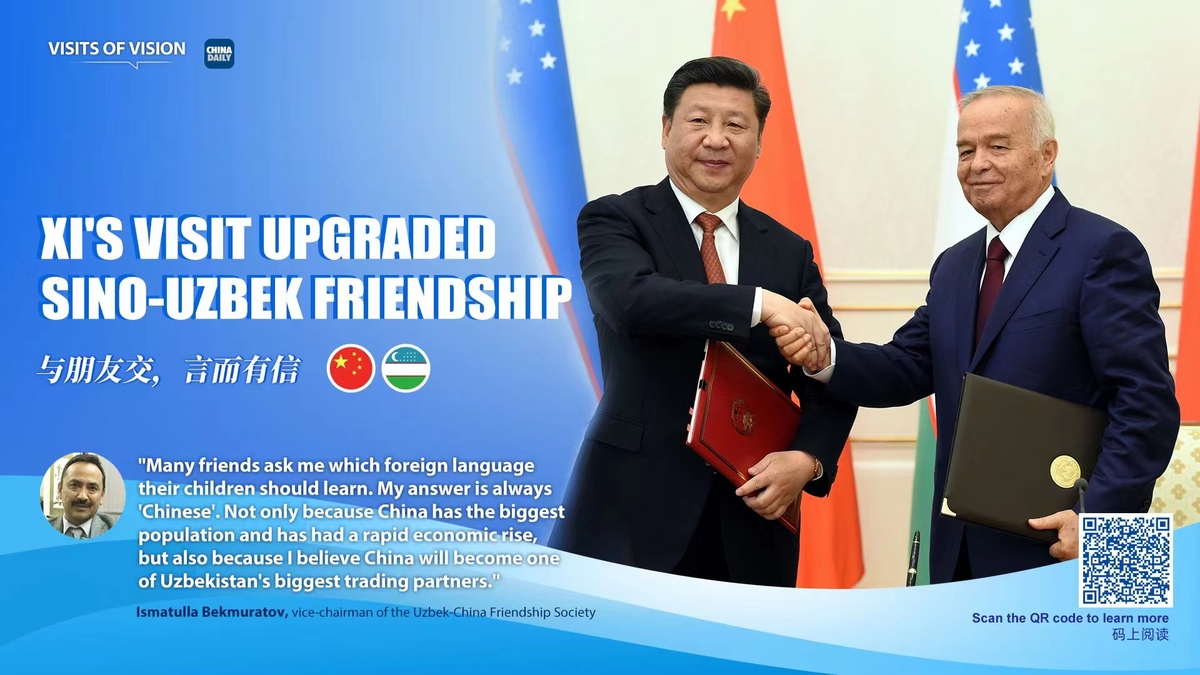
President calls for building 'green, healthy, peaceful' Silk Road in Uzbekistan speech
A Chinese-made tractor plows a 2,000-hectare field as spring stirs in Bukhara, southwestern Uzbekistan, readying the land for a new type of mung bean developed by Chinese researchers.
This is a corner of the Luoyang-Bukhara agricultural comprehensive demonstration zone, which has a planned area of some 100 square kilometers. The zone is one of the joint projects of the cities of Bukhara and Luoyang to be launched since President Xi Jinping proposed the Belt and Road Initiative in 2013.
The initiative refers to the building of the Silk Road Economic Belt and the 21st-Century Maritime Silk Road. It is aimed at fostering a trade and infrastructure network connecting Asia with Europe and Africa along the area's ancient trade routes.
In 2016, Xi visited Bukhara, whose history stretches back 2,500 years. It is one of the oldest cities in Central Asia and a center of trade and culture on the ancient Silk Road. Luoyang is 3,000 years old and was the capital of 13 dynasties. The two cities were linked by the Silk Road.
Addressing the Uzbek Parliament, Xi called for a "green, healthy, and peaceful" Silk Road to be built. He pledged to uphold the principle of wide consultation, joint contribution and shared benefits, and development plans among countries taking part in the BRI.
"On that basis, we will carry out bilateral and regional collaboration and create a new cooperation model underpinned by trade and investment liberalization and facilitation, focusing on connectivity, production capacity collaboration and people-to-people exchanges, and enabled by mutually beneficial financial collaboration," Xi said.
That collaboration between China and Uzbekistan now meets the demands of both sides, said Li Xiangchen, president of Mingyuan Silu, a Chinese company that invested in a plate glass manufacturing and processing factory in the city of Jizzakh, central Uzbekistan.
Sino-Uzbek relations are becoming closer under the framework of the Silk Road Economic Belt after two visits by Xi, and the market in the country has become more attractive than ever, Li said.
The value of trade between China and Uzbekistan was $3.2 billion in the first four months of this year, 45.8 percent higher than in the same period last year, official data showed.
Abdumalik Bektemirov, an Uzbek economist, said more products made in China have been used and accepted in Uzbekistan since the government decided to support the BRI.
"Now the Uzbek manufacturing industry is looking to develop its own made-in-Uzbekistan brand, and we need to learn from our Chinese partners."
Light manufacturing has become a pillar industry and the country has recorded an annual rise of 8 percent in gross domestic product in the past two years, he said. All of this could be realized under fine bilateral relations and frequent visits by the leaders of both nations, Bektemirov said.
China has signed production capacity collaboration deals with 20 countries and jointly set up 46 overseas economic cooperation zones in 17 BRI countries, with accumulated Chinese investment topping $14 billion and creating 60,000 local jobs, Xi said.
Pengsheng Industrial Park in Jizzakh, for instance, is the result of Sino-Uzbek collaboration, and has attracted investment from Chinese companies.
The park, approved in 2013, the year Xi paid his first visit to the country, has been upgraded to a free economic zone by the Uzbek government. It produces goods valued at more than $90 million a year and has created 1,300 jobs.
On Xi's second state visit to Uzbekistan in 2016, he signed a joint statement with then-president Islam Karimov to elevate China-Uzbekistan relations to a "comprehensive strategic partnership".
The upgrade was based on the "unprecedented high standard of China-Uzbekistan high-level interaction, political mutual trust and win-win cooperation" they have experienced since establishing the strategic partnership in 2012, the document said.
Addressing the Parliament in 2016, Xi highlighted the role of Uzbekistan and other Central Asian countries in the construction of the BRI. China was keen to have Uzbekistan and other countries seize the historic opportunity to jointly pursue greater progress of the BRI in both its breadth and depth, Xi said.
The Silk Road has been the venue for peaceful and harmonious interaction between Chinese and Uzbeks for more than 2,000 years.
Xi made a stop at the famous historical and cultural city of Bukhara, which he called a "shining pearl on the ancient Silk Road".
Xi and his wife, Peng Liyuan, accompanied by then-prime minister Shavkat Mirziyoyev, now president of Uzbekistan, were taken on a tour of the UNESCO World Heritage Site in central-southern Uzbekistan.
After asking detailed questions on the history and traditions of Bukhara, Xi said the tour gave him a profound understanding of the deep-rooted historical connections between China and Uzbekistan.
Qodir Djuraev, a member of the Uzbek Parliament, said after Xi's speech that he was impressed by his extensive knowledge of Uzbek culture and his respect for it. In the speech, Xi said Uzbekistan has a rich and proud cultural heritage.
"This land has produced a galaxy of eminent scholars of world renown," Xi said. The "precious jewels of Uzbek culture" continue to exude wisdom and truth now as ever, he said.
During Xi's visit to the country in 2016, he voiced support for advancing projects in priority areas under the BRI, including infrastructure networks, and working together on production, financial innovation and people-to-people exchanges.
In recent years China and Uzbekistan have maintained close cultural and people-to-people exchanges. In 2005, Uzbekistan opened the first Confucius Institute in Central Asia, in Tashkent. A second such institute was established in 2014 in Samarkand, a historic city Xi visited during his first state visit to Uzbekistan.
In June 2004, Lanzhou University, in Gansu province, and the Tashkent State Institute of Oriental Studies signed contracts to build the first Confucius Institute in the Uzbek capital, assisted by the China National Office for Teaching Chinese as a Foreign Language.
The institute, which opened in 2005, had 30 to 50 students in its first year. At the time, few Uzbeks knew anything about China, its language and culture, said Di Xiaoxia, the Chinese director of the Tashkent Confucius Institute.
"In the beginning we had to expend a lot of effort because the Uzbeks had no idea of what we were or what we taught. We had to place a lot of ads and promotions in the community before parents brought their children to the institute," Di said.
Things have changed greatly since Xi's visits. More than 1,200 students, young and old, now attend the institute's Chinese classes every year, said Saodat Nasyrova, the institute's director.
Nasyrova visited China as a 17-year-old student and began teaching the language in 2003. Studying Chinese has become increasingly popular in Central Asia, she said, and two high schools in Tashkent offer classes in the language.
Having studied Chinese for three years, Nozima Komijonova, 14, can speak the language fluently. When she decided to study the language, her mother fully supported her decision, she said.
"Many people say Chinese is difficult to learn, but I don't think so. I started learning Chinese because I'm fascinated by the country's culture. My biggest dream is to visit China someday."
Ismatulla Bekmuratov, vice-chairman of the Uzbekistan-China Friendship Society, said Xi's visits to Uzbekistan have had a positive influence on Sino-Uzbek relations as well as Uzbekistan's domestic development.
"Many friends ask me which foreign language their children should learn," he said. "My answer is always 'Chinese'. Not only because China has the biggest population and has had a rapid economic rise, but also because I believe China will become one of Uzbekistan's biggest trading partners."


- Investigation uncovers mismanagement of donated artifacts
- Gold mine accident kills 7 in East China
- Defense minister greets foreign military envoys at Chinese New Year event
- Judicial efforts lead to decline in China's pollution cases
- SPP steps up food and drug safety oversight
- Visually impaired student's rail journey goes viral












