



Different perspectives







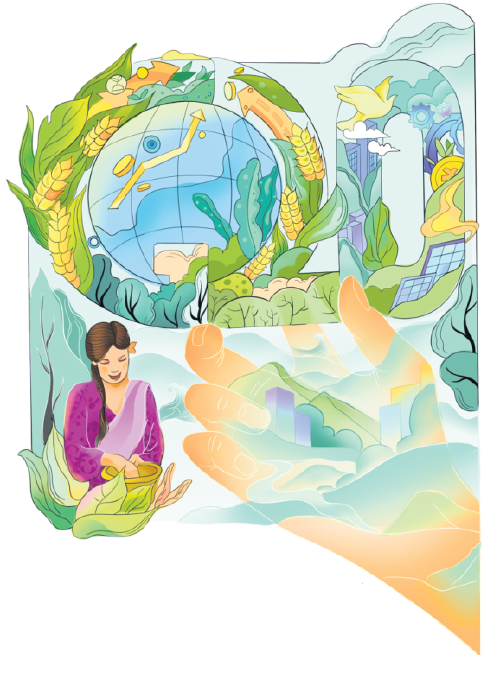
Western countries are not the only actors, other countries can focus their resources and diplomatic priorities on addressing the real global challenges
We are facing a growing number of global crises. War in Ukraine is taking place against the backdrop of wider tensions between the so-called great powers. Climate crisis is worsening, while economic challenges are manifest in energy prices and possible disruptions to food supplies, inflation and growing precarity for many of the world's poorer people. And, of course, the COVID-19 pandemic is still with us, while the possibility of other transnational pandemics remains.
Domestic politics and posturing so often seem to shape the responses to these problems, while in some countries prolonged political theater is diverting attention from the real challenges confronting the societies.
Meanwhile, the dominant lens through which international politics is discussed is one of great power rivalry. This is the trope of the "return of geopolitics", as UK Foreign Secretary Liz Truss put it in a recent speech. This perspective is not the best way of tackling the global challenges of the 2020s.
In Europe, it is clear that the Russia-Ukraine conflict has had a huge impact on how global affairs are perceived, and will shape European thinking about its external environment for years to come.
Meanwhile, despite what is happening in Europe, the United States continues to argue that China is the greatest threat to international order, as US Secretary of State Antony Blinken stated in a recent speech on the US government's China policy. Some in Europe go along with this view, particularly in the United Kingdom, where what the US wants is increasingly cited as a consideration by those seeking to influence UK policy toward China.
These positions get in the way of what is needed to bring the Ukraine conflict to an end. This requires influence to be applied on both sides. The communiques from the G7 and NATO summits showed how difficult it is going to be to find a way forward to bring the fighting to an end.
Their views on China are driven by politics and based on a simplistic analysis of Chinese capability and misreadings of Chinese intentions and the nature of China today. But perhaps more importantly from a global perspective, they represent a fallacious interpretation of the strategic challenges at a global level.
To be fair to the G7, there are plenty of references to climate challenges in its communique. But they are edged out by rhetoric reflecting the return of geopolitics. There is little to support greater real global cooperation on climate actions beyond existing mechanisms. One brief and rather reluctant sentence states that "it is necessary to cooperate with China on shared global challenges, in particular addressing climate change and biodiversity loss and other relevant multilateral issues", but this is hidden in the midst of hectoring criticisms.
Is there a way of getting back on track?
First, the framing of global challenges needs to be different. Competition and conflict are part of our world, so are poverty, underdevelopment, food insecurity, migration, climate and environmental challenges. The solutions to all of these problems are related, but they will require different global approaches to security and development.
The data is striking. Extreme poverty rose from 8.4 percent in 2019 to 9.5 percent in 2020 as the COVID-19 pandemic impoverished around 120 million people globally in 2020. Global undernourishment rose from 8.3 percent to 9.9 percent in 2020, and 23.1 percent in the least developed countries. In 2021, an additional 40 million people (compared to 2020) were in food crises, with the total reaching 193 million.
Resources should be allocated accordingly. Pumping more money into military capability may be appealing to some politicians and their supporters, but it reflects the wrong priorities.
Second, there needs to be a shift in mindset around cooperation. It is not enough to refer to cooperation as necessary on issues where interests align. A real effort to work together requires a different approach, larger groups of key actors (here the G20 is much more appropriate than the G7), and a willingness to respond to others' concerns and make concessions in the wider interest. This can be difficult politically, especially for democracies, but without it, genuine cooperation will falter and global problems will not be addressed adequately.
Emerging powers have an important role to play in this. Indonesia's bold use of the G20 chair to try to address the Russia-Ukraine crisis in a way different from the West is a good example.
Is any of this possible? Politically, it looks very difficult in the West at the moment. But others can set the agenda, build cooperation and partnerships, and focus their resources and their diplomatic priorities proactively to address the full range of global challenges. It is clear that the rest of the world does not want to get caught up in great power competition, but to focus on more immediate challenges at home and abroad. As the distribution of power shifts over time, there is space for this agenda to move toward the center of the stage.
Criticizing misguided policies has its place, but the best way of winning hearts and minds is action, not words. That is what the world needs as we face the global challenges of the 2020s.
The author is an assistant professor at the Centre for China Studies at the Chinese University of Hong Kong and an associate fellow with the Asia-Pacific Programme at Chatham House.
Contact the editor at editor@chinawatch.cn





