First domestic cases of BA.5 registered







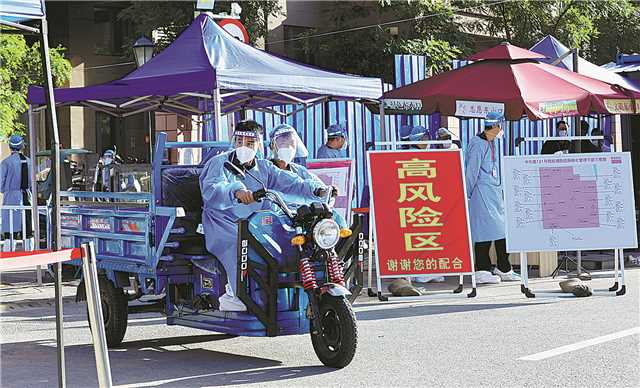
China has reported its first domestic cases of the Omicron subvariant known as BA.5-a highly-transmissible strain feared for its immunity-evading ability-renewing calls for accelerating COVID-19 vaccine booster campaigns.
Xi'an, capital of Northwest China's Shaanxi province, confirmed on Tuesday that the latest outbreak hitting the city was caused by the BA.5 strain. As of Wednesday, the city had reported 33 infections.
Officials in Beijing said on Wednesday that new infections registered in the capital since Tuesday were found to be BA.5, but its transmission chain was clear and controllable.
The first imported case of BA.5 was discovered in an incoming traveler arriving in Shanghai from the Netherlands on April 27. The patient recovered and was released from hospital on May 12, according to an article published by China CDC Weekly, the national public health bulletin and an academic platform established by the Chinese Center for Disease Control and Prevention.
The outbreaks sweeping large parts of China since February, including Shanghai, were mainly caused by the BA.2 Omicron subvariant, according to Wang Wenling, a researcher at China CDC's National Institute for Viral Disease Control and Prevention.
"Recently, the number of BA.4 and BA.5 cases found in inbound travelers has been on the rise," she said during a news conference in late June. "Preliminary research shows that their transmissibility and ability to evade immunity have enhanced, increasing difficulties for China's disease control work."
It was estimated that the R0, or basic reproduction number, of the original strain of COVID-19 was about 3.3, meaning an infected person will transmit it to an average of 3.3 people. The Delta strain has an average R0 of about 5 and the BA.1 strain of Omicron has an R0 of 9.5, according to information released by health authorities in Australia.
Studies led respectively by Chinese and South African scientists found that BA.2 is 1.4 times more transmissible than BA.1, and BA.5 has a spread advantage over BA.2 similar to that of BA.2 over BA.1.
Scientists said the new strain's spread advantage is likely driven by its strong ability to evade immunity.
Compared to dominant strains, BA.4 and BA.5 "are substantially more resistant (to antibodies harbored in vaccinated and boosted individuals) and thus more likely to lead to vaccine breakthrough infections", according to a preprint study published by researchers from Columbia University in the journal Nature.
"The Omicron lineage of SARSCoV-2 continues to evolve, successively yielding subvariants that are not only more transmissible but also more evasive to antibodies," the article concluded.
While BA.5 has only just begun its assault on the mainland, the formidable strain is quickly rising to dominance in some other countries, fueling new case surges in Australia and Europe.
In the United States, BA.5 made up 53.6 percent of COVID-19 cases for the week ending on July 2, up from 40.5 percent from the previous week. The proportion of the previous dominant strain of BA.2.12.1 dropped to second place at around 27 percent, down from nearly 40 percent.
However, whether the new strain can lead to more severe symptoms and result in severe harm to lungs as seen in the original strain remains unclear.
Jin Dongyan, a virologist at the University of Hong Kong, said that even though BA.5 can bypass immunity, getting fully vaccinated and boosted will remain effective at reducing total case numbers and lowering mortality.
China should intensify efforts to administer booster shots, especially for the elderly, he said during an interview with 8am Health Insight, an online news outlet.
As of June 27, the mainland had fully vaccinated 89.4 percent of its population and 83.4 percent of the elderly. Nearly 790 million people had received a booster shot, including 172.5 million seniors.



- 6.6-magnitude quake hits waters off Taiwan: CENC
- China seeks public feedback on draft rules for anthropomorphic AI services
- China's top legislature concludes standing committee session
- China adopts revised Civil Aviation Law
- China launches satellite to aid in early extreme weather detection
- Report on mining accident that killed 6 suggests accountability for 42 individuals