



Ban on Xinjiang goods to boomerang on Washington







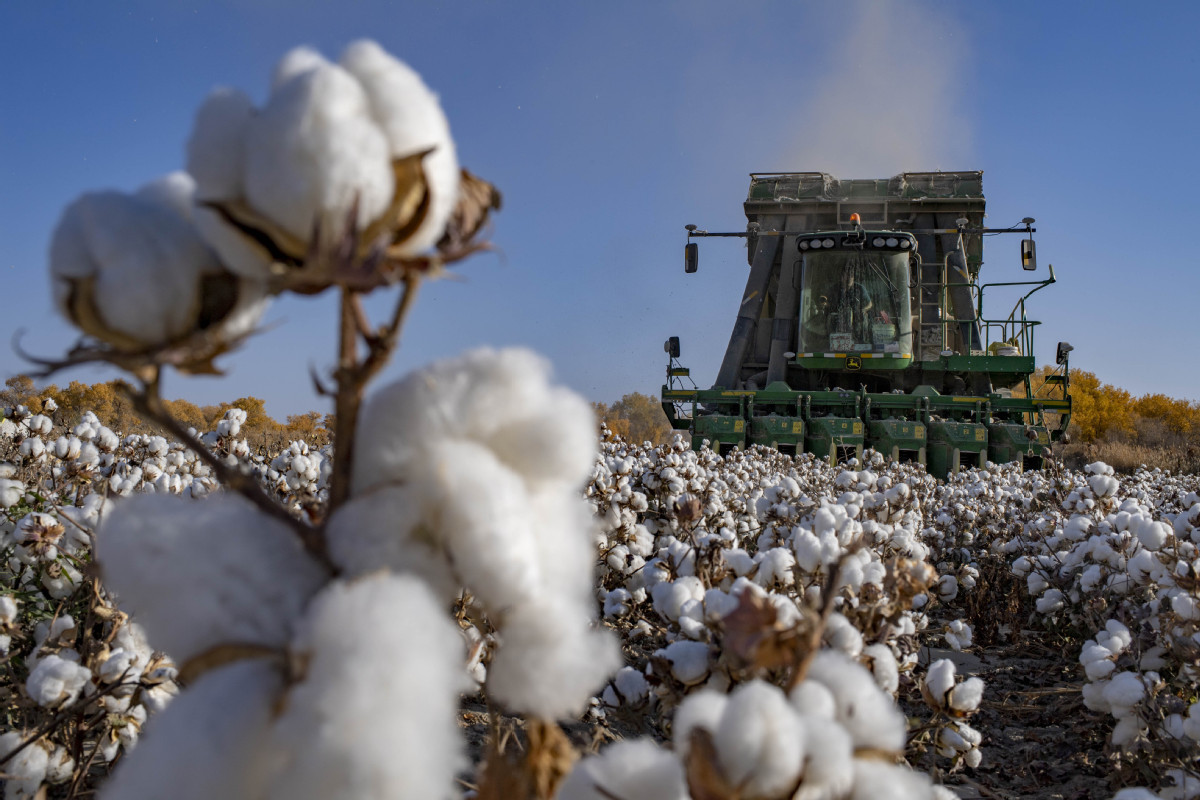
The US ban on import of goods using raw materials from or produced in China's Xinjiang Uygur autonomous region, which came into effect on June 21 and has affected hundreds of thousands of US importers, has been strongly condemned by China.
The spokespersons for China's Foreign and Commerce ministries, while denouncing the ban, said the US' claim that "forced labor" is used in Xinjiang to produce goods is an out-and-out lie fabricated with malicious intentions. They also said China will take strong countermeasures against the ban to protect the interests of Chinese businesses.
As a consequence of the ban, huge volumes of goods have piled up at US Customs and Border Protection depots pending documents from the importers showing irrefutable evidence that no forced labor was used to produce those goods, prompting The New York Times to say that the ban has dealt a strong blow to the US supply chains and the world economy.
Eugene Laney, chairman of the American Association of Exporters and Importers, said he didn't know what evidence will prove the goods were produced without "forced labor". The former chairman of American Association of Footwear and Apparel described the ban as a "category 10 hurricane" hitting the US apparel industry, because Chinese cotton and apparel have a big share of the US market.
According to Evan Smith, CEO of Altana AI, an artificial intelligence-driven company focusing on supply chains, the "Uyghur Forced Labor Prevention Act" will affect about 1 million out of a total of 10 million businesses worldwide.
Some US media outlets have even raised doubts if the law can be effectively enforced, because Xinjiang accounts for 40 percent of the world's polysilicon, 25 percent of tomato paste and 20 percent of cotton output, 9 percent of beryllium reserve, and 13 percent of wind turbine manufacturing capacity.
The "Uyghur Forced Labor Prevention Act" is driven by political motives, not based on facts, reasons or evidence. Yet US Congress members, seemingly well educated, voted in favor of a law based on lies.
In 2015, I visited an apparel factory in the Xinjiang city of Kashgar, where Uygurs comprised more than 80 percent of the total population (half a million). Uygur and Han women were working in the same factories, earning the same wages. I saw large areas with affordable housing for the local people built with assistance from the Shenzhen city authorities.
The fact is, forced labor exists in the US. An article on the website of Denver University said that at least half a million people are victims of a "modern serf system" in the US, and another half a million children are forced to work on farms. Little wonder the US has not ratified the International Labour Organization's "Forced Labour Convention, 1930". Because it does not want to abide by it.
The US ban on Xinjiang goods also violates the United Nations Charter which explicitly prohibits a UN member state from interfering in the internal affairs of another. On June 14, just a week before the US ban came into effect, more than 90 countries supported China at the 50th session of the UN Human Rights Council and upheld the UN Charter's principle of noninterference in the internal affairs of other countries.
The lawmakers who devised the "Uyghur Forced Labor Prevention Act" knew they could not find any forced labor in Xinjiang, so instead of following the tenet of presumption of innocence in law, they resorted to presumption of guilt in the act. Since the act goes against the basic statutory tenet, the United States can no longer be considered a society ruled by law.
The act also violates World Trade Organization rules, which are based on nondiscrimination, and free, fair, open flow of goods and services among member economies. By building serious trade blocks between member economies, the act disrupts the global supply chains.
True, the US ban will create new obstacles for Chinese exports, especially of cotton, tomatoes, wind turbines and polysilicon. But the negative impact on China may be limited, because Xinjiang products are mainly exported to Belt and Road partner economies. Xinjiang's exports to the US was just $700 million, accounting for only 3.5 percent of the total, in 2021, and while its exports to the US fell by 10 percent in the first five months of this year, its global exports shot up by 45 percent. The loss of the US market for China as a whole could be easily covered by other markets.
However, the losses suffered by US importers and the US economy will be significant. That means for the US, the passing of the law is like lifting a rock only to drop it on its feet.
The author is a senior fellow at the Center for China and Globalization.
The views don't necessarily reflect those of China Daily.
If you have a specific expertise, or would like to share your thought about our stories, then send us your writings at opinion@chinadaily.com.cn, and comment@chinadaily.com.cn.





