BRICS working together to reinvigorate globalization







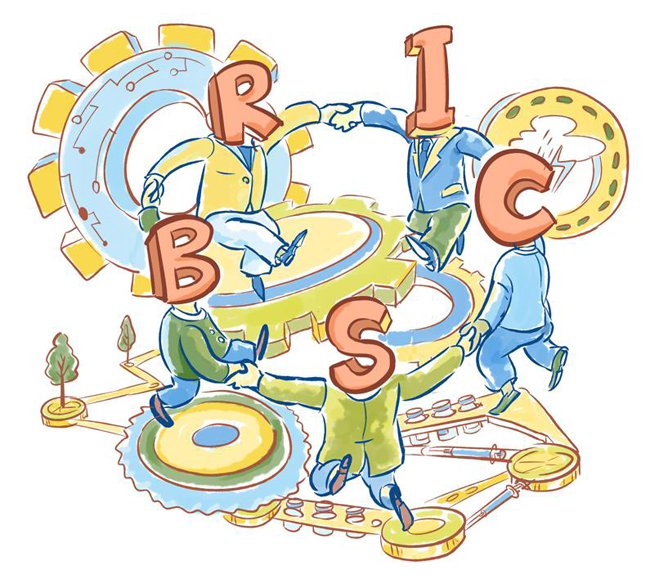
BRICS, which initially grouped Brazil, Russia, India and China and was later joined by South Africa, was conceived 16 years ago with the general idea that it would be a cooperation mechanism that could amplify the voice of developing economies.
In the 14 years since the first summit, the BRICS cooperation mechanism has undoubtedly become one of the world's most visible and effective international multilateral frameworks.
From the perspective of the world economic trade system and the global value chain, the BRICS countries have become fundamental players. They account for more than 40 percent of the world's population and about one-fourth of the global GDP.
Since the inception of BRICS, its member countries have contributed more than 50 percent to world economic growth. The enormous potential of the BRICS countries cannot be ignored.
Against the backdrop of a new period of turbulent global changes, the BRICS nations have taken on the mission of revitalizing the global economy and continuing to lead globalization.
BRICS has established a solid cooperation structure-trade and finance, politics and security, and humanistic exchanges-by taking advantage of the member nations' complementary advantages and tightening the ties of interest.
Economically, the BRICS countries have strengthened their cooperation by virtue of their resource endowments and the diversity and complementarity of their industrial structures.
Politically, they respect each other's core interests and different concerns and seek consensus through communication and dialogue.
Culturally, their distinctive multiculturalism has brought about rich humanistic exchanges, which are demonstrated through seminars, cultural festivals and film and television cooperation. Several nongovernment organization networks have been established, and more than 100 think tanks have been created to envision the future of BRICS.
Today, in the face of the COVID-19 pandemic, the trend of counter-globalization, local conflicts, and the unstable, uncertain and insecure nature of the international situation, BRICS cooperation must play the role of a stabilizer and contribute to addressing global challenges and solving global problems.
During the 14th BRICS Summit last week, President Xi Jinping proposed in his keynote speech to the virtual summit that "we need to uphold the pioneering spirit and innovation and unleash the potential and vitality of cooperation".
BRICS has a challenging agenda ahead, and the answers to overcoming the challenges lie in the "BRICS+" cooperation concept. China, as the BRICS chair in 2022, has proposed "BRICS+" cooperation to accommodate the demands of a wider range of developing countries. In terms of global governance, a broader consensus can be formed so that their voices can be heard and their demands can be seen.
The rising representation of developing countries is itself a very important way to deal with the global governance deficit. The results of these discussions can be understood regarding a number of issues such as the digital economy, green and sustainable development, supply chain cooperation, and support for United Nations and World Trade Organization reform.
Expanding the BRICS association is fundamental to the future of the mechanism and to addressing global economic challenges. Data from China's National Bureau of Statistics has shown that last year, China's bilateral trade with BRICS countries rose against the trend, totaling more than $490 billion, up 39.2 percent year-on-year, doubling that of five years ago and showing great resilience. Economic and trade cooperation has become an important grip to tighten relations and unite the strength of the five countries.
For example, China-Brazil trade in particular has shown strong resilience and dynamism. In 2021, trade between the two nations was about $164.1 billion, an increase of 35.8 percent year-on-year. In the first quarter of 2022, China's total exports to Brazil were valued at about $19 billion, accounting for 23 percent of Brazil's total imports. China's imports from Brazil totaled $19.7 billion, accounting for 29 percent of Brazil's total exports. China has become Brazil's leading trade partner in the last decade and is a top-five foreign direct investment nation.
Development is the golden key to solving all problems, and cooperation that contributes to the development and well-being of all countries is beneficial to all participants. Whether it is helping South Africa build roads and bridges, helping to restructure water resources in the desert areas of India, or assisting Russia in building long-distance transportation corridors, BRICS has brought visible and tangible development benefits.
The BRICS members should continue to promote the formation of a virtuous economic and social cycle in which the developing world plays a greater role in finding solutions to global challenges.
It is believed that BRICS and "BRICS+" will bring the betterment of the global order if these countries take collective actions to reform and strengthen global governance into a more equitable system, fight for the implementation of the UN's 2030 Agenda for Sustainable Development, work in solidarity to combat COVID-19, promote global economic recovery, and safeguard peace and security.
The author is former minister of tourism of Brazil and a professor of public policy at the School of Public Policy and Management at Tsinghua University.