Biden's old infrastructure plan in new G7 bottle








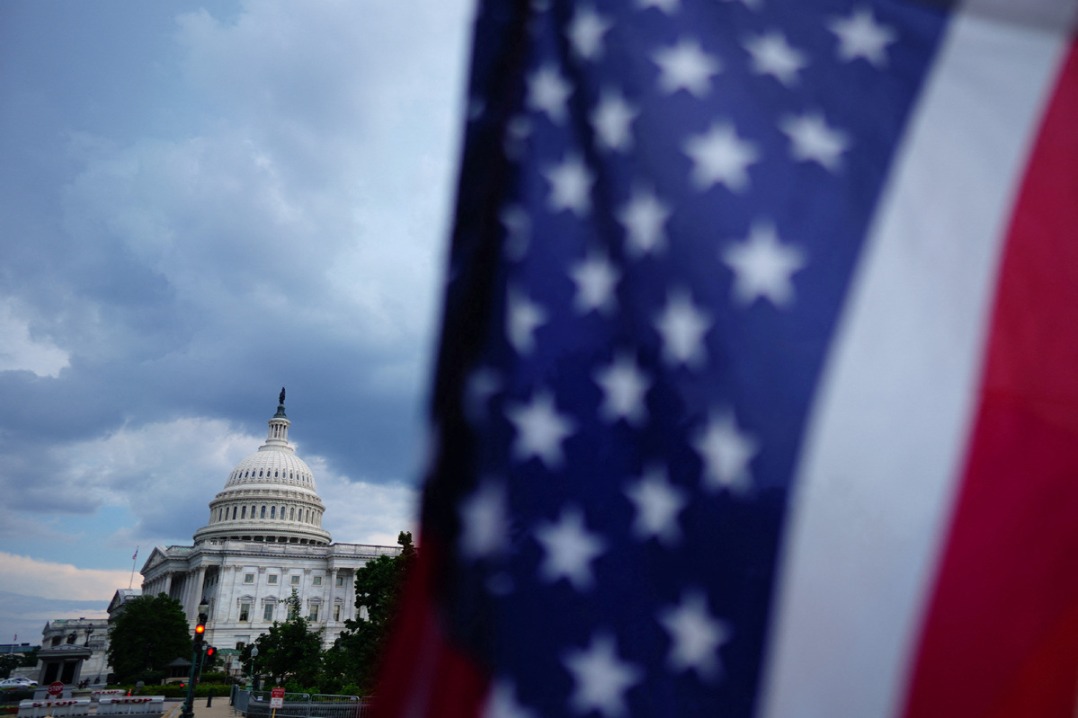
At last year's G7 Summit in Britain, US President Joe Biden announced an ambitious infrastructure plan, Build Back Better World (B3W), but it faltered from lack of money and support. It really got nowhere perhaps other than dripping off the lips of some State Department diplomats a couple of times in Washington parties. But at this year's recently concluded G7 Summit in Germany, with the US allies much more unified thanks to Russia's actions in Ukraine, Biden twisted the arms of the bloc's leaders to rehash the B3W into a seemingly more substantive plan, the Partnership for Global Infrastructure and Investment (PGII).
The plan calls on G7 leaders to raise $600 billion over five years to fund the launch of infrastructure projects in developing countries. Washington has promised to raise $200 billion of this through grants, federal funds and private investment, while the EU has announced 300 billion euros ($315 billion).
The promised $600 billion from the world's rich economies and the entire EU bloc is a big chunk of money. But it still pales in comparison to what the Belt and Road Initiative (BRI) has achieved in terms of extending a helping hand to the developing world. Since the BRI was announced in 2013, according to AidData, the research lab at the College of William and Mary in Virginia, banks in China loaned $843 billion for over 13,000 projects in 165 developing countries. On the other hand, we don't know yet how much of the $600 billion is really going to happen.
The press release from the G7 Summit has to be read very carefully. The US has promised raising $200 billion including private investment. So it is not really a concrete commitment by the US government. In fact, the original B3W scheme used the phrase "mobilizing private investment." How much private capital will heed the call will be anyone's guess, given that the private sector's response to Washington's own domestic public infrastructure investment is lukewarm, to say the least.
The G7 Summit framed the PGII as a policy response to counter the BRI. Biden even put on an ideological stamp on it, saying, "The scheme would allow countries to see for themselves the concrete benefits of partnering with democracies."
But it doesn't have to be countering the BRI, as the market is large enough for both. Both PGII and BRI infrastructure projects can be complementary and not competing against each other because the developing world has a huge need for infrastructure. As a matter of fact, the Chinese foreign ministry's response is that "China always welcomes initiatives that promote global infrastructure."
The real reason the G7 Summit framed it as a policy response to counter the BRI is because it views the latter via a geopolitical prism. It sees it as a means by China to expand its sphere of influence, whereas in reality, it is really about seeking commercial interests. Just like the potential projects in the PGII, the infrastructure projects in the BRI are also no philanthropy but two-way streets to yield benefits for both sides. Therefore, the G7's geopolitical and geostrategic mindset on infrastructure investment in the developing world is unwarranted, and thus wrong.
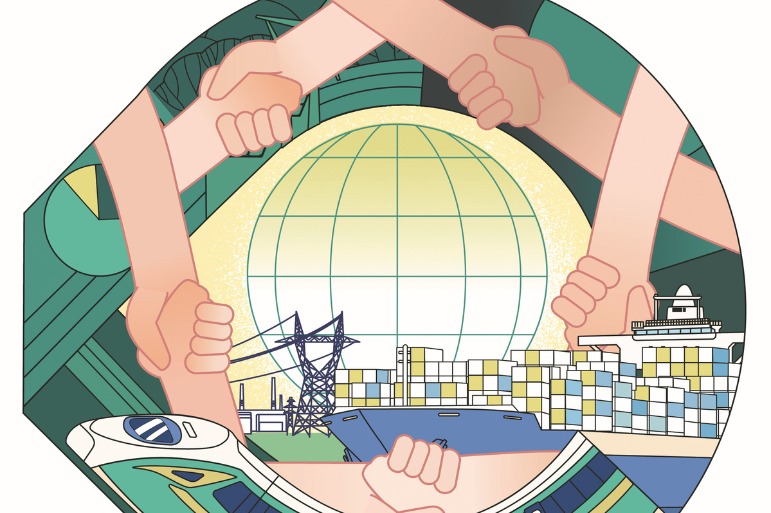
In the past, some of the West's investments and assistance to the developing world were in the form of "capacity-building" types of soft infrastructure build-outs, which actually lined the pockets of the very expensive "experts" sent from London and Washington. This was not much of a benefit to the host countries. What the developing world really needs are bridges, railways, ports, electricity, plants and telecommunications networks, those real things. Hopefully, the $600 billion announced so far will really be spent on these things.
John Gong is a professor at the University of International Business and Economics (UIBE) and a research fellow at the Academy of China Open Economy Studies at UIBE.