



Nation's coal king speeds up its green transition







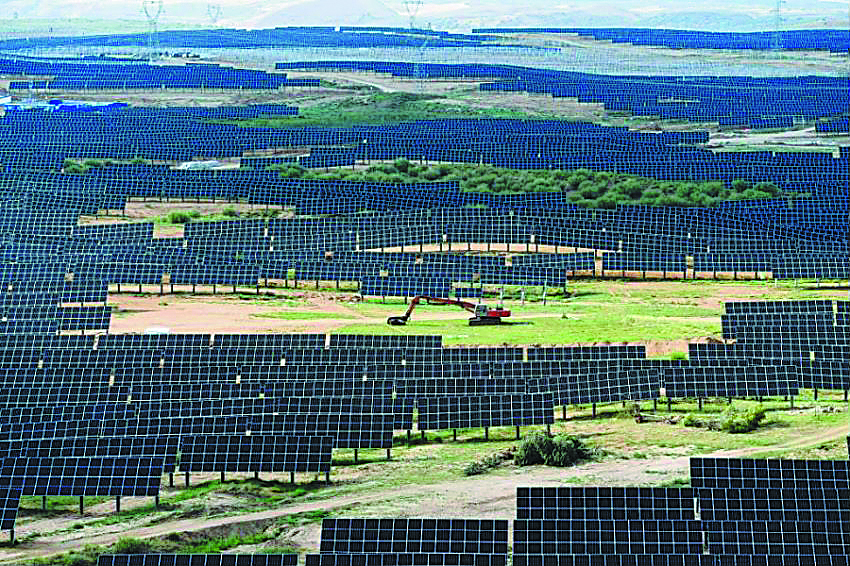
The Inner Mongolia autonomous region is ramping up efforts to invest in new energy as China goes full throttle on its green energy transition, with the aim of becoming carbon neutral by 2060.
As the country's largest coal producer, the region has been adjusting its energy structure while keeping the coal flowing in recent years. In Ordos, for example, the Bortoi coal mine, which has produced 175 million metric tons of coal, is currently covered with 1.12 million photovoltaic panels that can generate up to 900 million kilowatt-hours of clean energy each year.
Encouraged by preferential government policies, three companies came to Bortoi in September 2020 and have been developing the solar power project since.
From major coal production hub to mega new energy producer, Bortoi is only one part of Inner Mongolia's green transition efforts.
Construction of a massive 1 million kW solar power production base in Ordos was completed last year. It is capable of generating up to 2 billion kWh hours of energy each year-the equivalent generated by 680,000 tons of coal-and will support a future power grid, according to Gao Jian, head of the new energy industry development office of the development and reform commission of Dalad Banner in Ordos.
Inner Mongolia also finished developing a series of wind power projects last year, including one in Xilin Gol League with a capacity of 7 million kW and one in Ulanqab with 6 million kW.
The region's installed capacity of grid-connected new energy increased by 3.71 million kWh last year, taking installed capacity to 54.46 million kWh, or 35.2 percent of Inner Mongolia's total energy output.
Power generated through new energy sources last year rose to 119.1 billion kWh, a 28.8 percent increase year-on-year, and the region's installed and generating capacity has led the country for years.
Inner Mongolia's efforts are in line with the government's push to accelerate solar and wind power development during the 14th Five-Year Plan (2021-25) period.
According to a statement jointly released by the National Development and Reform Commission and the National Energy Administration on May 30, the government will increase the total installed capacity of wind and solar power to 1.2 billion kW by 2030. It will also cover as much as 50 percent of buildings with rooftop solar panels as part of a broader clean-energy generation and storage push.
China will also speed up the construction of solar and wind power generation facilities in the Gobi Desert and other arid regions amid efforts to boost renewable power consumption, taking advantage of plentiful solar and wind resources there, the statement said.
According to the National Energy Administration, China added a record 54.9 gigawatts of solar farms last year, 14 percent more than in 2020.
The country has also been stepping up financial support for the development of wind and solar power generation, including promoting green financial products and services, and strengthening support for green bonds and green loans for new energy projects. It will conduct further research into the inclusion of new energy projects in real estate investment trusts.
According to Wei Hanyang, a power market analyst at BloombergNEF, Inner Mongolia has managed to upgrade its energy industry to a new energy-based structure in response to a national effort to reduce energy intensity.
"In the past, local GDP growth relied on heavy energy consumption and coal-related pollution," he said. "However, Inner Mongolia successfully installed 5.5 percent more wind power and 14.2 percent more solar power facilities last year, and more will be installed this year."
According to Wei, a major advantage for Inner Mongolia is that it has two separate power grids that fit into different paths of decarbonization.
As the major national energy base, Inner Mongolia has set the goal of new energy surpassing thermal power generation by 2030.
In terms of new energy, Inner Mongolia's installed generating capacity should already exceed that of thermal power by 2025, according to Chen Zheng, deputy director of the region's energy administration, adding that this year alone, 262 new energy projects each with an investment of over 100 million yuan ($15.77 million) will break ground.
The region will also take measures to promote the development of an industrial chain for the manufacture of wind power, photovoltaic and other new-energy equipment, he said.
The development of energy storage has also been stepped up.
According to data released by the administration, coal output in Inner Mongolia last year exceeded 1 billion tons. In terms of power transmission, 246.7 billion kWh of electricity was exported from the region, making it first in China for the 17th consecutive year. Clean energy has been sent nationwide, facilitating the government's ambition of achieving peak carbon emissions by 2030 and carbon neutrality by 2060.
Inner Mongolia is looking to replace more of its fossil fuel with clean energy this year, with plans to add an additional 20 million kW of new energy to power grids this year.
According to Chen Zheng, the region will speed up the construction of major energy projects, which will account for 40 percent of the region's total fixed-asset investment.
It will also promote the development of a new energy equipment industrial chain to manufacture fixtures for wind, solar and hydrogen power and energy storage, he said.


- Cherry blossom festival in Yongfu town celebrates agricultural innovation and cultural exchange
- China's first domestically built cruise ship welcomes its 1 millionth guest
- The Devil Still Dances: High Vigilance against Japanese Militarism's Infiltration in Sports and Culture Fields
- 189 historical artifacts of Japanese invasion donated to museum in NE China
- Death toll rises to 8 in North China factory explosion
- Over 140m train tickets sold for Spring Festival travel rush












