



Shenzhen at the vanguard of low-carbon development







Metropolis ramps up efforts for green transition, more sustainable future
Editor's note: China aims to peak its carbon dioxide emissions by 2030 and achieve carbon neutrality by 2060, major goals in a national green transition drive. This series looks at efforts in various sectors to meet the goals.
Xiao Tianfa had lived for almost 40 years in the historical Xinqiao residential area, among a group of walled houses of the Hakka people in Shenzhen's northeastern Longgang district, Guangdong province. The 84-year-old was born, grew up, and spent half of his life there.
Although he moved to a nearby location in the late 1970s, he still came to visit his old house from time to time.
Referring to the Hakka village where his previous home is located, he said, "I have witnessed its remarkable change from a rundown area to a modern example of low-carbon development.
"In the past, houses in the village were filled with waste. Roof tiles could fall off anytime. The environment was quite poor at the time," he recalled.
But now, it has become the first "near-zero carbon" community in Shenzhen and a pilot demonstration area for the city's low-carbon development, featuring more than 140 types of "green" technology.
The village, which covers 36,000 square meters and has about 400 residents, currently produces 680 metric tons of carbon each year, of which 600 tons are offset by using green technology, said Zhang Yalong, executive dean of the Shenzhen Institute of Sustainable Development.
Reduction of the remaining 80 tons of carbon is left to local residents in an initiative to promote green lifestyles, he said. "They each have a carbon personal account and are encouraged to cut their carbon footprint by changing living habits, modes of transportation and other things."
The transformation of Xinqiao reflects how Shenzhen is pressing ahead with the green transition to contribute to fulfilling China's national goal of peaking carbon dioxide emissions by 2030 and achieving carbon neutrality by 2060.
The metropolis in South China is one of the country's first low-carbon pilot cities.
According to government data, Shenzhen's carbon dioxide emissions per unit of GDP dropped by about 70 percent in 2020, compared with the level in 2005. Energy consumption per unit of GDP stood at one-third of the nation's average in 2020, while carbon dioxide emissions per unit of GDP were one-fifth of the nation's 2020 average.
In late 2021, Shenzhen launched its 14th Five-Year Plan (2021-25) on ecological environmental protection, which mapped out the blueprint for the city's green development in the coming years. According to the plan, the eco-environmental quality of Shenzhen will reach an internationally advanced level by 2025. The city will formulate a low-consumption, low-emission, circular and sustainable mode of development and strive to take the lead in achieving the nation's dual carbon goals.
Ecological accounting
In the longer term, the southern metropolis will build itself into a vanguard of sustainable development and a role model for "harmonious coexistence of humans and nature" by 2035. Eco-environmental quality will reach a world-class level by that time, according to the plan.
As part of its green development efforts, the city has established a new ecological accounting system that focuses on contributions made by resources, the environment and ecology to the local economy. The gross ecosystem product, or GEP, system was launched in March last year and is the first complete system of its kind in the country.
According to the International Union for Conservation of Nature, GEP is "the total value of final ecosystem goods and services supplied to people's well-being in a region annually, and can be measured in terms of biophysical value and monetary value. Ecosystems that can be measured include natural ecosystems such as forests, grasslands, wetlands, deserts, lakes, rivers and oceans, and artificial systems that are based on natural processes like farmlands, pastures, aquaculture farms and urban green lands."
Shenzhen generated 130.4 billion yuan ($19.5 billion) in GEP in 2020, according to municipal government statistics.
The implementation of GEP accounting carries important meaning for achieving the carbon peak and carbon neutrality goals, as it provides a data basis for it by monitoring and evaluating the ecosystem's carbon sink, the Shenzhen Municipal Ecology and Environment Bureau said in a written reply to China Daily. A carbon sink is a forest, ocean or other natural environment that absorbs carbon dioxide from the atmosphere.
The accounting system also helps the government formulate ecosystem management measures in a scientific way, providing technical support for fulfilling the goals, the bureau said.
In addition, the bureau said it is exploring the possibility of applying the GEP system in city management.
"Based on GEP accounting, we are able to figure out those high-value areas and low-value areas in the city. Then we can strengthen ecological protection of those high-value areas to enhance ecological quality there," it said.
"The system could also provide a reference for site selection in urban development and construction. Prioritizing the development of low-value areas could reduce the negative impact of the activities on the environment," the bureau added.
Carbon trading has also played a significant role in Shenzhen's green drive. The city began carbon trading operations, the first in the country, at the China Emissions Exchange in June 2013.
Thirty-two sectors, including industrial manufacturing, electricity, water, gas, public buses, subways, ports and hazardous waste disposal have been covered in the carbon trading market, with the total number of enterprises reaching 750 by the end of last year.
Since the launch of the market, carbon dioxide emissions among manufacturing enterprises were reduced by 40.29 percent on average as of the end of 2020, while industrial added value to GDP had increased 61.64 percent.
The city's carbon trading market accounted for 13 percent of the nation's total in terms of both transaction volume and value by the end of 2020.
Shenzhen has unique features in developing the carbon trading market, said Jiang Can, assistant general manager of China Emissions Exchange.
"Compared with other pilot cities, Shenzhen's status as a special economic zone means that it has the power of legislation. The launch of several regulations and rules in the city has laid a solid legal foundation for the development of the market," she said.
"It has also played a demonstration role in the country's carbon market development in a number of aspects, such as institutional design and carbon-related financial products."
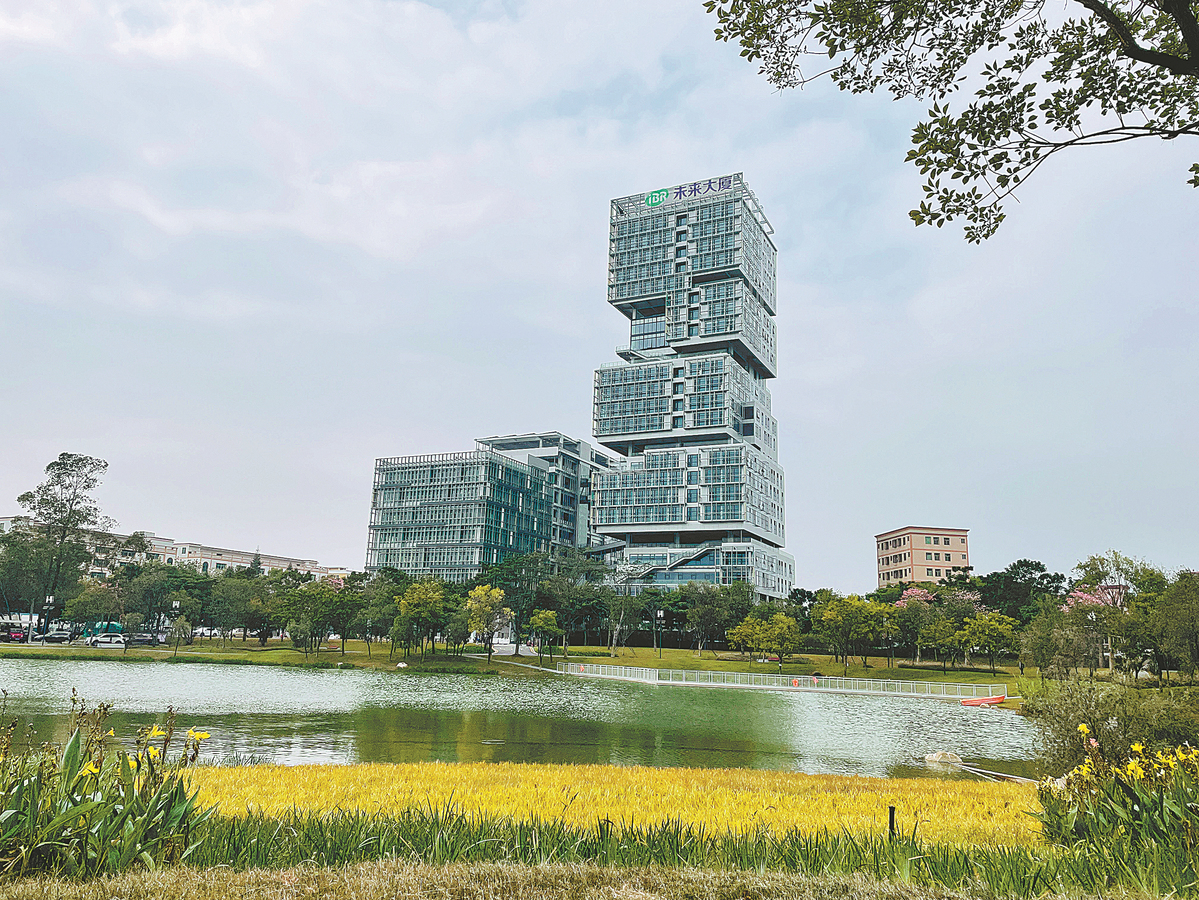
Shenzhen International Low-Carbon City, a key development zone in Shenzhen that features green development, is directly across from a small river that runs past the Xinqiao historic residential area.
Since the project was launched in 2012, the 53-square-kilometer zone has been striving to develop itself into a hub for the low-carbon industry and has achieved great progress.
A number of architecture projects in the zone have been built using the highest level of green building standards. The city's first line for hydrogen-fueled buses was launched there, and hundreds of high-tech enterprises have set up business in the zone.




















