


Traditions transcend centuries to reflect people's patriotism








Dragon Boat Festival is more than 2,000 years old, originating in the Spring and Autumn Period (770-476 BC).
Different from other traditional festivals, it is an occasion with a strong social influence.
Since ancient times, the customs associated with the festival have had a human touch. The interpretation of a particular custom in each region is often linked to commemorations of local sages, such as the patriotic poet Qu Yuan.
Despite having many origins and legends surrounding it, the festival is today acknowledged and celebrated by most Chinese in memory of Qu, who lived in the latter part of the Warring States Period (475-221 BC).
The festival carries historical memories and spiritual connotations that transcend time to reflect Chinese people's unwavering patriotism.
According to Shiji (Records of the Grand Historian), a vast history of the Chinese world from its beginnings to the late second century BC written by Grand Historiographer Sima Qian, Qu was a minister in the court of King Huai in the Chu state during the Warring States Period.
Qu advocated empowering talent, enriching the country, strengthening the army, and making alliances with states such as the Wei and Qi to fight against the Qin state. However, he was strongly opposed by the nobleman Zilan and others.
During his time in exile, Qu wrote long poems such as Li Sao (On Encountering Sorrow), Tian Wen (Questions to Heaven) and Nine Songs to express his concern for the country and its people.
In 278 BC, the Qin Army conquered the Chu capital. Seeing that his homeland had been invaded, Qu was heartbroken. He could not bear to abandon his home, and committed suicide by drowning in the Miluo River.
Legend has it that after Qu's death, the Chu people were deeply saddened and flocked to the river to pay their respects.
Fishermen took to their boats, scouring the waterway to salvage Qu's body. One fisherman took out some rice balls, eggs and other food prepared for Qu, making a loud sound as he threw the food into the river, in the belief that if the fish, lobsters and crabs were full, they would not eat Qu's body.
When people saw this, they followed suit. One elderly physician brought a jar of realgar wine and poured it into the river to stun the dragons in the water so that they would not harm Qu's body.
Later, fearing that the rice balls would be eaten by dragons, people came up with the idea of wrapping rice in reed leaves and tying the leaves with colored silk thread. Thus, zongzi came into being.
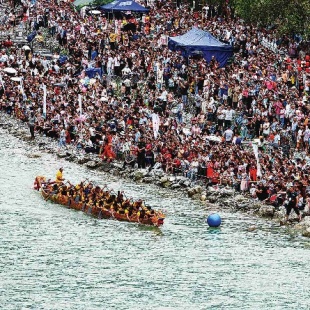
Dragon boat racing mainly takes place in southern China.
On May 23, 2011, the activity was approved by the State Council for inclusion in the third batch of national intangible cultural heritage.
Dragon boat racing has developed into a water sport, with competitions held nationwide on the fifth day of the fifth lunar month.
In 2010, the activity became an official event for the first time at the Asian Games, which were held in Guangzhou, Guangdong province.
In the past two years, a belief has arisen that due to Qu's death, Dragon Boat Festival should not be celebrated as a happy occasion. Instead of saying "Happy Dragon Boat Festival", people should say, "Stay safe and sound at Dragon Boat Festival", according to the belief.
However, Tian Zhaoyuan, a professor at East China Normal University's Folklore Institute, said it is irresponsible to say that people should not express their happiness during the festival.
The event, a Chinese carnival, has been a happy occasion over the years, Tian said. Before the pandemic emerged, people formed teams to compete on the water, and spectators gathered on the shore to watch and drink.
As for commemorating Qu, Tian said the festival should not be used as a day of mourning and sorrow.
Qu was a romantic poet, and his works are full of beautiful things. The stories and legends about him are also part of the romantic Chu culture, Tian said.
"Everyone can say, 'Happy Dragon Boat Festival'," Tian added.