


Let's hope kids dig dinosaur magic again








China is a historian's field of dreams because it is truly a massively fertile platform for field research. Many of us know it is the oldest continuously existing civilization, having gotten things rolling somewhere along the Yellow River about five millennia ago. But for another branch of the broad discipline of history-ie paleontologists-the pickings are even more plentiful.
Paleontology is the study of fossilized plants and animals. It's the latter we're concerned with here given the copious truckloads of fossilized dinosaur bones that have been dug up in the country over only the space of a few years.
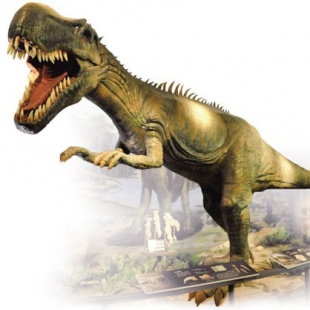
The West got digging early, even back in the 18th century when the father of evolutionary theory Charles Darwin was a mere twinkle in his parents' eyes. But perhaps because of pent-up supply and sudden demand, over the past three decades, dinosaur hunters have been finding more and more evidence that tens of millions of years ago, a countless variety of "terrible dragons "as the Chinese word for dinosaurs-konglong-literally means, roamed the plains of what is now China.
Simply put, there wasn't much interest or knowledge of the wealth of long-extinct life-forms lurking under China's fertile riverbeds and sand-swept deserts until paleontologists began scouring terra firma in earnest.
It's somewhat analogous to the accidental discovery of major gold pockets at Sutter's Mill in California in 1848.Why didn't earlier settlers, traders, missionaries or indigenous peoples scoop up the yellow metal for themselves before the waves of miner forty-niners flooded to the Pacific Coast of North America? Because they didn't know they were treading over a king's ransom.
The same can be said of China's fossilized fortunes (at least to a scientist) previously obstinately obscured under its turf. But when the first "terrible dragons" began to be painstakingly pulled from the crust and made their way into museums, a different sluice gate was opened and paleontologists began flocking to hot spots.
It turns out China has three mega-site dinosaur bone clusters of its own, a trio of "scientific Sutters" if you will.
They are the western Liaoning fossil sites (Jehol biota) in Liaoning province and its neighboring Hebei province and the Inner Mongolia autonomous region; Weng'an fossil sites (Weng'an biota) in Guizhou province; and the Chengjiang fossil sites (Chengjiang biota) in Yunnan province.
Oddly enough, one of the most high-profile successful digs "of late" (remember, the dinosaurs are generally believed to have been wiped out by an asteroid strike off Mexico 65 million years ago, so the 2012 big dig is "of late", relatively speaking) took place a decade ago in Piqan county, Xinjiang Uygur autonomous region.
At the time, Xinjiangtitan shanshanesis, one of the longest sauropods thought to have ever existed, was pulled from the Earth.
The giant herbivore probably measured around 32 meters in length, and in the year after being unearthed, it was initially described and named by Wu Wenhao, Zhou Changfu, Dong Zhiming and two other specialists.
It is called after both the region in China where its bones were discovered, and another name for the county, Shanshan, which is from the eponymous ancient Shanshan Kingdom.
Only one specimen of the species has been unearthed so far, which gives greater significance to the dig site.
But readers in Beijing like me needn't trek halfway across the country to get a taste of the remains of the terrible lizards. The capital is home to two highly-regarded repositories of exhumed dinosaurs, and you don't even have to get your hands dirty to enjoy them.
They are the Beijing Museum of Natural History, and the Paleozoological Museum of China.
With more class field trips to this safe and sanitary fieldwork venue, perhaps more youth in China will take a growing interest in the wealth of ancient zoological history beneath their feet, and truly start to "dig" fossils, in more ways than one.