Lessons from history







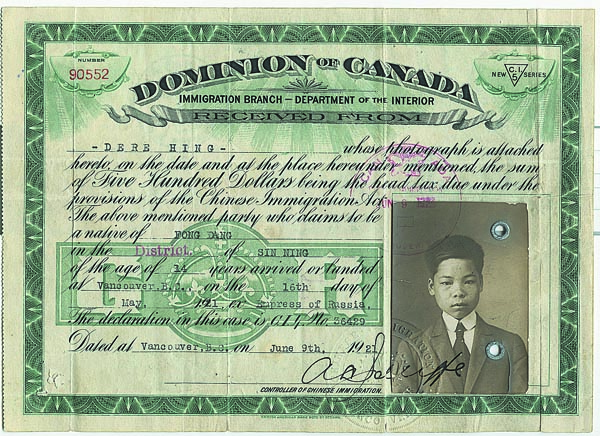
Chinatown historian Arlene Chan says the prejudice and discrimination of the exclusion act were echoed by politicians, the public and press. As a result, the Chinese community suffered low social standing.
"But the most devastating consequence of the act was its impact on family life," Chan says.
After the NCCC was established in 1992, the congress has paid tribute to the railway workers at a monument on every Canada Day since 1993.
"The successful completion of the railway helped to consolidate the newly formed Canada confederation. However, the workers were forgotten, and their contributions to the building of Canada were never properly acknowledged. Therefore, it is significant to pay tribute to them during Canada Day celebrations," Ping Tan, a lawyer who was the founding executive chair of the NCCC, tells China Daily.
Dere also dedicated himself to the head tax redress campaign. In 1993, he made a documentary-Moving the Mountain-to draw awareness to the tax's racist legacy and the campaign to redress it.
Chinese aren't the only victims of systemic racism in Canada's history, says Helen Li, chair of the China Solidarity Committee, an organization to encourage mutual understanding between Canada and China.
Other ethnic groups have been singled out for terrible treatment, harassment and persecution, including the internment of Japanese Canadians during World War II and especially the horrific history of residential schools and the indigenous people still languishing on Indian reserves today.
For almost 150 years in Canada-from 1863 to as recently as 1998-about 150,000 children from the indigenous community were forced to attend the residential schools, which forcibly separated indigenous children from their families. At least 4,000 children died due to abuse, malnutrition, disease and neglect.
As remains of more than 1,000 indigenous children have been found at former residential schools across Canada, the tragedy has made people connect their suffering with that of the Chinese railway workers.
When hundreds of Chinese working on the railway died from accidents, winter cold, illness and malnutrition, many of their bodies were just pushed off the side of a mountain, and their remains or bones lay in the bottom of rivers, not found until many years later, according to Barbara Hall, the 61st mayor of Toronto, a former chief commissioner of the Ontario Human Rights Commission.
"So, I think there's always some new injustice that comes to light as the real history of this country is discovered and many of us become educated," Hall said at a memorial event for Chinese railroad workers on the last Canada Day.
Wendy Fletcher, a professor of religious studies and social work at University of Waterloo, who has worked with both the indigenous and Chinese communities, finds that the two groups have a shared history in building the railway.
According to Fletcher, when Chinese were severely discriminated against, it was First Nations people who treated them as equals, offering warmth and comfort. As the railway moved across the west, Chinese workers were refused burial in Christian cemeteries, many indigenous chiefs buried them in their traditional indigenous burial grounds.
"The Chinese community also stood with First Nations for their historical trauma. They have the same mission when it comes to anti-racism in Canada," Fletcher tells China Daily.
"Both groups have been the victims of Canada's shocking racist policies and practices. An intentional and continued partnership and friendship between Chinese and indigenous communities has the capacity to make real change and move forward an anti-racism agenda in strong ways for Canada," Fletcher adds.
In June 2021, the Angus Reid Institute released a survey of Chinese Canadians, which found that 58 percent of respondents said they had experienced discrimination within the past year, while 28 percent said discrimination occurred "always" or "often".
An online attack against Canada's Hong Kong-born chief public health officer Theresa Tam is the latest example of growing anti-Asian sentiment and violence resulting from the COVID-19 pandemic.
Tam was criticized by Conservative MP and leadership candidate Derek Sloan on whether she was "working for Canada or working for China", which Sloan has refused to apologize for. The incident mobilized Asian communities across Canada to form the new national network to end racism.
Judy Hanazawa, president of Greater Vancouver Japanese Canadian Citizens' Association, told the media that "Derek Sloan's repugnant and xenophobic accusations show how the stereotype of Asian Canadians as the perpetual untrustworthy, foreigner persists today".
The systemic racial discrimination against Chinese in Canada has been stirred up again in recent years due to multiple factors.
"Disputes between China and Canada and the outbreak of the COVID-19 pandemic have become an excuse and an outlet to carry the discrimination against the Chinese community," says Lu Xu, Chinese consul general in Calgary.
"Furthermore, some Canadian politicians insisted on the 'political correctness' out of their own political interests, leading the Canadian public opinion on China to the wrong direction," Lu told a recent virtual Canada-China Friendship Forum with the theme "anti-racial discrimination".
The forum called on Chinese and Asian communities to unite, motivate and organize to fight for their civil rights by opposing hypocrisy, slander and racial discrimination in words or actions.
Helen Li from the China Solidarity Committee points out that it is up to Chinese and all ethnic groups to write a new chapter with peace, love, justice and equality.
"We will not allow history to repeat," Li told the forum. "We will not allow injustice to be imposed on any one of our Canadian citizens. We urge the government to stop meddling in the internal affairs of other countries by using human rights as a pretext. They should, first and foremost, address human rights issues at home."