



Unified health code can bring more convenience, efficiency







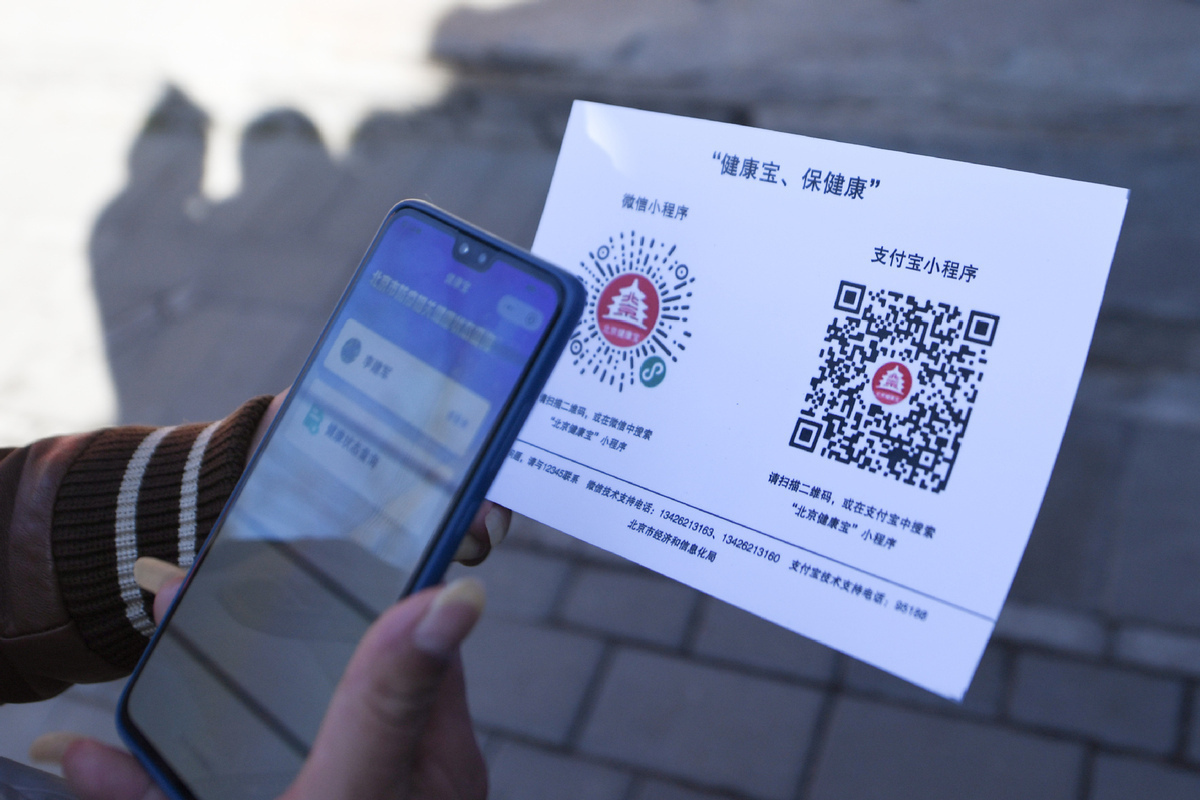
Innovative digital tools including health codes and itinerary codes have played a key role in China's fight against the COVID-19 pandemic. Facing repeated cluster outbreaks, China has used these digital tools as part of its prevention and control measures over the past more than two years to achieve the best results at minimum cost. And they may prove their worth once again during the Tomb Sweeping Day and May Day holidays when millions of people are expected to travel across the country.
But since the health codes developed by different provinces and cities are not coordinated or compatible, they could obstruct the flow of people within the country. As such, cross-regional, cross-tier and cross-departmental coordination should be strengthened to synergize the digital anti-pandemic prevention and control apps.
First, there is a need to improve the applicability and management of the digital anti-pandemic tools across the country. Since each province has its own health code, as do some cities in the provinces, and infection prevention and control mechanism, cross-regional flow of people is affected to a certain extent.
For example, at airports, railway stations and other transportation hubs, visitors are often stranded, waiting to scan the health codes with their smartphones and apply to get the local health code. And although the central government service platform launched the "epidemic prevention health information code" in February 2020, it has not been widely used as a "travel permit".
So the applicability and management of health codes based on prefectures and cities should be gradually unified by the provincial authorities, and eventually the central government. The provinces should also integrate the prefecture- and municipal-level health code platforms and ensure that one province (or autonomous region or municipality) has only one health code.
There is also a need to establish a mutual recognition and communication mechanism within urban agglomerations and metropolitan circles where the flow of people is relatively high. As for the central government, it should adhere to unified deployment, standardization and management of digital apps at the national level, and develop a common country-wide health code.
Second, the coordination of rules and information sharing of digital anti-pandemic tools should be strengthened by, for example, building a health code management and service system at the national and provincial levels, and clarifying the rules for code assignment and trans-coding. For instance, due to different "change code" management rules, the color of the health code of the same person can be different in different places at the same time.
Unfortunately, some local authorities have failed to effectively implement prevention and control measures, because they presumptuously assigned "red codes" to everyone in a city with confirmed cases and refused to recognize other cities' health codes.
So it's high time local health authorities and people started adhering to the national integrated government service platform's norms, strengthened the provincial-level platforms, and improved cross-departmental information, so as to lay a solid foundation for coordinating anti-pandemic measures.
At present, local health codes are managed by different departments. For example, Guangzhou's "Suikang Code" is managed by the Guangzhou health commission, Beijing's "Jiankangbao" by the Beijing economic and information technology bureau, and Shanghai's "Suishen Code" by the Shanghai big data center. The different departmental management systems and insufficient inter-departmental coordination are more likely to create data barriers and information-isolated islands.
And third, the coordination and integration of digital anti-pandemic tools is a necessity, as some apps such as itinerary and health-check codes have been superimposed on the health code, with some places adding manual registration measures to it.
Besides, in the hope of better managing the health codes, some departments have created blank codes (unknown circumstances), purple/orange codes (in areas with confirmed cases, people have to undergo multiple rounds of nucleic acid testing to turn the code green), and gold codes (vaccinated). These tools add to the burden of repeated verification on the public, increase the risk of infection because of long queues and large gatherings at testing sites, and obstruct people's flow.
Health and travel codes should be combined to provide "one code" access to the public. For example, the Ningbo health commission launched the "Pass on Code" application, which displays both itinerary code and health code on one screen for the convenience of residents.
Moreover, the digital anti-pandemic tools should be made more inclusive to facilitate the movement of special groups such as senior citizens and minors. For example, improving the tools' functions to allow an individual to manage the health codes of relatives and friends, and to make one person's code binding for multiple people will meet the travel needs of people who do not or cannot use smartphones.
The author is an associate professor of public management at the China National Academy of Governance.
The views don't necessarily reflect those of China Daily.
If you have a specific expertise, or would like to share your thought about our stories, then send us your writings at opinion@chinadaily.com.cn, and comment@chinadaily.com.cn.





