



Rooftop solar energy to power nation's green development







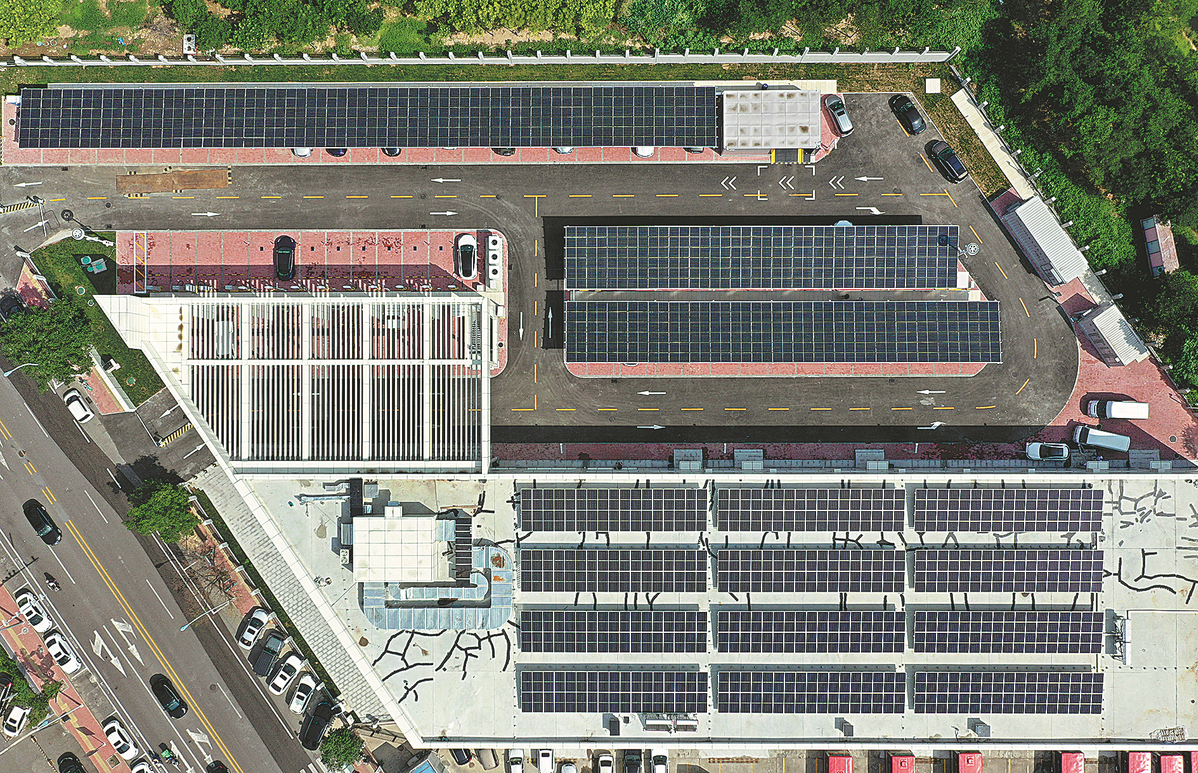
Rooftop solar PV installations in China may surge in the next three years as the country goes through a green energy transition and plans to make renewable energy a key cornerstone in the country's path to a greener economy, a recent research report said.
Rooftop installations in China increased to 27.3 gigawatts in 2021 from 19.4 GW in 2017, and the growth should keep rising for the rooftop solar market, a Rystad Energy analysis piece said. Before 2017, rooftop solar was almost non-existent, with only 4 GW of installed capacity in 2016.
The increased adoption of rooftop installations in China has also driven the world's total global rooftop solar capacity, which has jumped 64 percent in five years, rising from 36 GW in 2017 to 59 GW in 2021, representing 30 percent of total global solar capacity, it said.
The world's total capacity is seen to reach 94.7 GW by 2025, with growth to steadily continue following the slow adoption from 2010 to 2016.
The agency said the surge in rooftop capacity is mainly due to the incentives and friendly policies introduced by the government to promote adoption, especially feed-in tariffs that guarantee an above-market price for producers.
The National Development and Reform Commission said earlier in March the country should accelerate the development of rooftop solar projects and ensure half of the newly built public institutions will be covered by rooftop solar panels in 2025.
This is the latest government effort in promoting rooftop solar capacity construction, after China carried out a pilot program to develop rooftop solar photovoltaics across the country last year.
The National Energy Administration called for a selection of counties to be nominated for a trial program to promote rooftop solar pilot projects in late June, and 25 provincial-level regions nationwide have come up with detailed pilot programs in response, most in economically developed regions.
Rystad Energy said small-scale solar PV, including residential, commercial and industrial (C&I), and off-grid projects are gaining momentum supported by economics and policies, with China emerging as a key market.
An analyst said solar power is an enormous resource for China's decarbonization as the country is transitioning away from fossil energy use. The country's rapid development of rooftop solar capacity is also driven by government incentives.
Newly added annual installed capacity for solar stations has been around 30 GW on average over the past few years, China New Energy Investment and Financing Alliance said.
The figure, according to Peng Peng, secretary-general of the industry group China New Energy Investment and Financing Alliance, is expected to reach 80 GW annually if the government's push for distributed solar installations nationwide is implemented on schedule.
The government has been ramping up its push for distributed solar facilities nationwide to substantially boost newly installed photovoltaic capacity in the nation, she said.
Solar installations have boomed globally since 2010, with an annual growth rate of 40 percent. China is leading that growth and has ranked first since 2015 in both installed capacity and power generation, remaining the leader in solar installations in Asia and the world by adding roughly 619 GW of solar photovoltaic capacity over the decade, said a report by energy research and consultancy Wood Mackenzie.
Most of the country's distributed solar photovoltaics are installed in the eastern and southern parts of China, where the economy is prosperous and demand for power is greater, including in Zhejiang, Shandong, Jiangsu and Anhui provinces.
Believing that distributed photovoltaic power will have massive development potential as it plays a key role in achieving the government's carbon neutrality goal, companies nationwide-either State-owned or private, new energy companies or traditional energy companies-are all stepping up distributed solar projects in recent years.
Domestic solar company Risen Energy said as the cost of solar power generation gradually falls and as solar power consumption capacity rises, distributed solar including rooftop solar will embrace a broader market share and the company plans to continue expanding its presence in the domestic rooftop solar market.
Leon Chuang, global marketing director of Risen Energy, said the government's policy will speed up distributed solar projects while coordinating various resources within the photovoltaic industry.
Another domestic solar module manufacturer, JinkoSolar, also launched Tiger Neo series last November that targets the rooftop market, with an efficiency of 22.3 percent, which tops the current commercialized panel industry.
Qian Jing, vice-president of JinkoSolar, said while the bottleneck of grid accessibility and absorption has slowed down the deployment of utility-scale projects in China, distributed solar will account for 50 percent of new capacity over the next five years.
Growth in distributed rooftop solar calls for panels of higher efficiency, energy density and generation capacity due to its limited space, which will bring massive opportunities for companies like JinkoSolar, she said.
China Petrochemical Corp, or Sinopec Group, has commissioned the country's first "carbon-neutral" gas station, a distributed photovoltaic power project at its Jiaze gas station in Jiangsu province last year, which has rooftop solar panels that allow the facility to be self-sufficient and transmit unused power to the grid.
Luan Dong, China renewables analyst at BloombergNEF, said the policy has generated huge interest among State-owned and privately owned developers, which is expected to lift the distributed solar market.



















