



NATO's objective self-enrichment, not self-defense







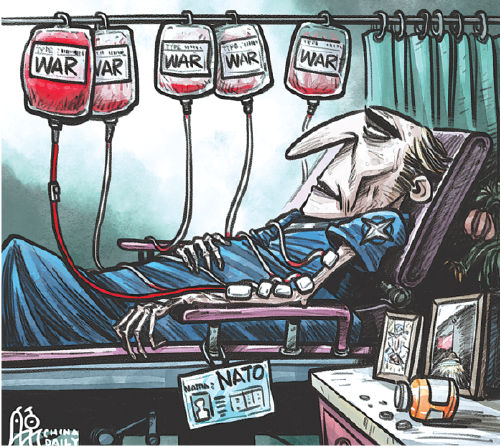
The US-led North Atlantic Treaty Organization has always portrayed itself as an alliance for self-defense. It was created around seven decades ago with the express purpose of defending the West from the Soviet Union. Following its rival's dissolution in 1991, NATO continued to exist but noticeably became much more aggressive. The bloc bombed the former Yugoslavia in 1999, utterly destroyed Libya in 2011 and continues to wage a hybrid war on Syria.
Russia regards NATO's continued eastward expansion after 1991 a violation of verbal promises given to the former USSR not to move beyond the then-newly reunified Germany as an existential threat. Russian President Vladimir Putin reiterated these concerns during his speech on February 24 announcing the commencement of his country's special military operation in Ukraine. The Kremlin considers NATO's regional deployment of "anti-missile systems" and strike weapons near its border to be very dangerous.
These high-profile criticisms by a world leader and the subsequent military action he ordered in response to Russia's concerns about that bloc have prompted a global debate over its true purpose. Putin has a valid point in asking why NATO feels the need to continue expanding and deploying various military systems closer to Russia's border. It was this development that provoked what international relations theorists describe as Russia's security dilemma with NATO.
This concept refers to one country or group like NATO making military moves it claims are in self-defense. But others like Russia might have legitimate reasons to regard them as latent threats to their security. This in turn leads to them making their own military moves on a similar pretext of self-defense seen as threatening by the other. The cycle continues, which escalates tensions while worsening regional security. That's what happened with NATO and Russia.
NATO's first post-Cold War wave of expansion in 1999 led to the incorporation of former Warsaw Pact members Czech Republic, Hungary and Poland. Its second 2004 expansion then saw former Soviet republics in the Baltics joining alongside Bulgaria, Romania, Slovakia and Slovenia. Russia was mired in instability due to the federal intervention in Chechnya during that time after having just barely survived a massive decade-long economic crisis from 1989-1999. It objectively didn't pose a threat to the region.
This shows those first two waves of NATO's post-Cold War expansion weren't genuinely predicated on self-defense, but on advancing ulterior self-interest. While some members like those in the Baltic states and Poland have historically been suspicious of Russia, others like Slovenia weren't. It should also be remembered Putin came to regard those expansions as provoking the security dilemma that followed.
The international security context prior to 1999 was that the US had been preparing for what would eventually become NATO's war on Yugoslavia. This unprovoked aggression insincerely launched on the false basis of defending "human rights" and "stopping genocide" was intended to fill the bloc with a new purpose, well beyond containing the former USSR or modern-day Russia. The then-US unipolar hegemon wanted to expand its network of vassal states to fight its future wars.
The 2004 expansions came after the US' wars on Afghanistan and Iraq that America ordered its vassals to participate in. It gained seven new official ones after sparking those two conflicts. The motivation was two-fold: recruit more vassals to fight its growing number of wars in the Global South while also pressuring them to comply with NATO's demand they spend 2 percent of GDP on defense. Their military equipment would obviously be mostly supplied by American companies.
The US' military-industrial complex is infamously influential in terms of shaping this now-declining unipolar hegemon's foreign policy. Political officials who invested in such companies were partially motivated by self-enrichment to continue expanding NATO. They did so despite concerns in academia and the media (back when both were a lot freer in the West) this would provoke a security dilemma.
Far from the supposed alliance for self-defense it was during the Cold War, NATO rapidly transformed into an alliance for US elites' self-enrichment and the Pentagon's neo-imperialist plans for the Global South after the USSR's dissolution. It too should have dissolved or at least incorporated Russia as an equal member to stand against shared transnational threats to global security. Instead, NATO became nothing more than one of the Pentagon's many weapons to wield against its opponents.
This insight is crucial to remember during the present day. Folks mustn't be misled by the US' information warfare campaign into thinking the Ukrainian crisis is purely Russia's fault. The Kremlin has legitimate reasons to regard NATO as an existential threat. This bloc isn't based on self-defense but on self-enrichment and neo-imperialism. Its members are little more than American vassals. NATO, not Russia, arguably constitutes the greatest threat to global security and will likely remain so.
Andrew Korybko is a Moscow-based American political analyst.
The opinions expressed here are those of the writer and do not necessarily represent the views of China Daily and China Daily website.
If you have specific expertise, or would like to share your thoughts about our stories, then send your writing to opinion@chinadaily.com.cn and comment@chinadaily.com.cn.





