Sino-Indian ties face a window of opportunities







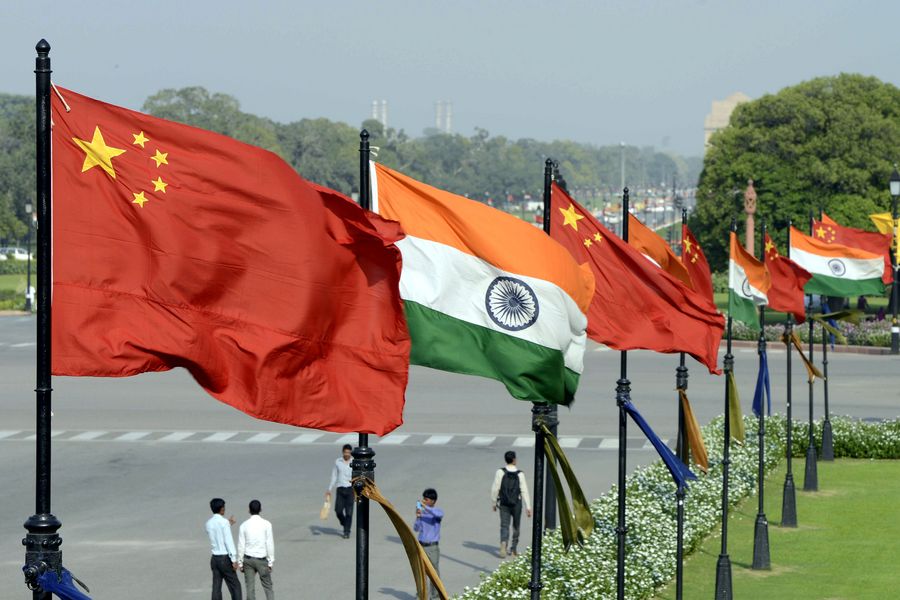
The meeting between State Councilor and Foreign Minister Wang Yi and Indian External Affairs Minister S. Jaishankar in New Delhi on Friday is seen as a rare window of opportunity for the two sides to put bilateral relations back on track.
Since the Donglang (Doklam) standoff in 2017, which damaged the mutual trust between China and India that had been accumulated through bilateral interactions since 1998, and the Galwan Valley clash in 2020, which ruined the political consensus between the two countries, China-India relations have been at a three-decade low.
The foreign ministers' meeting of the Quad (a loose strategic grouping of the United States, India, Japan and Australia) on Feb 11 heightened concerns over "unilateral attempts to change the status quo" in the Asia-Pacific region. And on Feb 15, India again banned 54 Chinese apps, including those of Tencent and Alibaba, indicating India-China ties were difficult to mend.
The main reason for this situation lies in India's belief that it faces a "period of strategic opportunity" due to the Sino-US strategic competition. In reality, New Delhi has made the wrong assumption, at least economically. For example, in 2021, Sino-Indian trade exceeded $125 billion, up 43.3 percent year-on-year, with India's exports increasing by 34.9 percent and imports by 46.1 percent, showing that China-India economic cooperation is beneficial to both sides and the Indian government's efforts to "de-Sinicize" the country's economy have failed.
At a time when China-India boundary talks have yet to make substantial progress and the US continues to advance its Indo-Pacific strategy, can the growing Sino-Indian trade help reset bilateral relations?
At the Munich Security Conference on Feb 20, Jaishankar reiterated that "the state of the China-India border will determine the state of China-India relations". Such conditional remarks suggest resetting China-India ties is extremely difficult. But the one-sided "competition, confrontation and strategic mutual suspicion" approach should not become India's overall policy toward China.
India's excessively "assertive diplomacy" vis-a-vis China has not won it any substantial benefits on the boundary issue, and due to the lack of strategic resources and the huge governance gap left behind by the US in Afghanistan, the "expectation gap" between the US and India continues to widen.
In 2022, one of the priorities of the Indian government is to ensure healthy economic recovery. The Economist Intelligence Unit's February 2021 report forecast that, because of rising commodity prices, India's economic recovery will face challenges in 2022 and its current account deficit will widen further to reach 6.4 percent of GDP. Therefore, stabilizing China-India relations will help New Delhi to boost the country's economic recovery.
India has always insisted on "strategic independence" and believed in using its "smart leverage" to become a leading global power so it can influence the world's major agendas. India's insistence on "strategic independence" could also be the reason behind the possible correction of China-India ties.
As neighbors whose interactions were basically frozen for the past two years, it would be very constructive for China and India to have "face-to-face" open exchanges on bilateral and regional issues of mutual concern at a higher political level. Although they will not immediately stabilize bilateral relations, they could at least prevent ties from continuing to hit new lows at an "unexpected" rate.
Serious follow-up would be needed to "stabilize" the overall fundamentals of bilateral ties and gradually build a new framework and principles for interaction based on in-depth and lasting communication between the two countries.
Against the unprecedented changes in the international situation, the strategic communities of China and India have much room for exchanging views on climate change, multilateralism and global governance, economic recovery and other issues. This is not just about analyzing each other's attitudes, progress and dilemmas, but more importantly about trying to understand each other's concerns at a deeper level and making follow-up moves.
Given that young people are the future of a country, and communication and interaction can help them better understand each other, the youth in China and India should open new communication channels in entrepreneurship, the digital economy, cross-border e-commerce, overseas study, cutting-edge technology and other fields in the post-pandemic era to take Sino-Indian relationship forward.
The biggest factor preventing China-India ties from improving is the influence of India's protectionist nationalists on the Indian government. To restructure China-India relations, India should refrain from banning Chinese-made digital devices and apps, boycotting Chinese investment, and trying to "hunt down Chinese capital" through multilateral policy banks, because such actions will further widen the rift between the Indian government and the pro-China business community. In short, the Indian government needs political courage to make wise decisions, as Indian nationalists' pressure could hurt the interests of both peoples.
The author is an associate research fellow at the National Institute of International Strategy, Chinese Academy of Social Sciences. The views don't necessarily reflect those of China Daily.