



High-speed railway thaws travel issues in frozen zone








Technological improvements and know-how ensure safe operations in Northeast China's frequent subzero temperatures. Luo Wangshu reports.
Although most regions of China have recently started embracing spring breezes, snowstorms still frequently hit Cong Liyan's home in the northeastern province of Heilongjiang.
In Cong's memory, winter travel has always been difficult and unpleasant. "Trains were slow and often canceled or delayed by storms, and driving was even harder," recalled the 51-year-old native of Harbin, the provincial capital.
Members of her family and relatives live across Heilongjiang and the neighboring provinces of Liaoning and Jilin. Whenever the family gathered for Spring Festival, there were complaints about travel difficulties.
"There was always someone trapped in the traffic and unable to arrive on time," Cong said.
In Heilongjiang, China's coldest province, the mercury can easily drop as low as-20 C, and sometimes even-30 C, during winter.
"That's why we call spending the winter maodong, 'hidden in the winter' in the local dialect," she said, adding that like most people, she tried to avoid making, or at least reduce the frequency of, journeys during winter.
Rapid changes
However, things have changed in the past decade thanks to the development of the region's high-speed railway network.
Before this year's Spring Festival, Cong took a five-hour trip on the bullet train from Beijing to Harbin, a journey that used to take more than 10 hours. Her son, who works in Shenyang, Liaoning's capital, also took a bullet train home, a trip of about two hours.
"The journeys are short, and the trains are always on time. The onboard environment is nice and clean," Cong said.
The expanding high-speed railway network in China's northeastern region has benefited millions of people like Cong and her family.
The three provinces that comprise Northeast China-Liaoning, Jilin and Heilongjiang-are generally the coldest parts of the country, which poses challenges for the construction of the high-speed rail network.
In 2012, four years after the country's first high-speed railway was put into operation, the first high-speed line to operate in extremely cold weather was opened. It connects Harbin with Dalian in Liaoning and links the capitals of the three provinces: Liaoning's Shenyang; Jilin's Changchun; and Heilongjiang's Harbin.
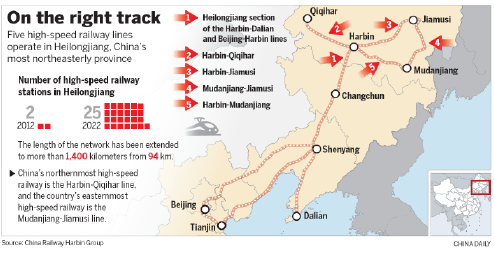
Now, Heilongjiang, the most northeasterly province, has five highspeed lines. They connect major cities such as Beijing, the three provincial capitals, and Qiqihar and Mudanjiang in Heilongjiang.
Two of the five lines are China's northernmost and easternmost highspeed railways: the Harbin-Qiqihar and the Mudanjiang-Jiamusi lines.
China Railway Harbin Group, the operator of the regional railway, said the number of high-speed railway stations in Heilongjiang has risen from two in 2012 to 25, while the network has extended to more than 1,400 kilometers from 94 km.
Transformed, expanded
Yang Xingqiang, head of Daqing East Railway Station, has witnessed the quiet, small facility turn into a busy, modern bullet train station.
Before the Harbin-Qiqihar line opened in 2015, Daqing East Railway Station, was called Longfeng Railway Station.
At the time, it had about 30 staff members and two platforms on its roughly 200 square meters, and it handled seven trains a day, with a total of about 1,100 passenger trips.
Since the facility has been expanded and become a bullet train station, it handles 56 arrivals and departures-both bullet trains and regular services-and nearly 7,000 passenger trips every day. The station has expanded to 14,999 square meters, and the customer service department alone employs 140 staff members.
"Work was much quieter before. We handled seven services a day, which meant that the intervals between services were quite long. We usually undertook some training and cleaned up the station during that downtime. Now, though, we handle trains every 20 to 30 minutes, which is quite intense and busy," Yang said.
Work starts at about 5:30 am, and the first thing Yang does every day is check the equipment and infrastructure.
"In the past, there was not much equipment and infrastructure to examine, such as that related to the platform and ticket sales counters. Now, I have to check much more equipment and infrastructure, such as screens, elevators, hanging banners, computers and other items," he said.
The station's traffic peak occurred during the National Day holiday in October 2019, a few months before the COVID-19 outbreak, when it handled 160,000 passengers, a record for the facility.
"During holidays, staff members have to be on site to ensure the safety of passengers and operations. The requirements have risen due to the increased number of passengers. It makes more work for us. For example, some passengers require special services, such as wheelchair services," Yang said.
He has also seen the changes the station has brought to the neighborhood. "It used to be a wasteland, with shabby houses and collapse-prone single-story buildings surrounding the old station. The environment has changed, with the station square and commercial and residential buildings standing next to the station," he said.
As a local, Yang has also noticed that more people are choosing rail travel over driving.
"People prefer to take the bullet train to big cities, such as Harbin. The bullet train has boosted people-to-people exchanges," he said, noting that the journey from Daqing to Harbin now takes just 40 minutes.
Technology and safety
Technology has been adopted in the design of the railways and their operation, making China one of the global leaders in the construction of high-speed railways in extremely cold conditions.
An image-collection-and-analysis system has been introduced to help monitor bullet train operations. Cameras have been installed along the tracks to collect images during operation, and they are compared with database images to identify safety hazards. Technologies, including three-dimensional imaging and image recognition, are applied during the process, said Tian He from China Harbin Railway Group's bullet train department.
The system assigns images to analysts for examination, which they are required to assess in regular checks, reporting malfunctions if required and calling the on-site workers to handle the problem within 15 minutes of it being noticed.
The average age of the team's analysts is 30, and most of them have bachelor's degrees.
The designers, who have a decade of experience in building high-speed railways, have carried out innovations and gained positive results to ensure that the lines run safely in such low temperatures.
The first challenge in designing a high-speed railway in such conditions is to tackle the problems caused by the constant freezing and thawing of water on the tracks and surrounding areas, according to China Railway Design Corp.
The trackbed freezes, thaws and refreezes repeatedly according to the weather, which can cause it to become uneven and potentially pose a safety hazard. Other issues, such as the resilience of concrete when exposed to extremely cold weather, have also been taken into consideration.
The company's engineers have designed and provided consultation services for several high-speed railways in extremely cold areas, such as the line that connects Mudanjiang and Jiamusi.
China's technology for building high-speed railways in extremely cold weather is ranked in the top-tier globally, which allows passengers to enjoy high-quality journeys and underlines the nation's ability to build similar projects overseas, the company said.
It added that the country has established a comprehensive technology standard for building high-speed railways in extremely cold areas.


- Hainan's 1st batch of daily consumer goods duty-free shops for island residents opens
- Cross-Strait affairs should be settled 'like family', official says
- Whale injured in collision with fishing boat near Weizhou Island
- Lizard found on high-speed train brought by passenger, rail authorities say
- Zeiss top exec: Learn from China speed
- Ancient tomb cluster in Changsha offers a glimpse into millennia of history











