



Deep rifts in US color views on foreign policy







Extreme positions, fanned by social media, driving debate, forums hear
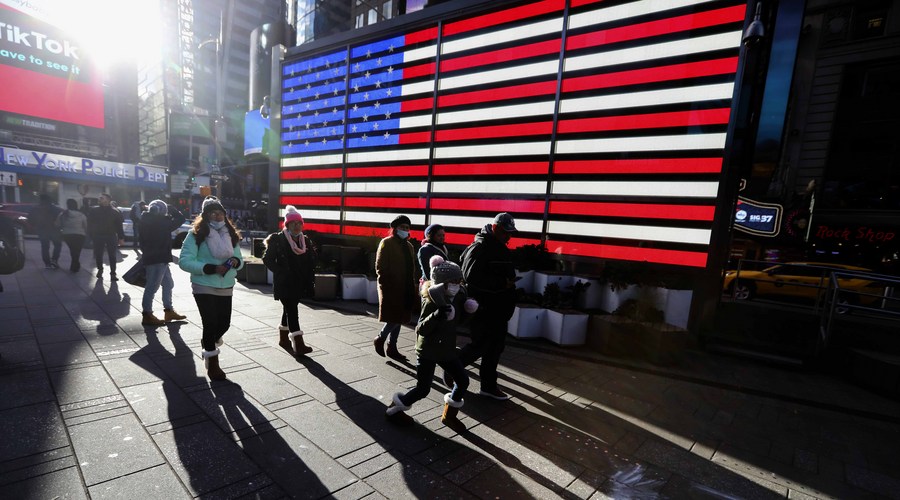
The deep political divisions among people in the United States are spilling over into the nation's foreign policy, according to participants at recent forums that also blamed social media for amplifying the polarization in society.
Erol Yayboke, director of the Center for Strategic & International Studies Project on Fragility and Mobility, introduced a report titled Softening Sharp Divides: Foreign Policy in an Era of Domestic Division at a webinar on March 7. The webinar, titled Global Security Forum 2021, was hosted by the CSIS.
He said the report shows "that domestic dividers extend beyond partisan politics" and "that the US citizens see foreign policy through lenses that differ greatly depending on socioeconomic status, age, rural versus urban location, and race".
Yayboke added: "We can certainly see over the past several years in the US there are examples of divisions within the US. We certainly saw it on and around and after Jan 6 (the Capitol riot). We saw it around and following the protests regarding the death of George Floyd. We've seen it in other ways, including around elections in the US."
He also noted that one of his findings in the paper was that the public is more divided than policy experts.
During workshop discussions, the experts acknowledged that more extreme positions among the public could sometimes drive the debate.
"While only 2 percent of workshop participants self-identified with the extreme ends of the political spectrum, 41 percent of public respondents identified as such," said Yayboke.
Mike Green, senior vice-president for Asia at the CSIS, said that the debate over China policy, however, is less populist and takes place more in the private sector, specifically Silicon Valley and Wall Street, and within the national security community.
"Those are big divisions and there are a lot of corporate boards that think it is crazy to even imagine decoupling technology from China at all," Green said. "We did a survey a year and a half ago at CSIS of the Chamber of Commerce and others, and there are a lot of different views.
"They are not monolithic, but a lot of big corporations in northwest California and New York do not want to get on side with the strategic competition with China, do not want to decouple, do not want to divest, do not want to limit technology except a little bit.
"But … by the same token, many people in the national security space don't understand what corporations do, don't understand profits, don't understand …responsibilities to shareholders. And that's the divide in the strategic competition with China."
William Cohen, a former US secretary of defense who also served in the Senate and the House of Representatives, described the current era as one of "crudeness, crudity, and coarseness".
At another Washington think tank event on March 9, Alex Johnson, deputy director of US Foreign Policy-US Programs at Open Society Foundations, highlighted the role that social media platforms play in political divisions.
In the symposium titled A Look at America's Policy Challenges for the Next Decade held by the Atlantic Council, Johnson said: "Algorithms and content moderation on some platforms have yielded increased asymmetry in hate speech.
"Are our tech platforms meeting their obligations to society in terms of countering hate speech, misinformation and disinformation? Are those efforts the same across different markets, languages and geographies?" Johnson asked.
"How hate speech is treated must be consistent, or those who seek to do harm will adapt and find other opportunities. Also, as digital spaces are segregated by AI, how are we preventing hate speech and the coordination of hate-motivated crimes?" he said.
"As long as the business model for tech platforms is to target audiences and individuals with distinct and identifiable data, that model can be corrupted by state and non-state actors to nefarious ends."










