



Music strikes major chord for budding composer with autism







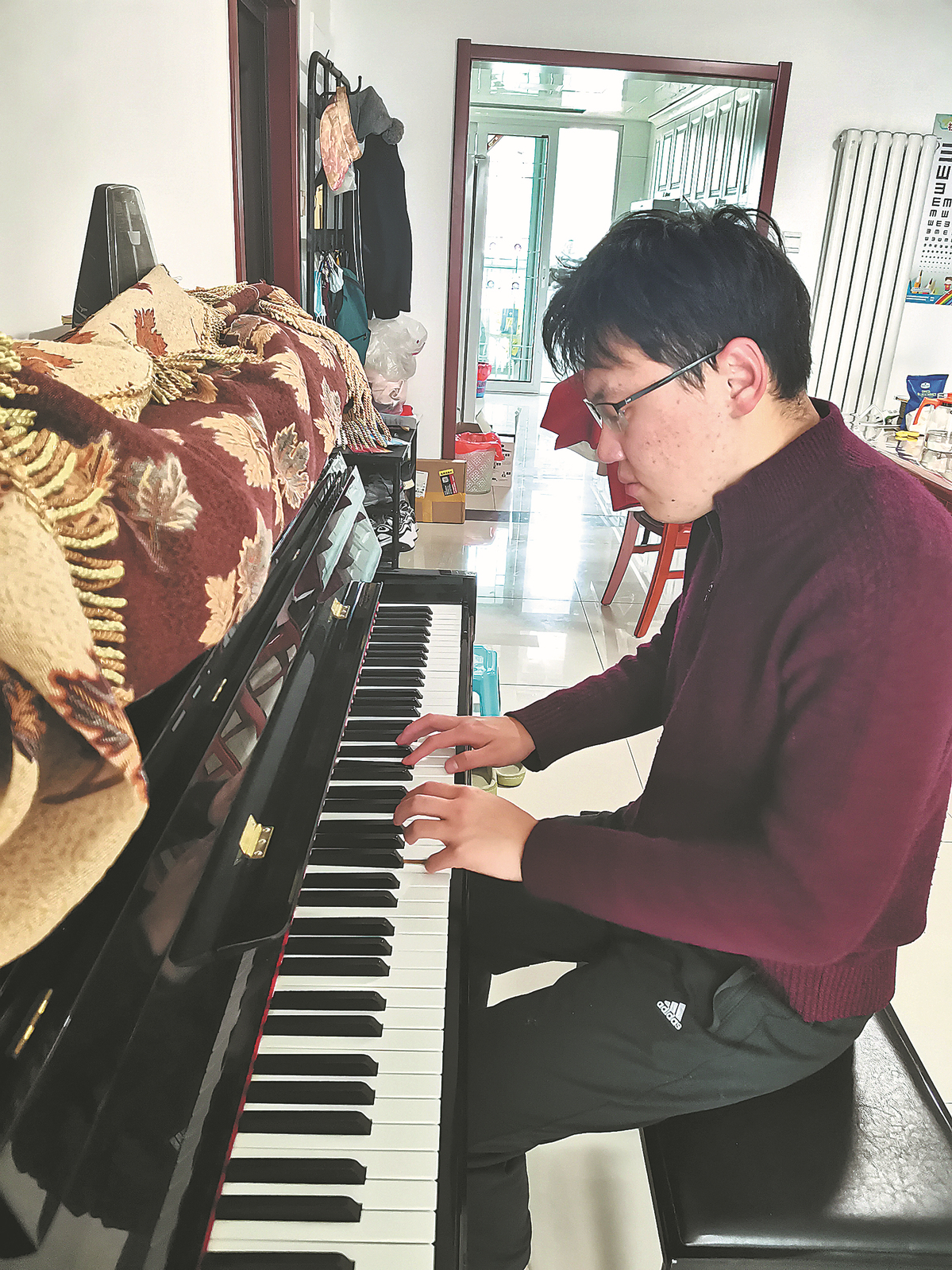
When a doctor diagnosed Ke Xianye with autism, he said it would be enough if the 3-year-old finished primary school. He probably never imagined that years later Ke would gain a bachelor's in musical composition at the National Academy of Chinese Theatre Arts in Beijing.
Ke, originally from Langfang, Hebei province, lives with his family in Beijing. The 24-year-old works two part-time music-related jobs, and he recently co-wrote a song for the 2022 Beijing Winter Olympics with his peers in a choir. He said that through the song, he hoped athletes from across the world would reflect the Olympic motto to go "Faster, Higher, Stronger-Together".
Jiao Shengmin, Ke's mother, said that although her son gained entry to the academy through the gaokao, the national college entrance exam, she still needed to convince the school that he would behave appropriately because it had never accepted a student with autism before.
"My son's musical talent should not be wasted. As a child, he would sit still when listening to music, and he can accurately identify a musical pitch. We made efforts over many years to allow him to go to school, so we couldn't give up." she said.
Ke attended regular primary, middle and high schools in Langfang, overcoming many difficulties.
When he was 3, Jiao left him at a kindergarten for the first time. However, the boy didn't play with the other children or eat anything. Instead, he cried the whole day. The next day, Ke frantically waved his hands and feet, then he held Jiao's bicycle to prevent her from taking him to the kindergarten.
Jiao tried hard to make life good for her son during the years of preschool education, but primary school was a far tougher situation, because the curriculum was more demanding than at kindergarten.
Because he didn't know how to communicate, Ke wouldn't sit still in class or listen to the teacher, Jiao said. When the school officers wanted Ke to leave, Jiao reported the problem to the local education bureau.
"The bureau's head said that if there was a problem, the school should solve it. After all, if the school wouldn't accept him, how could children like him go to school? That saw the crisis quickly resolved," she said.
Jiao also helped Ke study at home. "Math and physics were easier for him. He sometimes didn't need to think to get the answers, and he had a good sense of thinking in images," she recalled.
"The most difficult subjects were politics and language, and he was not good at social or linguistic studies."
At middle school, Ke often sneaked into the playground from class, and when he became emotional, he hit himself. In response, the teacher invited Jiao to discuss the problem several times.
Under pressure, the family had many heated discussions about whether Ke should continue at school. Some members said that it would not be a big deal to support him for his lifetime. The debate continued until high school.
"I never considered letting him drop out. He had communication problems, but he kept up with his studies. If he stayed at home and never made contact with people, what would he do in the future?" Jiao said.
Ke works as a music editor, listening to sound files and transcribing a score. "His aim is to become a composer. He also wants to study more, either for a master's or in training seminars at home or abroad. I will find more opportunities for him to realize his dream," Jiao said.
Chen Weijing, associate professor at the Peking Union Medical College, who co-founded ALSOLIFE-a special education platform that helps children with autism master life skills and reduce problematic behavior-said inclusive education gives such children opportunities.
"They need to meet nondisabled children, because they will have to enter society someday. Such children have social barriers, and teaching is a social process, so they find it boring. It's difficult for them to adapt to ordinary schools, so they are more likely to cause trouble," he said.
"Given the trend for ordinary schools to accept children with special needs, we should expand special education training for schoolteachers to promote inclusive education."
Li Xue contributed to this story.


- Thousands of cherry blossoms bloom in Chongqing, drawing visitors
- Guangdong Provincial Archives exhibits evidence of Japanese war crimes in China
- Xi's article on fostering trend of taking responsibilities to be published
- Intelligent emergency system enhances patients' access to expert care
- China's carbon dioxide emissions per 10,000 yuan of GDP down 5% in 2025
- Tangible gains during China's 14th Five-Year Plan period








