Coordination venue







JIN DING/CHINA DAILY
Improvement of Sino-US relations would ensure a better overall strategic environment in Southeast Asia
Former US president Richard Nixon's visit to China in 1972 fundamentally reshaped Sino-US-Soviet Union relations and profoundly influenced Southeast Asia. Fifty years later, the China-US rivalry in Southeast Asia has intensified, but no direct or indirect military confrontation has occurred. Southeast Asia has the experience and wisdom to navigate between China and the United States, and the two powers have the potential to build an inclusive order in Southeast Asia.
With the China-US detente and the withdrawal of US forces from Vietnam, the security pressure in Southeast Asia was reduced, and the strategic relationship between China and the US in Southeast Asia eased. Subsequently, Malaysia, the Philippines and Thailand followed the US' change of attitude toward China and established diplomatic relations with China. Then, with the end of the Cold War in 1991 and the completion of negotiations on Cambodia, Southeast Asia ushered in a 30-year period of peaceful development. In general, without the Sino-US detente after Nixon's visit, there would have been no subsequent step-by-step development of Southeast Asia.
Fifty years after that momentous visit, changes have emerged in China-US-Southeast Asia relations. The general context remains the strategic change in China-US relations. The Donald Trump and Joe Biden administrations have made China the US' main adversary and strategic confrontation between the two sides has intensified. The US think tank community frequently presents gloomy scenarios such as the Thucydides Trap and a new Cold War to characterize the relationship between the two countries. Southeast Asia, meanwhile, has become the core venue for the competition between China and the US. The US is promoting the Indo-Pacific strategy in Southeast Asia, trying to hedge against the Belt and Road Initiative advocated by China and suppress China's influence in the region.
Currently, there are three prominent aspects to the competition between China and the US in Southeast Asia. First, despite the intensity of their strategic competition, no direct military confrontation or proxy war has occurred. Second, the role of the Association of Southeast Asian Nations has been strengthened, but it is being pressured to choose sides. ASEAN is becoming more and more autonomous through its internal solidarity and friendly relations with other parties, gradually assuming a key role in East Asia cooperation. But due to the growing sense of insecurity of the US, more and more areas may be seen as security issues and become a zero-sum game, and the increasing competition may prompt China and the US to strive for the support of countries in the region, and ASEAN's unity may be at risk. Third, China and the US still have the possibility of establishing an inclusive regional order in Southeast Asia. Since the end of World War II, especially after president Nixon's visit to China in 1972, the two countries have always managed to reach a consensus on issues of war and peace in Southeast Asia, despite all the trials and tribulations. In the process, Southeast Asia has also accumulated a great deal of wisdom from the lessons learned and can navigate between China and the US. It means there is still a possibility for China and the US to reach a new state of equilibrium.
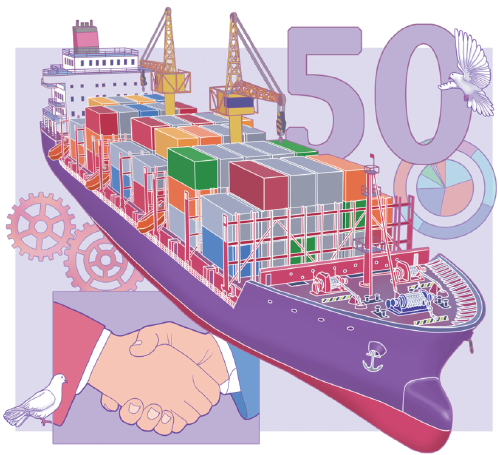
In a video conversation with President Biden in November 2021, President Xi Jinping emphasized that "China and the US are two giant ships sailing in the sea, and we have to steer the rudder so that the two giant ships of China and the US can move forward together against the wind and waves without yawing or losing speed, let alone colliding". With these words, President Xi vividly expressed China's attitude toward China-US relations, namely advocating cooperation and moving in the same direction, and opposing the waging of a new Cold War. The idea of "giant ships sailing together" is of great significance to the harmonious coexistence of China and the US in Southeast Asia.
On the one hand, maintaining peace and stability in the region is the bottom line. The caution that China and the US "cannot collide" applies first and foremost to Southeast Asia. The US should respect the efforts made by China and ASEAN countries to promote and maintain regional peace and stability, and should not continue to relentlessly provoke China under the banner of "freedom of navigation". China should enhance its dual-track communication and exchanges with Southeast Asian countries at both the government and civilian level, increase trust and clear doubts, clarify China's desire for peace and friendship, promote the implementation of the Declaration on the Conduct of Parties in the South China Sea as soon as possible, and jointly promote a high-quality 21st Century Maritime Silk Road. ASEAN and China need to continue to increase bilateral trade and investment, promote scientific and cultural cooperation and exchanges, and deepen people-to-people exchanges.
At the same time, China and the US should try to coordinate their strategic interests in Southeast Asia in a more direct way. The two countries have common interests in Southeast Asia and should strive to cooperate on improving regional governance to jointly ensure the liberalization and unification of trade rules, respecting and protecting international law to help safeguard regional security. To this end, China and the US could actively work together to establish a coordination mechanism for crisis management and ensure that exclusive economic systems are not formed.
China and the US should make good use of the ASEAN-led multilateral regional cooperation mechanism, continue to respect ASEAN's centrality, let ASEAN make full use of its home advantage, and help ASEAN promote China-US consultation and cooperation through regional multilateral mechanisms such as the East Asia Summit and the ASEAN outlook on the Indo-Pacific.
Zhai Kun is a professor of the School of International Studies and deputy director of the Institute of Area Studies at Peking University. Yao Xiaolin is a doctoral candidate of the School of International Studies at Peking University. The authors contributed this article to China Watch, a think tank powered by China Daily. The views do not necessarily reflect those of China Daily.
Contact the editor at editor@chinawatch.cn