



E-tailers boost presence in fresh food sector







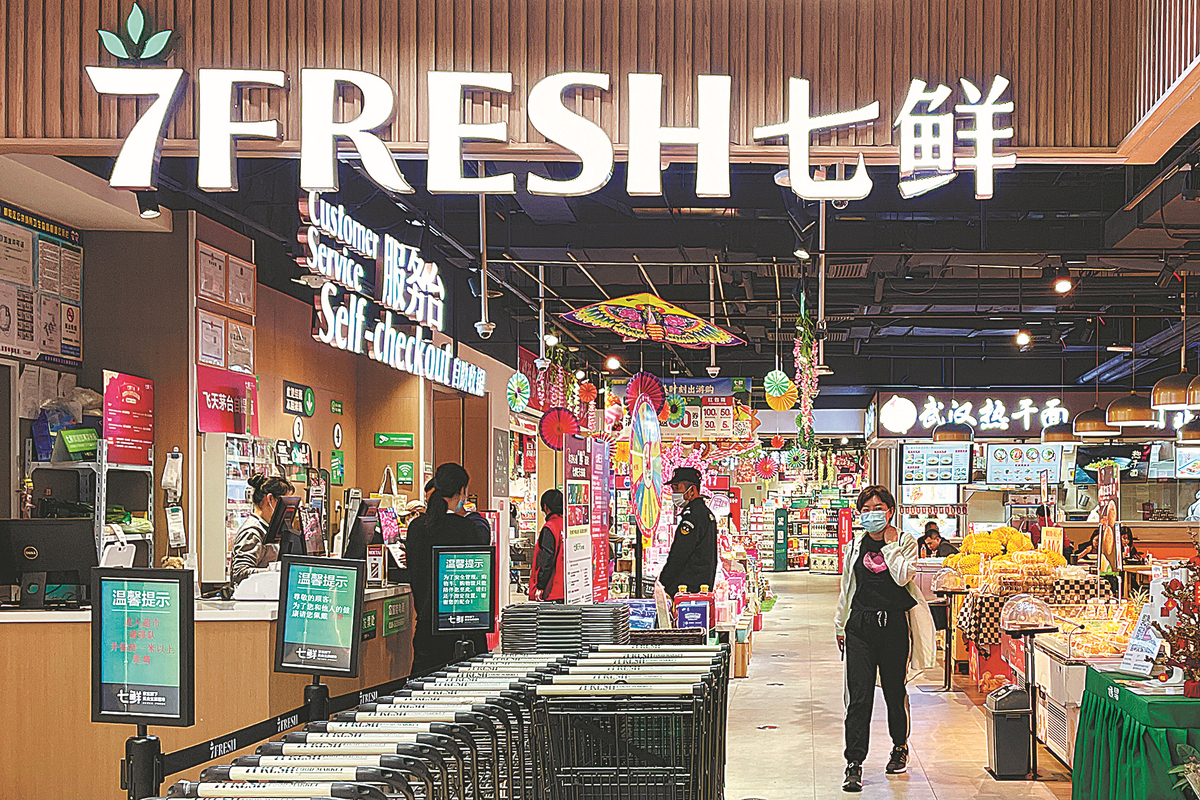
Major online retailers are beefing up efforts to expand their presence in the fresh food sector, as China's mid- and high-income consumers have rising demand for premium brands and high-quality fresh produce such as freshly caught seafood and imported fruit and meat, experts said.
Chinese e-commerce giant JD plans to open more offline fresh food stores in the Beijing-Tianjin-Hebei region and the Guangdong-Hong Kong-Macao Greater Bay Area, strengthen supply chain construction and improve operational efficiency, said Zheng Feng, president of Seven Fresh, JD's fresh produce supermarket chain.
The gross merchandise value or sales revenue from Seven Fresh rose by over 36 percent year-on-year in April, and 85 percent on a yearly basis in August, Zheng said.
"We have been continuously reinforcing the supply chain construction by establishing two commodity centers in Beijing and Shenzhen and cooperating with local premium suppliers, to offer tailor-made fresh products to consumers," Zheng said, adding the company will continue to expand product categories and build its self-owned brands.
So far, Seven Fresh owns 47 supermarkets in 13 cities across the nation, including Beijing, Tianjin, Guangzhou, Shenzhen, Chengdu and Wuhan. "We have opened six new brick-and-mortar shores in the Guangdong-Hong Kong-Macao Greater Bay Area since April 30, and will open two stores in Guangzhou in the next week," Zheng said.
In addition, consumers can order products via the Seven Fresh app to get their orders delivered as fast as 30 minutes from nearby stores that are within a radius of 3 kilometers, Zheng said. The main users of the app are from mid- and high-income families who live in first- and second-tier cities, and have a monthly income of more than 30,000 yuan ($4,710).
In November, Seven Fresh and Japanese retail company Muji jointly launched a fresh food complex spanning an area of over 4,000 square meters in Shanghai.
The company has established a joint venture with Chinese retailer Better Life, with an aim to open new stores in Changsha, Hunan province. It will cooperate with leading property developers in the future to speed up its layout in more cities.
Market research company iResearch said China's fresh food retail market has maintained steady growth in recent years. The transaction volume of China's fresh food market is expected to increase from 5 trillion yuan in 2020 to 6.8 trillion yuan in 2025, fueled by increases in per capita disposable income.
Hema Fresh, the grocery chain of Alibaba Group Holding Ltd, has accelerated its pace of opening new stores nationwide since it opened its first store in Shanghai in 2016. Moreover, the company opened its first Hema X member store in Shanghai in October 2020, and plans to open 10 new membership stores by the end of the year.
The combination of different store formats can complement one another to serve a city's fast-moving and advanced consumption needs, said Hou Yi, president of Hema.
Analysts said the supply chain construction and quality control of fresh food is of great significance for e-commerce players that have tapped into the offline fresh food segment.
Wei Jianhui, an analyst with internet consultancy Analysys in Beijing, said JD has gained upper hand in omnichannel retail and supply chain capacities, providing users with shopping experiences covering various scenarios and improving the repurchase rate of users.
Fresh produce retailers should focus on improving the efficiency of the supply chain and satisfying the diverse needs of consumers to ensure the quality of their products, Wei said.
"Big data and artificial intelligence technologies could be utilized to accurately offer corresponding products and services based on different regions and customer groups, and constantly improve the shopping experience," Wei added.
Chinese high-income consumers are pursuing a high-end lifestyle along with the consumption upgrades, said Lu Zhenwang, CEO of Wanqing Consultancy in Shanghai, adding online retailers should ramp up efforts in the supply chain system, which includes warehousing, procurement, cold chain logistics and delivery, along with taking measures to ensure product quality.
fanfeifei@chinadaily.com.cn




















