



Implementation of property tax should be smart







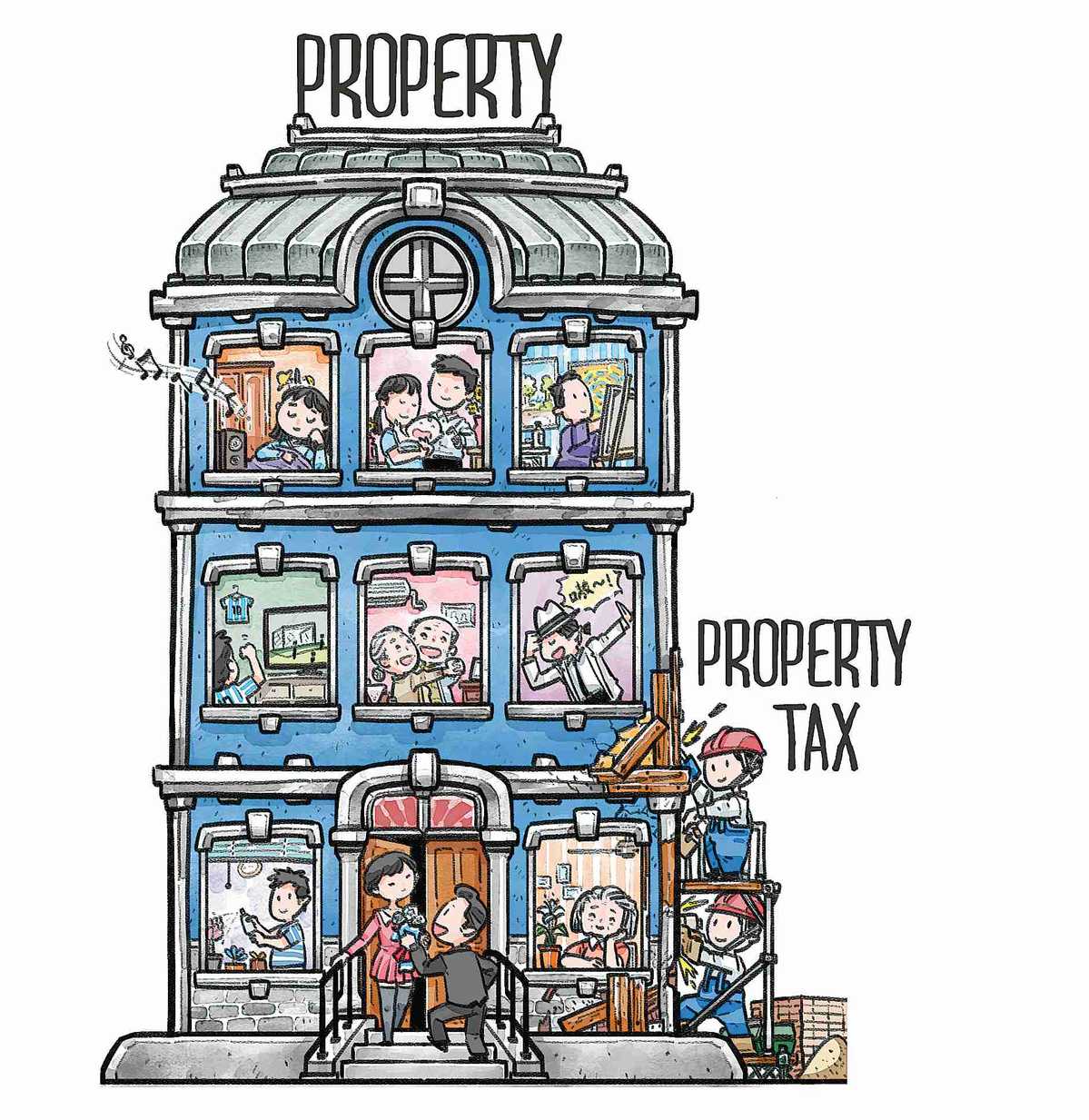
Property tax contributes a small share of government revenue in countries all over the world. Foreign practices notwithstanding, and given the current or even future situation in China, property tax is also unlikely to become a major fiscal revenue resource in China.
However, property tax is important in their own right. Property tax often guiding discussions these days typically targets residential real estate. To some extent, this is a completely new type of tax category in China, and something that has never been implemented before.
Now that the residential property tax is to be levied, it may not be defined and understood simply from the perspective of textbooks. That may create a divergence from fiscal and economic reality.
As a tax type, property tax has fiscal, economic and social attributes. Whether the residential property tax can be introduced, levied and implemented smoothly, and whether it can serve the expected purpose, we need to pay attention to what people feel about it, that is, what kind of property tax is acceptable to society at large.
The design of the property tax must be viewed in the context of what's happening in China. We need to think in terms of reality, not just textbook examples.
In the past, the real estate sector was regarded as a pillar industry of the Chinese economy for a long time, as well as a guarantee for livelihood. Real estate has also been regarded as an important channel for wealth accumulation.
Obviously the real estate sector is very important not only in generating economic growth but also in people's lives. Yet, will such importance carry on? It looks like it's time for a change.
If a family's wealth is mainly based upon real estate, risk will become increasingly greater. The urban home ownership rate is currently 90 percent, and there are quite a lot of vacant houses. According to the principle that "Houses are for living in, not for speculation", a residential property should be regarded as consumer goods, and is not supposed to be vacant.
When the large number of vacant houses are just sitting idly for their prices to go up to become a channel of accumulation of wealth, then they become assets with strong financial attributes, and a way of wealth accumulation.
Therefore, what kind of "distribution expectations" will this lead to? If the wealth accumulation is mainly realized by purchasing real estate, everyone will convert more income into real estate, and then housing is utilized for speculative ends.
Now we use various indicators to measure whether there is a bubble in real estate. When real estate takes on too many functions, huge public risk to economic growth, sustainable development and common prosperity will appear in its wake.
The residential property tax must help solve macroeconomic problems and allow the housing sector to return to a consumer good status again. Housing should not be regarded as the main way for individuals and families to accumulate wealth, or as a carrier of accumulated wealth, at least not as the primary carrier.
From this perspective, owning real estate should not become overly accessible. If it is gradually made more challenging, property investing behavior can be changed. Residential property tax should have an adjustment function to promote the restoration of residential assets to consumer goods, and dilute their financial asset status.
Financial attributes cannot be completely removed by the imposition of a single tax, but this tax must at least play a positive role in forming a synergy with other policy measures.
Once properties become financial assets, speculation leads to vacant houses and a waste of resources. Although residential property tax is a kind of beneficial taxation in textbooks, that doesn't necessarily conform with reality. Homebuyers purchase real estate in the name of consumption, but then often turn such purchased properties into investment assets.
To regulate such speculative homebuying behavior, residential property tax should be a tax on consumption behavior. This kind of tax is not the same equivalents targeting one-time home purchasing behavior among consumers, because as long as the purchase of a house is made, the tax will be paid every year afterward.
In this regard, residential property tax should be introduced to adjust home purchasing behavior, prevent and dissolve accumulated risks in the real estate sector, and promote the transformation of the real estate market, thereby promoting the development of the economic growth mode and advancing overall economic and social transformation.
Under the current rural-urban dual system in China, there are still differences between public services for migrant workers and local citizens. Therefore, the social transformation is slower than the economic transformation.
Although residential property tax alone cannot solve such a big problem, the introduction of it can help to some extent.
While urbanites rely mainly on real estate to accumulate wealth, farmers have little to do with such real estate-based wealth accumulation. On the contrary, farmers' homes are built on homestead land and begin to depreciate the day they are built, leading to increasingly wider wealth gaps with their urban counterparts.
Social transformation must first consider offering farmers more opportunities for wealth accumulation. Without more opportunities for farmers, the gap between the rich and the poor under this dual structure will be more pronounced.
Residential property tax is not simply a means to regulate income distribution and wealth distribution, but actually a way of regulating wealth accumulation.
The spillover effect of this tax could be significant, because it can play an obvious role in changing distribution expectations.
Some only consider the impact of the property tax on economic growth, but we cannot merely think about such immediate concerns.
If we depend on real estate to drive economic growth, the economy will become unsustainable, and it will be difficult to achieve high-quality development. An important aspect of economic transformation is not relying on real estate to achieve continuous economic growth. For this, residential property tax can play a role over the long run.
In the short term, the levy of a residential property tax will have a limited impact on real estate prices. Like throwing a stone into a pond, the waves of such an impact will not last long, and will gradually wane.
Yet, in the medium and long terms, the impact of a residential property tax is important and beneficial, and the probable short-term impact of the tax on real estate prices should not get in the way of us recognizing the positive overall long-term impact on promotion of transformation, improvements of the dual social structure and on the achievement of common prosperity, although such impacts will also be marginal.
The residential property tax is a local tax, and the central authorities should establish a legislative framework to stipulate basic principles and then delegate more autonomy to local authorities, allowing them to make their own decisions.
This is not only because the residential property tax is a local tax, but also because of the huge differences from place to place in China's vast territory.
If the central authorities' regulatory narratives of residential property tax being a local tax are too detail-oriented, it will be difficult to implement the regulations in accordance with different local situations.
Since residential property tax is a local tax, and considering the development differences in China and varied situations from place to place, it is better to leave the specific implementation plans of the tax to local authorities in order to give full play to the creativity and enthusiasm of local conditions.
More decentralization, that is more delegation of power to locals, may help to promote the progress of the adoption of the new property tax in a healthy and steady way.
The writer is head of the Chinese Academy of Fiscal Sciences.
The views don't necessarily reflect those of China Daily.




















