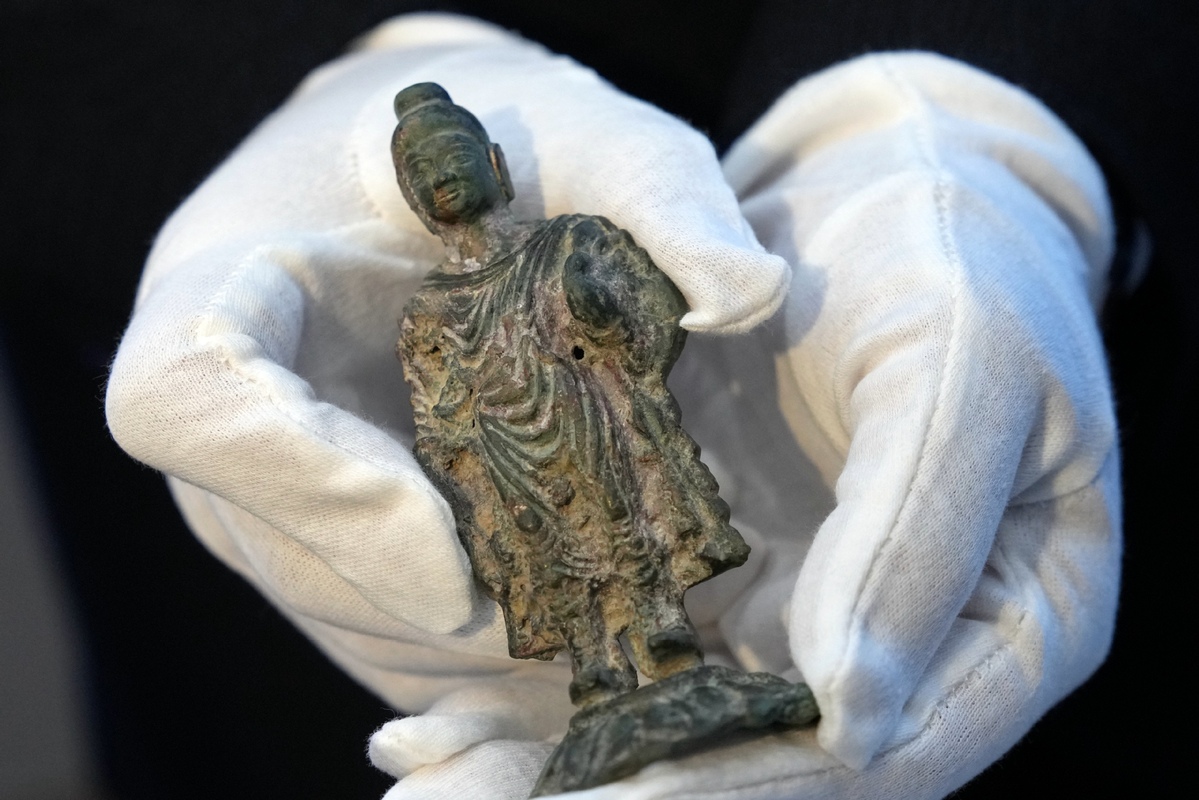
What are thought to be China's oldest known bronze Buddha images have been discovered in Shaanxi province.
The two sculptures were unearthed this year in a tomb from the Eastern Han Dynasty (25-220) in the city of Xianyang, Shaanxi Academy of Archaeology announced in Xi'an, the provincial capital, on Thursday.
Li Ming, the leading archaeologist on the site, said one of the relics, a standing statuette of the Gautama Buddha on a lotus-shaped foundation, is about 10-centimeters-high. The other piece, which is flat, is about 15-cm-high and depicts five sitting Buddhist deities.
"The discovery of the two relics is significant for studies of how Buddhism was introduced to China and got localized in our country," Li said.
Historical documents show Buddhism was first introduced to China in the first century AD. The oldest known Buddhist temple was built in AD 68 in Luoyang, Henan province, which was then the capital of the Eastern Han Dynasty.
Li said that previous archaeological findings in China indicated that standalone Buddha images with a religious purpose only appeared during the period of the Sixteen Kingdoms (304-439).
Consequently, the new findings may increase the history of Chinese Buddha images by two more centuries, he added.
The tomb where the two Buddha images were recently found is one of six in a family plot. Though the specific time when the two relics were made remains to be clarified, a pottery jar from a nearby and contemporaneous tomb in the complex has a clear marking of the year it was made, AD 158.
"This could be a benchmark for dating this graveyard," Li said. "Its owner should be a family of local officials or landlords with strong economic power."
In South China, Buddhist elements also appeared on relics during the Eastern Han Dynasty, but they were found to be used as decorations on architecture and other artifacts.
The newly found Buddha images feature typical styles of Gandhara Culture of South Asia, but material analysis indicated that these were locally manufactured.
"They showed that Buddhism came to China from South Asia via the ancient Silk Road during the boom time of the cultural exchange route," said Liu Qingzhu, a senior archaeology researcher with the Chinese Academy of Social Sciences.
Other than the Buddha images, other burial objects were also unearthed from the graveyard, including bronze mirrors, pottery vases and sculptures of animals. They are also typical artifacts indicating the late period of the Eastern Han Dynasty.
Known as Chang'an, Xi'an was the capital of the Western Han (206 BC-AD24) and Tang (619-907) dynasties, two peaks of culture and national strength in ancient China, and it remained a key metropolis in ancient China.
Consequently, numerous nobles' and high officials' tombs were excavated in Xianyang, which was on the outskirts of ancient Chang'an.
As Li revealed on Thursday, from June 2020 to November, including the Eastern Han graveyard, over 3,600 tombs ranging from the Warring States Period (475-221 BC) to the Qing Dynasty (1644-1911) were found in Weicheng district of the city.
"In the history of Chinese archaeology, we've never found another place where we could excavate so many graveyards spanning such a long period," Li said. "It's a perfect chance to study ancient burial customs."
As the archaeological findings indicated, in the Warring States Period and the Western Han Dynasty, public graveyards were dominant.
However, family graveyards gradually became popular after the Eastern Han Dynasty.
"The change was a result of hereditary aristocracy, and it also demonstrated people's devotion to ancestry, the homeland and rules,"Li said.