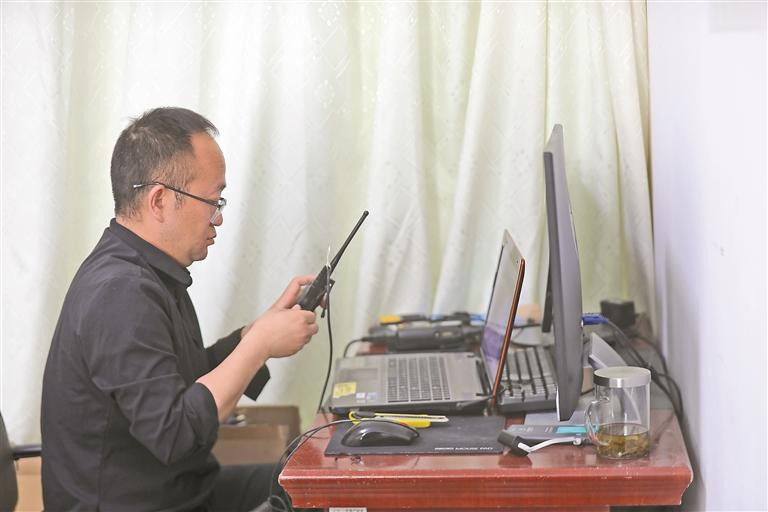
Railway freight handlers tackle virus threat at borders








Railway workers who handle freight bills for China-Europe freight train services at Manzhouli railway port in the Inner Mongolia autonomous region have acquired a new skill-tossing cargo documents to Russian drivers.
The practice is designed to reduce people-to-people contact at the border and to avoid the import and export of COVID-19 cases.
Manzhouli, on the border with Russia, is one of the gateways for freight trains entering and leaving China.
At the railway station, after a Russian driver tosses a freight bill to the ground from the train's cab car, a Chinese railway worker wearing protective gear including a gown, gloves and goggles picks up the document, seals it in a bag and sends it off for disinfection. After it is disinfected, the freight bill can be passed on to other Chinese personnel.
It is one of many disinfection procedures cross-border freight train services go through every day.
Although people-to-people exchanges have been limited since the COVID-19 pandemic started in late 2019, freight train services between China and Europe have soared.
China State Railway Group, the national railway service operator, said 12,605 services carrying nearly 1.22 million containers operated between China and Europe in the first 10 months of this year. The number of trains was up 26 percent year-on-year, while freight volume was 33 percent higher.
Last year, some 12,400 freight trains carrying 1.14 million containers operated between China and Europe. The number of trains was 50 percent higher than in 2019, and freight volume was up 56 percent.
The services have been hailed as a vital channel amid the COVID-19 pandemic, transporting much-needed commodities and daily supplies including protective masks and medical supplies between China and Europe.
Railway workers are keeping cross-border trains running while reducing the risks of a resurgence in novel coronavirus cases.
When a train crosses the border at Horgos or Alataw Pass in the Xinjiang Uygur autonomous region, a disinfection system automatically sprays sanitizer on it.
Railway workers in full protective gear carry out more thorough disinfection when the train stops at either port.
Urumqi Railway Group, the local railway operator, said it has cooperated with customs and border inspection departments to introduce a standard disinfection procedure for cross-border freight trains.
Measures are implemented as daily routines at the borders, including airing rooms, disinfecting facilities and stations, and conducting body temperature tests and nucleic acid tests on employees.
At the border railway station in Ereenhot, Inner Mongolia, thorough preventive measures focus on people, cargo, the environment and facilities.
Hohhot Railway Group said a train entering China from Mongolia is disinfected three times. When it crosses the border, an automatic system sprays sanitizer on the train. When it stops at the station for loading and unloading, a team of staff members wearing protective gear spray sanitizer on containers. After cleaning the cargo thoroughly, employees who conduct the disinfection and their equipment are disinfected in a separate room.
Freight bills from Mongolia are disinfected before being handed to other employees. The group has also increased the frequency of nucleic acid tests for workers in high risk jobs, such as drivers, who need to be tested every second day.
From January to October, the port handled 2,269 train services, a year-on-year increase of 16.5 percent.
China State Railway Group said the steady and safe operation of the services has won favor in the international logistics market during the pandemic, becoming an important strategic channel for global trade.





- Shanxi ends province-wide blanket fireworks ban
- Audit: China fixes bulk of fiscal problems tied to 2024 budget
- China reports major gains in circular economy
- Chinese lawmakers review draft revision to banking supervision and regulation law
- Top legislature to study draft laws on environment, ethnic unity, national development planning
- Administrative organs must secure people's interests: senior judge