



Industry needs to lower crude steel output







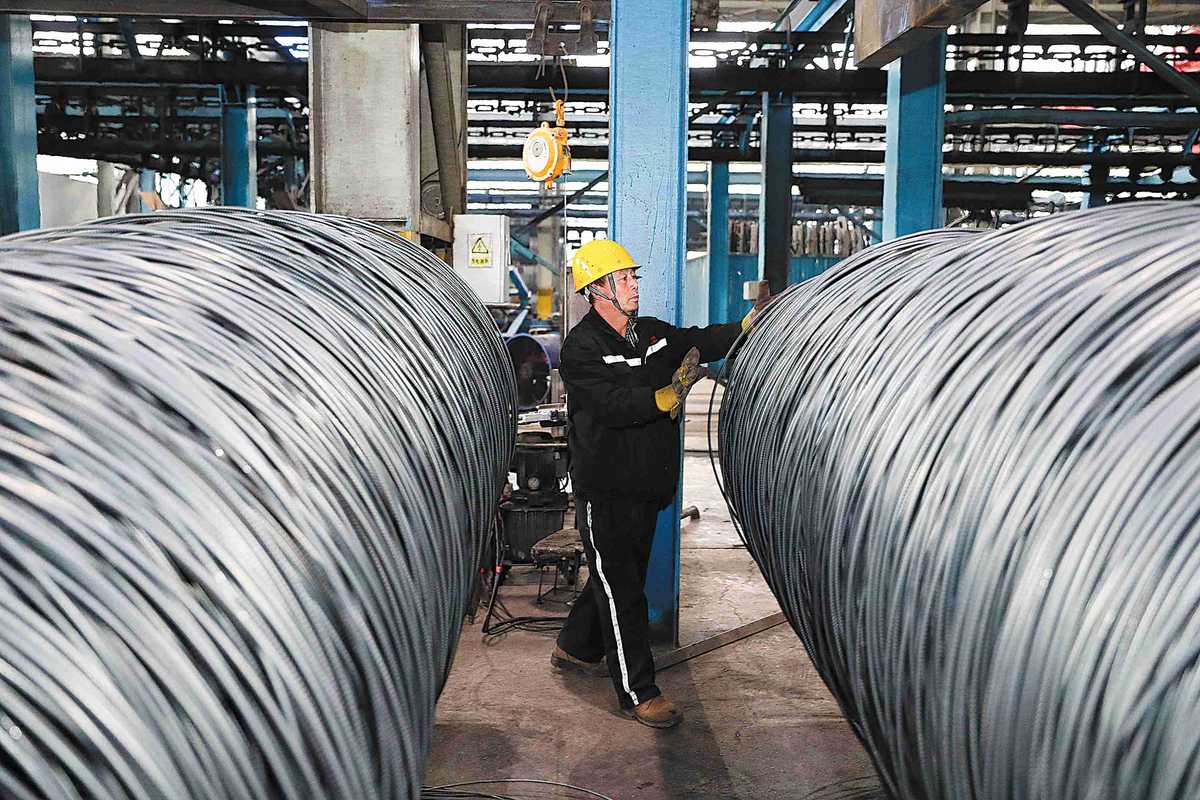
"Rapid growth momentum in crude steel production has been effectively curbed since the beginning of the second half," said Lyu Guixin, an inspector of the raw materials department at the Ministry of Industry and Information Technology.
"Yet, there is still a long way to go to achieve the goal of negative growth in crude steel output this year from last year," Lyu said.
Lyu spoke at a recent steel forum in Beijing held by the China Metallurgical Industry Planning and Research Institute.
"The steel industry, which is energy-intensive, accounts for a large share of carbon emissions from the industrial sector. The industry is currently faced with challenges as China aims to have carbon dioxide emissions peak by 2030 and achieve carbon neutrality by 2060," Lyu said.
The industry must increase awareness to align with the nation's goals to curb output, and adapt to meet requirements on production controls during the winter heating season to reduce output from last year, he added.
Wang, who is also deputy secretary-general of the CISA, stressed that reduced output of crude steel has not led to a surge in prices.
As China is working to curb crude steel output, market demand has also weakened, which has led to a balance between crude steel supply and demand and has stabilized prices of crude steel in the domestic market, he said.
In October, controls on electricity use affected not only production at steel mills, but also for their downstream clients.
While prices for steel imports usually have been higher than for steel exports, the situation was reversed in August and September. While steel prices surged in overseas markets, prices in the domestic market were relatively more stable, he said.
Given that construction usually slows starting in October, especially as building in the real estate industry customarily experiences a seasonal drop, steel demand from related sectors also declines, Wang said.
"There is no need to worry that domestic steel prices are going to spike because of a reduction in output and then affect upstream and downstream industrial chains," he said.
Chen Kexin, chief analyst at the Lange Steel Research Center in Beijing, suggested that China roll out stronger measures at the right time to restrain direct steel exports. Strong overseas demand and surging prices have made China's efforts to reduce steel output more difficult.
Chinese steel exports surged by 31.3 percent from a year ago during the first nine months to 53.02 million tons, according to Customs officials. Chen forecast that China will export about 70 million tons of steel this year, up by one-third year-on-year.
The estimated exports for the year are projected to equal more than 6 percent of China's total yearly steel demand. That yearly demand is estimated to be about 1.1 billion tons.
He suggested reducing exports through measures such as increasing tariffs on steel exports while encouraging exports of high value-added steel-based products such as home appliances, communications equipment, automobiles, machine tools, ships and construction machinery.
Li Xinchuang, chief engineer and Party secretary of the metallurgical institute, said China's steel industry should pay more attention to establishing systemic standards for green, low-carbon and high-quality development during the 14th Five-Year Plan period (2021-25).
More research should be conducted to design key standards for technologies for flexible and customized production to increase product and service quality, Li said.
Upgrading standards on carbon reduction and energy, raw material and water preservation should also be accelerated to better serve the nation's carbon goals and building of an ecological civilization, he said.




















