



RCEP will usher in an 'Asia era'







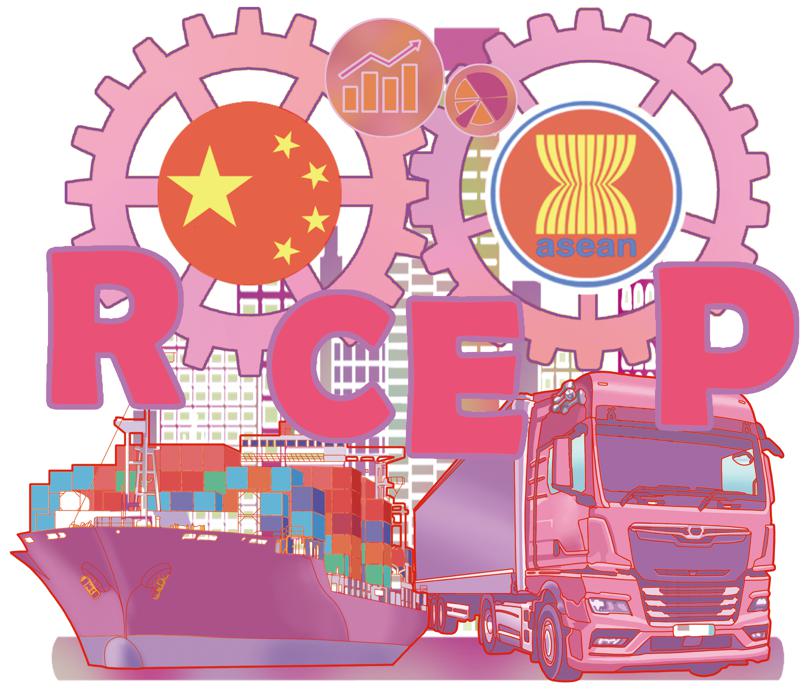
The Regional Comprehensive Economic Partnership agreement will come into effect on Jan 1, 2022, since six member states of the Association of Southeast Asian Nations including Singapore, Thailand and Vietnam and four non-ASEAN member countries, China, Japan, New Zealand and Australia, have ratified it.
Covering nearly a third of the world's population and accounting for about 30 percent of GDP, the new free trade bloc will be bigger than both the US-Mexico-Canada Agreement and the European Union, and is likely to become the most influential free trade zone in the world.
More importantly, this free trade zone will become the most diversified economic bloc with its member states being in different stages of development, following different political systems, and having diverse social structures.
The RCEP is expected to lead and promote free trade, and boost economic globalization at a time when globalization is facing headwinds and the world is battling the COVID-19 pandemic and economic slowdown.
The regional free trade agreement is also likely to shift global industrial technology and human capital to the East. According to the FTA, the larger the gap between the economies, the more complementary they will be. And since countries in different economic stages are part of the FTA, the huge Chinese market can help them boost their development.
The conventional FTAs in the region are on trade in goods, and do not include trade in services, or investments, and trade-related domestic regulation and coordination, while the RCEP includes and is expected to expand the new trends and needs for regional economic integration. In this sense, the RCEP goes beyond the regional economic integration concept proposed before.
The RCEP will influence regional economic development, and have an impact on the industrial and supply chains. Given its Cumulative Rules of Origin, the RCEP is expected to further expand the regional industrial and supply chains, and help the member states build mutually beneficial industrial and supply chain partnerships, as well stabilize the chains.
More than 90 percent of the trade in goods in the region will be tariff free once the RCEP comes into effect. Also, the RCEP and other existing free trade agreements are complementary and mutually reinforcing.
Moreover, the RCEP covers products that don't get tax reductions in other free trade zones. As for tax reduction on products included in the RCEP and other free trade zones, their manufacturers have to gradually adopt the regional trade partnership's Cumulative Rules of Origin to enjoy more preferential duty.
The Cumulative Rules of Origin is a big achievement of the RCEP. If the RCEP tariff concession commitments grant tax reductions at the national level, the Cumulative Rules of Origin is a guideline that enterprises can follow to enjoy preferential duty.
The RCEP member states are expected to set high-level customs rules, inspection and quarantine norms, as well technical standards. Through these rules, the RCEP can significantly lower the cost of trade in the region, enhance the competitiveness of products, create more business opportunities for enterprises, and provide more choices and benefits for consumers.
The RCEP will also enable China and Japan to build a direct free trade partnership, which can boost both the Chinese and Japanese economies. China-Japan trade cooperation will also get a further boost if China joins the Comprehensive Progressive Trans-Pacific Partnership.
China has promoted the RCEP, whose spirit, principles and specific policies are in agreement with China's, and aims to remove the trade barriers among member countries and promote one set of rules to achieve regional prosperity and maintain stability in the Asia-Pacific.
Once the RCEP comes into force, one-third of China's trade will be tariff free, which will offer Chinese enterprises more options to locate in the global supply chain, and China will work with trade partners to further promote trade liberalization and investment facilitation based on market rules.
More important, the RCEP is likely to further open up the service trade, compared with the World Trade Organization, and pave the way for reforms in the WTO, especially reforms in the global trade system.
Since China is a signatory to the RCEP agreement, it will become easier for small and medium-sized enterprises, especially private enterprises, in China to go global. The regional partnership agreement includes high-standard policies for e-commerce, competition and government procurement, and sets rules for strengthening SMEs and boosting economic and technical cooperation. The RCEP will also allow even relatively weak market players to enjoy their due benefits.
Also, by joining the RCEP, China can, with less difficulty, upgrade its manufacturing industry from the mid-low level to the highest level.
The RCEP could also signal the start of an "Asia era" or "Asia-Pacific era" not led by the United States. And if the RCEP and the proposed China-Japan-ROK Free Trade Area function properly, the Asia-Pacific will become the powerhouse of world economy.
However, Asia will remain the world's largest region with overlapping production chains, supply chains and consumption chains. The network of industrial chains in East Asia's manufacturing sector is the strongest in the world, and accounts for 50-60 percent of global output. The RCEP will make it even more prominent and attract enterprises from across the world to invest here.
China should take foolproof measures to prevent risks and resolve the disputes that may arise in the course of the RCEP's development.
The author is vice-chairman of the Beijing-based China Center for International Economic Exchanges, and former vice-minister of commerce.
The views don't necessarily reflect those of China Daily.
If you have a specific expertise, or would like to share your thought about our stories, then send us your writings at opinion@chinadaily.com.cn, and comment@chinadaily.com.cn.





