Very much a family affair
Pan-Asia oriented Raffles Family Office is focusing on the wealth creation needs of the Chinese mainland's second-generation billionaires, as it builds up a family office ecosystem. Oswald Chan reports from Hong Kong.








Raffles Family Office, which specializes in providing tailor-made investment services to high-net-worth individuals and families, has set its sights on the mushrooming second-generation Chinese mainland billionaires.
The Hong Kong-based multifamily assets and wealth manager, as well as legacy planner, currently has five offices in the Hong Kong Special Administrative Region, on the mainland and in Taiwan and Singapore.
Ray Tam Chun-wing, managing partner and co-founder of RFO, said the mainland's second-generation billionaires have a long investment horizon that calls for calculated solutions to their needs.
He sees the Guangdong-Hong Kong-Macao Greater Bay Area as a promising market for the company, with the region's cities, especially Shenzhen, breeding a new class of technology entrepreneurs that requires sophisticated investment solutions. These young technology businesspeople have a greater risk appetite and are more receptive to alternative ideas for parking or investing their money.
According to the 2019 Hurun Wealth Report, there were more than 452,000 high-net-worth families with over 6 million yuan ($770,943) in investable assets in the Greater Bay Area. Their estimated aggregate investable assets reached 2.7 trillion yuan, making the 11-city cluster the world's wealthiest region.
With a population of over 86 million, the Greater Bay Area boasts a combined GDP exceeding $1.67 trillion, with GDP per capita of more than $23,100.
The Greater Bay Area is an important factor for overseas companies in deciding whether to set up shop in Hong Kong. According to Invest-HK - the SAR government's foreign direct-investment promotion agency - 58.1 percent of the 260 foreign companies it has assisted said the Greater Bay Area was a factor when considering establishing a business in Hong Kong in the first nine months of this year - up from 46 percent of the 404 overseas companies it assisted in 2019.
The survey showed that mainland and overseas family offices, innovation and technology startups, as well as financial technology companies, are more interested in setting up offices in Hong Kong because of the Greater Bay Area's business prospects. They are mainly from the mainland, the United States and the United Kingdom.
Hong Kong attracts family offices, private equity-fund managers and other asset managers as the city is a good place for establishing investment funds to invest in Shenzhen-based startups powered by the technology environment in the southern Chinese metropolis.
"For the second generation, they are willing to take risks in private equity and ESG (environmental, social and governance) investments. They are also looking at specific sectors, such as healthcare, biotechnology and new energy," Tam said.
This is different from conservative family offices which are less focused on alternative investments in allocating assets. Their investments are instead based on their appetites, life-cycle needs, family governance codes and personal expectations of returns.
The younger generation is willing to take risks with their own knowledge and expectations. Private equity, alternative investments and initial venture capital are the key sectors.
"We try not just to get a good company to invest wisely, but investors would like to make some strategic investments that could benefit themselves and their companies," Tam said. "They are potential unicorns, good companies and future billionaires."
To meet investor's demand for bespoke services, RFO hires in-house experts to provide tailor-made investment solutions and is upgrading its internal information technology and reporting systems to offer better value for investors.
RFO is also creating a family office business ecosystem to meet market needs although this is not the main revenue stream.
RFO's head office in Hong Kong is its first family ecosystem hub through a co-working space arrangement to give companies better support and information. With headquarters in Hong Kong and Singapore, as well as an office in Beijing, RFO also aims to expand to Jakarta in Indonesia and Kuala Lumpur in Malaysia next year.
"We always welcome collaboration among families, asset managers and service providers to build up the ecosystem for stronger synergy and ideas," Tam said.
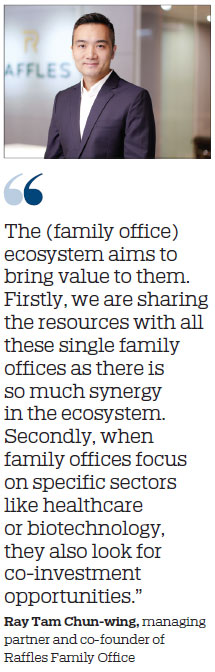
"The ecosystem aims to bring value to them. Firstly, we are sharing the resources with all these single family offices as there is so much synergy in the ecosystem. Secondly, when family offices focus on specific sectors like healthcare or biotechnology, they also look for co-investment opportunities. The ecosystem is more about information flow that benefits each other by complementing our strengths to create synergy," Tam said.
RFO sees potential in Hong Kong's wealth management sector if Hong Kong can ease the current travel restrictions. The family office is hiring and expects to double the size of its office in the SAR in the next two years. It will also devote more efforts to education by sharing its experiences in the family office business, such as how to deal with family offices offshore or achieve their family succession planning.
The assets under management of the asset and wealth management industry in Hong Kong grew by 21 percent year-on-year to nearly HK$35 trillion ($4.49 trillion) by the end of 2020, about one-third of which came from net fund inflows. About 64 percent of the funding sources were from abroad, showing the internationalization of the SAR's asset and wealth management sector.


- Chinese premier chairs symposium on draft govt work report, five-year plan
- AI model focused on optics developed
- China helps Indonesia restore its coral reefs
- Symposium on upholding executive-led governance in SARs held in Beijing
- Sharp rise in domestic tourism spurs spending
- Efficiency and reform drive SARs' progress